
Introduction
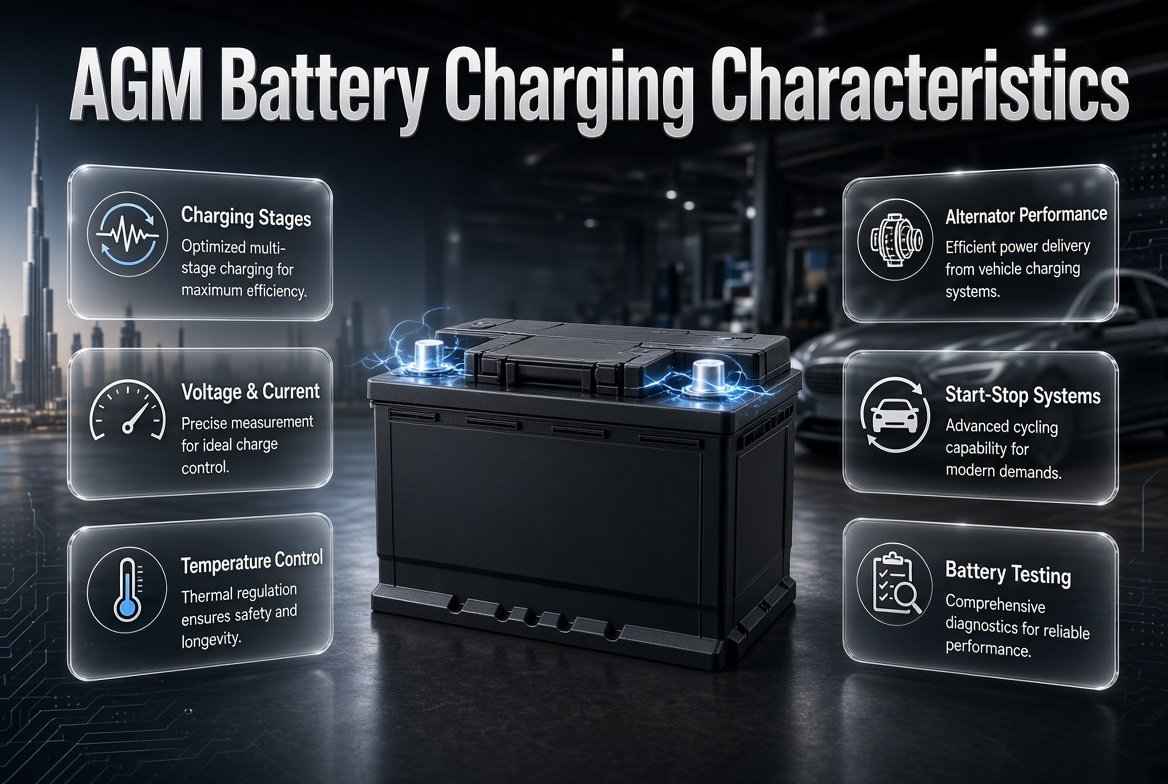
AGM Battery Charging Characteristics | Understanding AGM Battery Charging Characteristics is important for anyone using a modern vehicle equipped with an AGM battery. AGM, or Absorbent Glass Mat, batteries are designed differently from conventional flooded lead-acid batteries. Their internal construction allows them to provide strong starting performance, support demanding electrical systems, and tolerate repeated charge-and-discharge cycles, which makes them particularly useful in many modern vehicles.
However, AGM technology also requires the correct charging approach. Battery voltage, charging current, temperature, alternator performance, battery-management systems, and the vehicle’s electrical load can all influence how effectively an AGM battery charges and how long it remains reliable.
For drivers who want professional battery information, inspection, and replacement support, EuroSwift Auto Services provides a useful starting point for understanding automotive battery and maintenance requirements in Dubai.
A common mistake is to assume that every 12-volt lead-acid battery can be charged in exactly the same way. In reality, AGM batteries should be charged according to the specifications provided by the battery and vehicle manufacturer. Using an unsuitable charging profile, ignoring a faulty alternator, or repeatedly allowing the battery to remain undercharged can reduce performance and potentially shorten battery life.
This complete guide explains how AGM batteries accept charge, how charging stages work, the role of temperature, alternator charging, start-stop technology, deep discharge, battery testing, common charging mistakes, and the professional approach to maintaining an AGM-equipped vehicle.
What Is an AGM Battery?
An AGM battery is a type of valve-regulated lead-acid battery in which the electrolyte is absorbed into a fiberglass mat rather than freely flowing around the battery plates.
This construction gives AGM batteries several characteristics that make them suitable for modern vehicles.
Unlike a traditional flooded battery, an AGM battery is designed as a sealed, maintenance-free unit under normal operating conditions. It does not normally require the owner to add water, and its construction provides strong resistance to vibration.
AGM technology is particularly useful in vehicles with significant electrical demands. Features such as start-stop systems, advanced infotainment, electronic control modules, heated seats, driver-assistance equipment, and numerous onboard computers can place greater demands on the vehicle’s electrical system.
The battery therefore needs to do more than simply start the engine.
It may also need to support electrical equipment when the engine is temporarily switched off and recover energy efficiently when the vehicle begins charging again.
That is one reason why selecting the correct battery technology is important during Battery Replacement.
Why AGM Battery Charging Characteristics Matter
The charging process has a direct relationship with battery health.
When an AGM battery becomes discharged, the charger initially supplies a relatively high charging current. As the battery becomes more fully charged, its ability to accept current decreases.
A properly controlled charger responds to this change.
Instead of continuously forcing maximum current into the battery, the charging system normally progresses through different charging stages. These stages are intended to restore the battery efficiently while avoiding unnecessary charging stress.
The main factors include:
- Charging voltage
- Charging current
- Battery temperature
- State of charge
- Battery condition
- Charger characteristics
- Alternator output
- Vehicle energy-management strategy
- Electrical load
- Battery-management-system operation
A problem in any of these areas can influence battery performance.
For example, an AGM battery that is repeatedly undercharged may gradually lose usable capacity. On the other hand, excessive charging voltage can create unnecessary stress and heat.
This is why professional battery diagnosis should look beyond the battery itself.
How AGM Batteries Accept Electrical Charge
The behavior of an AGM battery changes throughout the charging process.
When the battery is heavily discharged, it can generally accept more current. As the state of charge increases, the charging current naturally begins to fall.
This can be understood through three broad stages:
- Bulk charging
- Absorption charging
- Float or maintenance charging
Not every vehicle or charger uses exactly the same terminology or strategy, and the manufacturer’s specifications should always take priority.
Nevertheless, these stages provide a useful way to understand AGM charging behavior.
Stage One: Bulk Charging
The bulk stage is the part of the charging process where a significant amount of energy is restored relatively quickly.
When an AGM battery has lost a considerable amount of charge, the charger can initially supply a higher current while controlling the voltage within its programmed limits.
During this stage:
- Battery voltage rises.
- Charging current can remain relatively high.
- A substantial portion of the discharged capacity is restored.
- The charger monitors the battery’s response.
- The charging process eventually moves toward the absorption stage.
Bulk charging is particularly relevant when a vehicle has been left unused for a long time or when electrical loads have discharged the battery.
However, a deeply discharged AGM battery should not automatically be assumed to be healthy simply because it accepts charge.
A battery can accept charging current while still having reduced capacity or internal deterioration.
That is why battery testing is important after significant discharge.
Stage Two: Absorption Charging
The absorption stage becomes increasingly important as the battery approaches a high state of charge.
At this point, the charger maintains a controlled voltage while the charging current gradually decreases.
This is different from the initial bulk stage.
The battery may appear to be nearly charged, but additional controlled charging time can be necessary to restore the remaining capacity.
If charging is stopped too early every time, the battery may repeatedly operate below its ideal state of charge.
Over time, chronic undercharging can contribute to reduced battery performance.
This is especially relevant for vehicles that are driven primarily on short journeys.
A short trip may provide insufficient time for the vehicle’s charging system to replace the energy consumed during engine starting and electrical operation.
Stage Three: Float or Maintenance Charging
After the main charging process is completed, some chargers use a float or maintenance stage.
The purpose is different from bulk charging.
Instead of trying to rapidly restore a discharged battery, maintenance charging is intended to keep an already charged battery at an appropriate level without continuously applying an aggressive charging profile.
This can be useful for vehicles that are stored for extended periods.
For example, a vehicle that remains parked for weeks may gradually lose battery charge because modern vehicles continue to consume a small amount of electrical energy even when the engine is switched off.
An appropriate maintenance strategy can help prevent excessive discharge, provided the charger and battery are compatible and the manufacturer’s instructions are followed.
AGM Battery Charging Voltage
Charging voltage is one of the most important parts of AGM battery operation.
However, there is no single universal charging voltage that should be applied blindly to every AGM battery.
Different battery manufacturers and vehicle manufacturers can specify different charging requirements.
The correct approach is therefore to consult the battery label, technical documentation, charger instructions, and vehicle specifications.
Why voltage matters
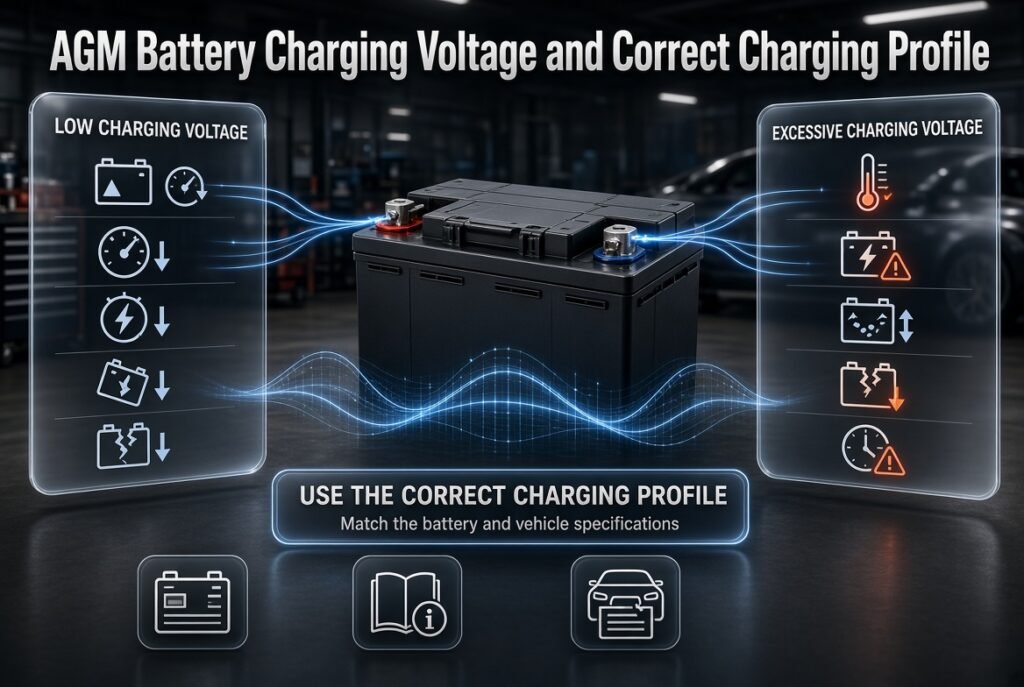
If charging voltage is too low, the battery may remain chronically undercharged.
Possible consequences include:
- Reduced available capacity
- Poor starting performance
- Increasingly frequent discharge
- Reduced reserve capacity
- Premature battery deterioration
If charging voltage is excessive, the battery can experience unnecessary charging stress.
Possible concerns include:
- Excessive heat
- Increased internal pressure
- Accelerated deterioration
- Reduced service life
- Charging-system faults
The important lesson is simple:
Correct charging is not about applying the highest possible voltage. It is about applying the appropriate charging profile for the specific battery.
AGM Battery Charging and Temperature
Temperature is another important part of AGM charging characteristics.
Lead-acid batteries behave differently at different temperatures. A charging system that is appropriate under one thermal condition may require different control under another.
This becomes especially relevant in hot environments.
Dubai vehicles can experience substantial thermal exposure because of high ambient temperatures, direct sunlight, engine-bay heat, traffic conditions, and heavy air-conditioning use.
The battery therefore operates in an environment where temperature management matters.
Modern vehicles may use battery temperature information as part of their energy-management strategy.
Professional temperature considerations
When charging or diagnosing an AGM battery:
- Check battery temperature when appropriate.
- Avoid inappropriate charging of an excessively hot battery.
- Follow the manufacturer’s temperature limits.
- Inspect the battery’s installation environment.
- Check charging-system performance.
- Investigate repeated overheating.
- Consider whether the battery specification is suitable for the vehicle.
A battery that repeatedly operates under excessive heat can experience accelerated aging.
AGM Battery vs Conventional Flooded Battery Charging
Although both AGM and flooded lead-acid batteries are based on lead-acid chemistry, their construction differs significantly.
| Characteristic | AGM Battery | Conventional Flooded Battery |
|---|---|---|
| Electrolyte location | Absorbed in glass mat | Freely circulating |
| Battery design | Valve-regulated | Vented |
| Maintenance | Normally maintenance-free | Some types require maintenance |
| Vibration resistance | Generally high | Generally lower |
| Charging sensitivity | Requires appropriate control | Different charging characteristics |
| Electrical demand suitability | Often suitable for demanding applications | Depends on specification |
| Start-stop applications | Commonly used | Application dependent |
The biggest mistake is treating these batteries as completely interchangeable.
If a vehicle was designed around AGM technology, installing an unsuitable replacement battery can affect how the vehicle’s charging and energy-management system behaves.
AGM Batteries and Modern Start-Stop Systems
Start-stop technology has changed the demands placed on vehicle batteries.
In a conventional vehicle, the engine may start once at the beginning of a journey and continue running until the driver reaches the destination.
A start-stop vehicle can shut the engine down when the vehicle is stationary and restart it when driving resumes.
This can happen repeatedly during a journey.
At the same time, electrical equipment may continue operating while the engine is temporarily stopped.
That places additional demands on the battery.
AGM batteries are frequently used in applications requiring stronger cycling performance and significant electrical support.
However, the exact battery requirement depends on the vehicle.
If the original vehicle specification calls for AGM technology, replacing it with an unsuitable conventional battery can create compatibility problems.
Professional Battery Replacement should therefore confirm the original battery technology, capacity, physical dimensions, terminal arrangement, and vehicle requirements.
AGM Battery Charging Through the Alternator
For most vehicles, the alternator plays a major role in maintaining the battery while the engine is running.
However, modern alternator systems are more sophisticated than older constant-output charging systems.
A modern vehicle may use:
- Battery sensors
- Intelligent alternator control
- Engine-management systems
- Energy-management software
- Variable charging strategies
- Regenerative charging
- Battery state-of-charge calculations
As a result, the charging voltage you observe at one moment may not remain identical under every operating condition.
The vehicle may deliberately change alternator output according to electrical demand, battery condition, engine operation, and energy-management requirements.
This is why a simple voltage reading should not always be treated as the only diagnostic test.
A complete electrical diagnosis may require observing charging behavior under different conditions.
How to Check AGM Charging Performance
Professional diagnosis normally starts with basic battery and electrical-system checks.
A technician may assess:
1. Battery Condition
The battery should be inspected for:
- Physical damage
- Terminal condition
- Corrosion
- Swelling or abnormal deformation
- Age
- State of charge
2. Resting Voltage
Resting voltage can provide useful information about the approximate state of charge.
However, voltage alone cannot determine complete battery health.
3. Starting Performance
A battery can show acceptable resting voltage but still struggle under starting load.
4. Charging System
The alternator and charging system should be checked for correct operation.
5. Electrical Drain
If the battery repeatedly becomes discharged while the vehicle is parked, parasitic drain should be considered.
6. Battery Management
Modern vehicles may require battery-management-system checks after battery replacement.
This complete approach is more reliable than replacing the battery immediately whenever a vehicle experiences a starting problem.
AGM Battery State of Charge vs State of Health
These two terms are often confused.
State of charge (SOC) describes how much charge is currently available in the battery.
State of health (SOH) describes the battery’s overall condition and remaining ability to perform compared with its original condition.
An AGM battery can have a high state of charge but poor state of health.
For example, a deteriorated battery may charge to a normal voltage but have insufficient capacity to reliably start the engine under demanding conditions.
This is why charging a weak battery does not necessarily restore it to new condition.
A professional battery test can help distinguish between:
- Low charge
- Reduced capacity
- Internal deterioration
- Charging-system problems
- Electrical drain
That distinction prevents unnecessary parts replacement.
What Happens When an AGM Battery Is Undercharged?
Undercharging is one of the common causes of reduced battery performance.
If the battery repeatedly fails to reach a sufficiently high state of charge, it can gradually lose effective capacity.
Possible symptoms include:
- Slower engine cranking
- Start-stop system becoming unavailable
- Frequent low-battery warnings
- Electrical system complaints
- Repeated jump-start requirements
- Reduced reserve capacity
Short-distance driving is one situation that can contribute to undercharging.
Starting the engine requires significant electrical energy. If the vehicle is then driven for only a short period, the charging system may not have sufficient opportunity to restore the energy used during starting.
This does not mean every short journey causes battery failure.
The overall driving pattern, battery condition, electrical loads, alternator strategy, and vehicle design all matter.
What Happens When an AGM Battery Is Overcharged?
Overcharging is another concern.
AGM batteries are sealed valve-regulated batteries, meaning charging conditions need to remain within appropriate limits.
Excessive charging can increase thermal and internal stress.
Potential consequences include:
- Increased temperature
- Accelerated aging
- Reduced battery life
- Internal pressure increase
- Battery damage
If a vehicle repeatedly shows abnormal charging behavior, the issue should be investigated rather than ignored.
A new AGM battery will not solve an underlying charging-system problem.
Can a Deeply Discharged AGM Battery Be Recharged?
A deeply discharged AGM battery may sometimes be recoverable, but the result depends on its condition, age, discharge duration, and internal health.
A battery that has been deeply discharged for a short period may respond differently from one that has remained heavily discharged for an extended time.
Before attempting recovery, the battery should be assessed according to manufacturer guidance.
A professional process can include:
- Visual inspection
- Battery identification
- Voltage measurement
- Charger compatibility check
- Controlled charging
- Post-charge stabilization
- Battery health testing
- Vehicle charging-system inspection
If the battery does not recover adequate capacity, replacement may be necessary.
The important point is that charging a deeply discharged battery is not automatically equivalent to restoring it to its original condition.
AGM Charging During Long-Term Vehicle Storage
Vehicles that remain parked for long periods can gradually lose battery charge.
Modern vehicles have numerous electronic systems that can consume small amounts of power while the vehicle is switched off.
Over an extended period, this can become significant.
For long-term storage, vehicle owners should follow the vehicle manufacturer’s recommendations.
Depending on the vehicle and storage situation, an appropriate battery-maintenance charger may be useful.
Before connecting any charger, confirm:
- AGM compatibility
- Correct voltage
- Correct charging mode
- Manufacturer approval
- Charger safety features
- Proper connection procedure
If the vehicle is regularly left unused, checking the battery before and after storage can help identify a developing electrical problem before it becomes a starting failure.
AGM Charging and Parasitic Drain
A parasitic drain occurs when electrical equipment continues consuming more power than expected after the vehicle has been switched off.
Some standby consumption is normal in modern vehicles.
The problem occurs when an electrical fault causes excessive current draw.
Potential sources can include:
- Aftermarket electronics
- Faulty modules
- Lighting systems
- Security equipment
- Accessories
- Improperly installed devices
- Modules failing to enter sleep mode
If an AGM battery repeatedly becomes discharged despite apparently normal charging performance, parasitic drain should be investigated.
Replacing the battery without identifying excessive electrical consumption may only provide a temporary solution.
AGM Battery Charging and Air Conditioning in Dubai
Dubai’s climate creates unique operating conditions for vehicle electrical systems.
Air conditioning is an essential part of everyday driving for much of the year. Heavy electrical and thermal loads can place additional demands on the vehicle’s charging system.
The air-conditioning compressor itself is mechanically driven in conventional systems, but climate-control operation also involves electrical components, fans, control modules, and other equipment.
When combined with traffic, frequent stops, extended idling, and high temperatures, these conditions can make battery and charging-system health particularly important.
This does not mean that air conditioning alone will automatically damage an AGM battery.
Instead, it highlights why the battery, alternator, electrical system, and cooling environment should all be considered during diagnosis.
Common AGM Charging Problems
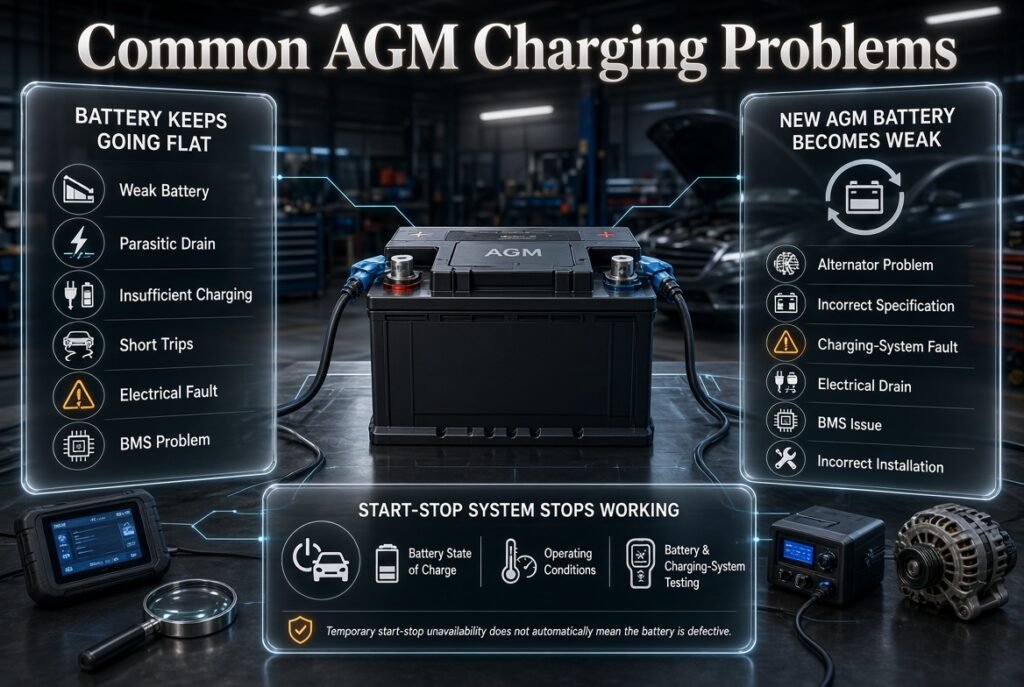
Problem 1: Battery Keeps Going Flat
Possible causes include:
- Weak battery
- Parasitic drain
- Insufficient charging
- Short-trip driving
- Electrical fault
- Battery-management problem
A complete diagnosis is required to identify the actual cause.
Problem 2: New AGM Battery Becomes Weak Quickly
A new battery that repeatedly loses charge deserves investigation.
Possible causes include:
- Alternator problem
- Incorrect battery specification
- Charging-system fault
- Excessive electrical drain
- Battery-management-system issue
- Incorrect installation
Installing another battery without finding the underlying cause can repeat the same problem.
Problem 3: Start-Stop System Stops Working
A start-stop system may temporarily disable itself for several legitimate reasons, including battery state of charge and operating conditions.
If the system remains unavailable for an unusual period, battery and charging-system testing may be appropriate.
Do not assume that the battery is automatically defective based on one warning or one inactive feature.
AGM Battery Charging Mistakes to Avoid
Using the Wrong Charger
A charger should be compatible with AGM batteries.
Do not select a charger solely because it is marketed as a generic 12-volt battery charger.
Check its specifications and charging profile.
Applying Universal Voltage Rules
Different batteries have different requirements.
The manufacturer’s specification should take priority over generic internet advice.
Ignoring Temperature
Battery temperature can influence charging behavior and should be considered during diagnosis and charging.
Replacing Without Diagnosis
If the battery fails repeatedly, inspect the charging system and electrical system before installing another battery.
Mixing Battery Technologies
If the vehicle requires AGM technology, replacing it with an unsuitable battery can affect system performance.
Ignoring Battery Registration
Some modern vehicles require the new battery to be registered or adapted to the battery-management system.
Whether this is necessary depends on the vehicle.
AGM Battery Replacement: What Should Be Checked?
When an AGM battery reaches the end of its useful service life, replacement should not be based solely on physical size.
A professional replacement check can include:
| Check | Why It Matters |
|---|---|
| Battery technology | Confirms AGM or other required design |
| Capacity | Ensures appropriate energy storage |
| Cold-cranking performance | Supports reliable engine starting |
| Dimensions | Ensures physical fit |
| Terminal arrangement | Prevents connection problems |
| Polarity | Ensures correct electrical installation |
| Battery-management compatibility | Supports correct vehicle operation |
| Charging-system condition | Helps protect the replacement battery |
For drivers looking specifically for AGM battery support in Dubai, EuroSwift’s AGM Battery replacement service can be considered as part of a broader battery-maintenance strategy.
AGM Battery Charging and Battery Brands
AGM charging requirements should always be checked against the specific battery installed in the vehicle.
Brand selection alone does not determine charging behavior.
The correct battery must match the vehicle’s electrical and physical requirements.
Depending on the vehicle and required specification, professional battery replacement may involve different manufacturers.
For drivers researching alternatives, relevant EuroSwift battery resources include:
- Bosch Battery Replacement in Dubai
- Amaron Battery Replacement in Dubai
- Tuflong Battery Replacement in Dubai
- Exide Battery Replacement in Dubai
- Panasonic Battery Replacement in Dubai
- FIAMM Battery Replacement in Dubai
- AC Delco Battery Replacement in Dubai
These pages can support different battery-related search intents without forcing unrelated keywords into the AGM charging discussion.
AGM Battery Charging and Cost Considerations
Battery charging and replacement costs can vary significantly depending on the vehicle.
Factors that may influence the total cost include:
- Battery technology
- Battery capacity
- Vehicle make and model
- Battery location
- Installation complexity
- Battery-management requirements
- Registration or adaptation requirements
- Diagnostic testing
- Emergency service requirements
- Brand and specification
A premium AGM battery can cost more than a basic conventional battery because of its construction and intended application.
However, the cheapest battery is not necessarily the correct battery.
The appropriate approach is to match the battery to the vehicle’s original specification and operating requirements.
For broader research into battery pricing, see the Car Battery Prices in Dubai 2026 guide.
Professional AGM Battery Inspection Process
A thorough inspection should follow a logical sequence rather than immediately recommending replacement.
Step 1: Identify the Battery
The technician confirms:
- Battery type
- Capacity
- Manufacturer
- Age
- Physical condition
Step 2: Inspect Connections
Loose or damaged connections can create starting and charging problems.
Step 3: Measure Battery Condition
Voltage and appropriate battery testing can provide information about the battery’s current condition.
Step 4: Test Charging
The vehicle’s charging system should be assessed under suitable operating conditions.
Step 5: Investigate Drain
If repeated discharge occurs, electrical consumption while parked may need to be evaluated.
Step 6: Check Vehicle Requirements
For modern vehicles, battery-management-system compatibility can be important.
Step 7: Decide Between Charging and Replacement
Only after testing should the technician determine whether the battery needs charging, further diagnosis, or replacement.
This approach reduces unnecessary battery replacement.
AGM Battery Maintenance Checklist
Drivers can reduce avoidable battery problems by following practical maintenance habits.
Regularly check:
✔ Battery terminals
✔ Electrical connections
✔ Charging-system performance
✔ Battery age
✔ Starting behavior
✔ Warning lights
✔ Repeated low-battery symptoms
✔ Unusual electrical behavior
Before long trips:
✔ Check battery condition
✔ Check charging performance
✔ Confirm starting performance
✔ Inspect terminals
✔ Address existing electrical warnings
A battery that is already weak may fail at the least convenient time, particularly when the vehicle is far from home.
For broader preventive care, battery checks can be incorporated into regular Car Service and Vehicle Inspection routines.
AGM Battery Charging Before Long-Distance Travel
Long-distance travel places importance on battery reliability because a weak battery may become difficult to deal with far from familiar service facilities.
Before a long trip, particularly in demanding weather conditions, it is sensible to check:
- Battery age
- Battery health
- Starting performance
- Alternator operation
- Electrical warnings
- Battery terminals
If a battery is already showing signs of weakness, replacing it before a major journey may be more practical than waiting for a complete failure.
The correct battery should be selected according to the vehicle manufacturer’s requirements.
AGM Charging and Roadside Battery Failure
Battery failure can happen without much warning, particularly when the battery has already experienced reduced capacity.
Common situations include:
- Vehicle does not start after parking
- Slow engine cranking
- Electronic systems fail to initialize correctly
- Battery warning appears
- Vehicle requires repeated jump-starts
A jump-start can temporarily get the vehicle running, but it does not necessarily solve the underlying battery or charging problem.
After a jump-start, the battery and charging system should ideally be tested.
For emergency situations, EuroSwift’s broader Roadside Assistance and battery services can form part of a complete vehicle-support strategy.
AGM Battery Charging and Other Vehicle Systems
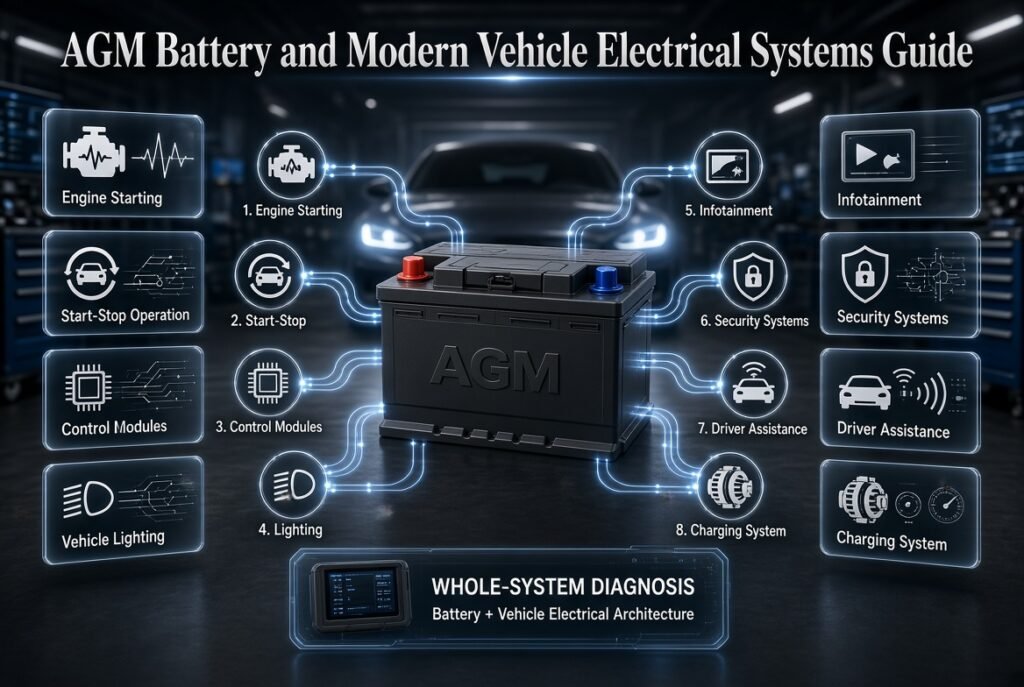
The battery does not operate in isolation.
Modern vehicles contain interconnected systems.
A battery problem can influence:
- Engine starting
- Start-stop operation
- Electronic control modules
- Lighting
- Infotainment
- Security systems
- Driver-assistance features
- Charging-system operation
Similarly, a fault in another electrical system can affect the battery.
This is why a professional approach treats the battery as one component of the vehicle’s overall electrical architecture.
If a vehicle also has mechanical symptoms, related services such as Engine Diagnostics, Brake Repair, Oil Change, AC Repair, Suspension Repair, or Wheel Alignment may be relevant depending on the actual problem.
These services should not be added simply because a battery article exists; they become relevant when the vehicle’s wider maintenance requirements justify them.
How to Improve AGM Battery Charging Reliability
Several practical principles can improve battery reliability.
Use the Correct Battery
The replacement battery should match the vehicle’s specifications.
Use Compatible Charging Equipment
External chargers should support the appropriate AGM charging profile.
Maintain the Charging System
A healthy alternator and electrical system are essential.
Avoid Repeated Deep Discharge
Repeated deep discharge can reduce battery longevity.
Investigate Electrical Drain
A vehicle that repeatedly loses charge while parked should be tested for abnormal current consumption.
Monitor Vehicle Warning Signs
Repeated starting problems should not be ignored.
Consider Climate
High temperatures can accelerate battery aging, making regular inspection particularly useful in hot regions.
AGM Battery Charging: Expert Recommendations
From a professional automotive perspective, AGM charging should be treated as a complete system rather than a single voltage measurement.
A healthy AGM battery depends on several components working correctly:
Battery + Charger/Alternator + Temperature + Electrical System + Battery Management
If one component is malfunctioning, battery performance can suffer.
The most important recommendations are:
- Follow the battery manufacturer’s charging requirements.
- Confirm AGM compatibility before using an external charger.
- Test the charging system when battery discharge repeatedly occurs.
- Do not assume that a fully charged battery is necessarily healthy.
- Investigate parasitic drain when repeated discharge occurs.
- Match replacement batteries to the original vehicle specification.
- Consider battery-management-system requirements.
- Pay attention to battery temperature.
- Avoid unnecessary deep discharge.
- Test the vehicle before and after battery replacement when appropriate.
Future of AGM Battery Charging Technology
Automotive charging systems are becoming increasingly intelligent.
Modern vehicles can use sophisticated battery sensors and energy-management software to determine how much charging is required and when it should occur.
Hybridization and increasing electrical loads are also changing the role of the 12-volt battery.
Future systems are likely to continue improving:
- Battery monitoring
- Energy recovery
- Charging efficiency
- Temperature management
- State-of-charge estimation
- State-of-health estimation
- Predictive battery diagnostics
For automotive workshops, this means battery service is becoming increasingly connected to vehicle electronics and software.
The traditional approach of simply measuring voltage and replacing a battery is becoming less sufficient for modern vehicles.
AGM Battery Charging Characteristics: Quick Reference Table
| Topic | Key Point |
|---|---|
| Battery type | Valve-regulated lead-acid |
| Electrolyte | Absorbed in glass mat |
| Charging | Requires controlled charging |
| Main charging stages | Bulk, absorption, maintenance/float |
| Voltage | Follow manufacturer specification |
| Temperature | Important for charging control |
| Deep discharge | May reduce battery health |
| Alternator | Must operate correctly |
| Start-stop | AGM is commonly used in demanding applications |
| Battery replacement | Must match vehicle specification |
| Maintenance | Battery itself is normally maintenance-free |
| Diagnosis | Battery and charging system should be evaluated together |
What Are the Correct AGM Battery Charging Characteristics for a 12V Battery?
AGM batteries are best charged with a controlled charging profile rather than treating them like a basic constant-voltage battery. In a typical charging cycle, the charger first restores the battery during the bulk stage, then maintains a controlled voltage during absorption, and finally moves to a lower float or maintenance stage once the main charging process is complete. The exact voltage settings should come from the specific AGM battery manufacturer because AGM specifications can vary between products.
The important point is that reaching a particular voltage does not necessarily mean the battery is completely healthy or fully restored. The absorption stage allows the charging current to taper as the battery approaches a higher state of charge.
Important points:
Use an AGM-compatible charging profile.
Follow the battery manufacturer’s specified voltage limits.
Allow the absorption stage to complete appropriately.
Use a suitable float/maintenance setting when required.
Do not assume one universal voltage applies to every AGM battery.
Consider battery temperature when evaluating charging voltage.
A professionally selected charging profile helps balance charging speed with battery longevity. An incorrect absorption or float setting can contribute to overcharging or chronic undercharging, both of which can reduce battery performance.
Can You Charge an AGM Battery With a Normal Battery Charger?
An AGM battery can be charged with a charger only when that charger provides a charging profile suitable for AGM batteries. Many modern smart chargers include an AGM mode, which is preferable because the charger can control the charging process according to the battery’s requirements.
The mistake is assuming that because both batteries are 12-volt lead-acid batteries, any 12-volt charger will automatically be appropriate. Charging equipment differs in how it controls voltage, current, absorption time, and maintenance charging.
Before using a charger, check:
Whether it specifically supports AGM batteries.
Its maximum charging voltage.
Its charging-current capability.
Whether it provides absorption and float stages.
Whether temperature compensation is available.
Whether the manufacturer’s battery instructions permit its use.
A suitable charger can make the charging process much more controlled. For example, modern adaptive charging systems can vary absorption time according to how deeply the battery was discharged, helping avoid an unnecessarily long high-voltage charging period after a relatively small discharge.
For a vehicle with an AGM battery, the charger is only one part of the picture. If the battery repeatedly becomes discharged, the vehicle’s alternator, electrical connections, battery-management system, and possible parasitic drain should also be checked.
Why Does Temperature Matter When Charging an AGM Battery?
Temperature is one of the most overlooked parts of AGM Battery Charging Characteristics. Charging voltage and battery temperature are closely related. As battery temperature rises, the appropriate charging voltage generally needs to decrease; as temperature falls, the required charging voltage increases. Temperature compensation is therefore important, particularly during prolonged charging.
This is especially relevant in hot environments such as Dubai. A battery operating at a high temperature can experience additional charging stress if the charging system continues using a voltage appropriate for a cooler battery.
For example, battery manufacturers may specify temperature-compensation values around a particular reference temperature. However, these figures are not universal settings and should not replace the specifications for the particular AGM battery being serviced.
Temperature-related points to remember:
Charging voltage should be appropriate for battery temperature.
Higher temperatures generally require lower charging voltage.
Excessive charging can increase battery temperature further.
High charging current can also contribute to temperature rise.
Temperature sensors can improve charging accuracy.
Hot batteries require particular attention during prolonged charging.
Professional charging equipment may automatically compensate for temperature, while some systems require the correct settings to be configured manually. Manufacturer documentation should always take priority.
Why Does My AGM Battery Keep Going Flat Even After Charging?
When an AGM battery repeatedly goes flat, the battery itself is not necessarily the only problem. This is one of the most important diagnostic points for vehicle owners.
A battery may repeatedly lose charge because of an aging or damaged battery, insufficient charging from the alternator, excessive electrical consumption while parked, frequent short journeys, poor connections, or another vehicle electrical fault.
Simply charging the battery again may provide a temporary improvement without fixing the reason it became discharged.
Common areas a technician should check:
AGM battery state of health.
Battery state of charge.
Alternator and charging-system performance.
Battery terminals and electrical connections.
Parasitic electrical drain.
Vehicle electrical accessories.
Battery-management-system operation.
Driving pattern and frequency of use.
Another important distinction is state of charge versus state of health. A battery can reach a normal charging voltage but still have significantly reduced capacity. In that situation, charging does not turn an aging battery back into a new one.
If a battery repeatedly becomes weak, professional Battery Replacement should ideally include testing of the charging system rather than simply fitting another battery. A charging fault or excessive electrical drain can otherwise cause the replacement battery to develop the same symptoms.
Can Overcharging Damage an AGM Battery?
Yes, excessive charging can shorten AGM battery life, which is why correct voltage control and temperature management are important. AGM batteries are valve-regulated, and excessive charging can increase internal gas generation and pressure. Manufacturer guidance specifically warns that incorrect absorption or float settings can contribute to overcharging and reduced service life.
This does not mean that a normal charging cycle is harmful. The issue is charging outside the battery’s intended parameters, particularly when high voltage is maintained for too long or temperature is not properly considered.
Warning signs worth investigating include:
Battery becoming unusually hot during charging.
Charging voltage remaining abnormally high.
Battery repeatedly requiring charging.
Unusual battery swelling or physical changes.
Charging-system warning indicators.
New AGM batteries deteriorating unusually quickly.
If abnormal heat or charging behavior is observed, the charging process should be stopped and the battery and charging equipment assessed safely rather than continuing to force a charge.
Modern charging systems can reduce this risk by using controlled absorption periods, temperature compensation, and appropriate float settings. Some adaptive systems also shorten absorption after a shallow discharge and extend it when the battery has been more deeply discharged.
Professional takeaway: AGM battery charging is not simply about “putting power back into the battery.” It is about controlling voltage, current, temperature, charging time, and battery condition together.
Conclusion
Understanding AGM Battery Charging Characteristics is essential for maintaining reliable performance in modern vehicles. AGM batteries are built to handle demanding electrical requirements, frequent cycling, and start-stop operation, but their performance depends heavily on using the correct charging strategy and maintaining a healthy vehicle electrical system.
Proper charging involves more than simply connecting a charger to the battery. Bulk charging, absorption charging, controlled maintenance charging, temperature, charging voltage, battery condition, and alternator performance all have a role in keeping the battery within its intended operating range. Using unsuitable charging equipment or ignoring abnormal charging behavior can gradually reduce battery performance and service life.
For vehicles operating in Dubai, high temperatures and demanding driving conditions make regular battery and charging-system inspection particularly valuable. If an AGM battery repeatedly becomes discharged, the cause should be investigated rather than assuming that another battery is the solution. Battery health, alternator output, electrical connections, parasitic drain, and vehicle battery-management systems may all need to be considered.
When replacement becomes necessary, selecting the correct AGM battery for the vehicle is equally important. A battery should match the manufacturer’s required technology, capacity, physical specifications, and electrical requirements.
The best approach is therefore straightforward: charge the battery correctly, monitor its condition, maintain the charging system, and investigate repeated battery problems early. These practices can help improve starting reliability, reduce avoidable battery replacements, and keep modern vehicle electrical systems operating efficiently.

Leave a Reply