
Introduction
Repeated Car Battery Discharge Causes | A car battery that repeatedly loses its charge can become one of the most frustrating vehicle problems. You may jumpstart the car, drive normally for a while, and assume everything is fixed—only to discover that the battery is weak again the next morning. When this happens repeatedly, replacing the battery without investigating the underlying problem may only provide a temporary solution.
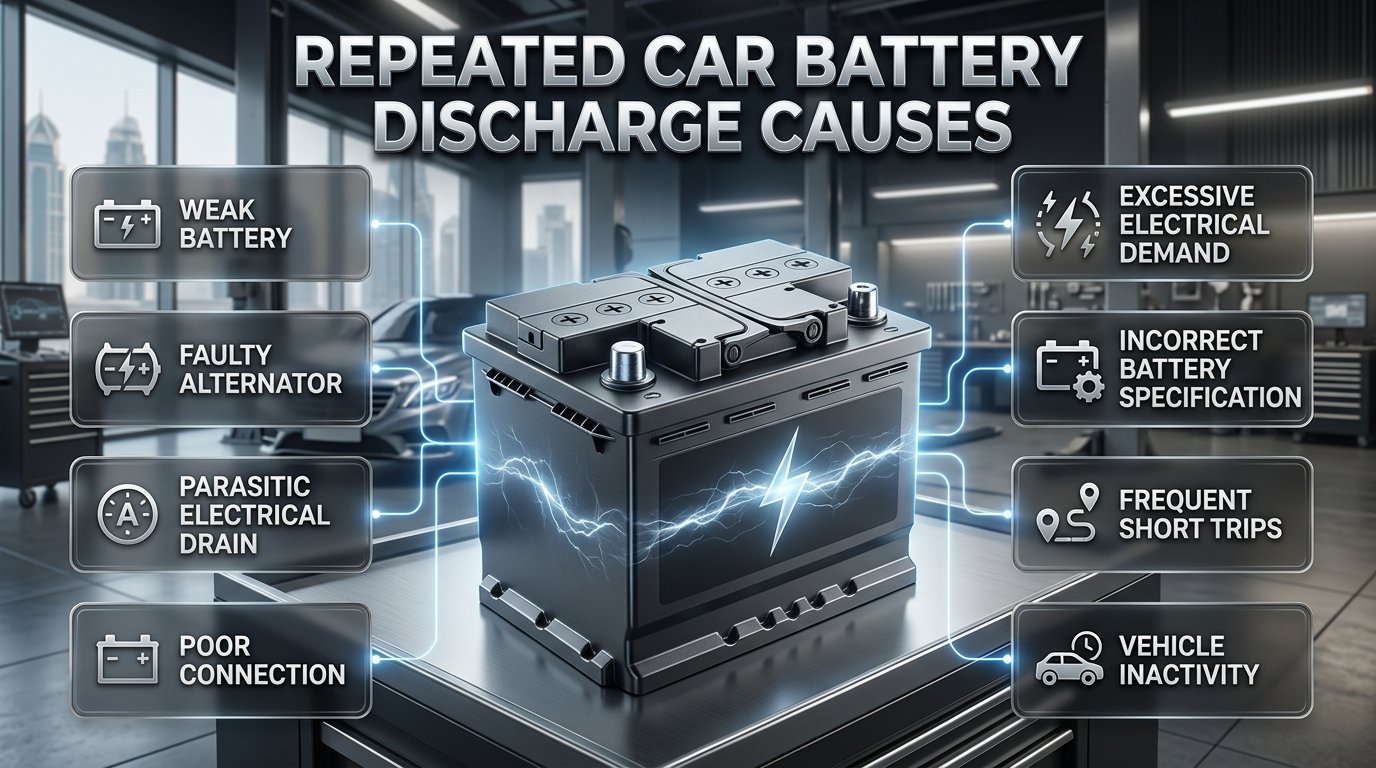
Understanding the Repeated Car Battery Discharge Causes is important because a battery does not operate independently. It works as part of the vehicle’s starting, charging, and electrical systems. A weak battery, faulty alternator, parasitic electrical drain, poor connection, excessive electrical demand, incorrect battery specification, or driving pattern can all contribute to repeated discharge.
For drivers looking for dependable vehicle maintenance and professional automotive assistance in Dubai, EuroSwift Auto Services provides a broader range of automotive support, including battery-related services and vehicle diagnostics. The right approach is always to identify why the battery keeps losing its charge rather than repeatedly treating the symptom.
In this guide, we will examine the most common reasons a car battery repeatedly goes flat, how to recognize different failure patterns, how professionals diagnose the problem, when battery replacement is actually necessary, and what drivers can do to reduce the risk of another unexpected breakdown.
What Does Repeated Car Battery Discharge Mean?
Repeated battery discharge means the battery is repeatedly losing enough stored electrical energy that it becomes unable to provide reliable starting power.
A single discharged battery does not necessarily mean there is a major vehicle fault. For example, accidentally leaving the headlights, interior lights, or another electrical accessory switched on can drain a battery. The situation becomes more concerning when the battery continues going flat even after being fully charged or replaced.
The pattern of the failure is often more useful than the fact that the battery died.
If the battery becomes weak after the car sits overnight, an abnormal electrical drain may be involved. If the battery gradually loses power after several short trips, insufficient charging time could be contributing. If electrical power decreases while driving, the charging system deserves immediate attention.
The battery is therefore only one part of the diagnosis.
A professional inspection should consider:
- Battery condition
- Alternator performance
- Charging voltage
- Battery terminals
- Ground connections
- Starter-system condition
- Electrical accessories
- Parasitic current
- Vehicle control modules
- Driving habits
- Vehicle storage patterns
- Correct battery specification
This broader approach prevents unnecessary parts replacement and helps identify the actual source of the problem.
Common Repeated Car Battery Discharge Causes
There is no single explanation for every repeatedly discharged battery. Different vehicles can experience similar symptoms for completely different reasons.
The most common causes include:
| Cause | What Happens | Common Pattern |
|---|---|---|
| Aging battery | Battery loses its ability to store sufficient energy | Weak starting or repeated discharge |
| Faulty alternator | Battery is not properly replenished while driving | Battery becomes weaker after driving |
| Parasitic drain | Electrical system continues consuming excessive power while parked | Battery dies overnight or after parking |
| Short trips | Battery does not receive enough opportunity to recover energy | Gradual undercharging |
| Loose terminals | Electrical connection becomes unreliable | Intermittent starting issues |
| Corrosion | Resistance develops at battery connections | Poor starting or charging |
| Vehicle inactivity | Standby electrical loads slowly consume stored energy | Battery weak after extended parking |
| Aftermarket accessories | Added equipment consumes unexpected power | Discharge after parking |
| Incorrect battery | Battery does not match vehicle requirements | Repeated charging or starting problems |
| Electrical module fault | A control unit remains active when it should sleep | Battery drain while parked |
| Extreme heat | Battery deterioration can accelerate | Reduced battery service life |
| Excessive electrical demand | Charging system may struggle under high demand | Weak battery or charging symptoms |
Correct diagnosis requires looking at when, how, and under what conditions the discharge occurs.
1. An Aging or Weak Car Battery
One of the most straightforward causes is a battery that has reached the later stage of its service life.
Automotive batteries gradually lose their ability to store and deliver energy. Internal deterioration can occur even when the battery still appears normal from the outside.
A weak battery may start the engine successfully one day and struggle the next. This can make the failure appear sudden even though its condition has been declining for some time.
A battery’s ability to start the engine is more demanding than simply measuring its resting voltage. A battery can show a reasonable voltage reading while still having insufficient starting capability.
Signs that battery condition may be deteriorating
Drivers may notice:
- Slower engine cranking
- Repeated jumpstart requirements
- Electrical systems appearing weaker during startup
- Difficulty starting after the car has been parked
- Battery-related warning symptoms
- Increasingly inconsistent starting performance
- A battery that loses charge unusually quickly
When these symptoms occur, the battery should be properly tested before deciding whether replacement is necessary.
A professional Battery Replacement service should therefore involve more than simply removing the old battery and installing another one. Battery condition, vehicle requirements, charging performance, and installation should all be considered.
2. A Faulty Alternator Can Leave the Battery Undercharged
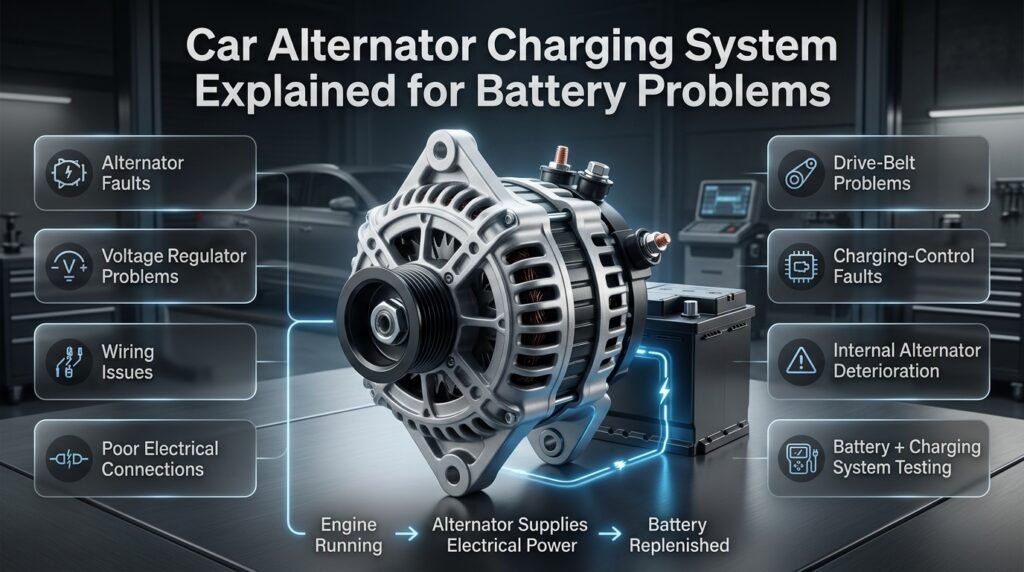
The alternator plays a central role in keeping the vehicle’s electrical system supplied with energy while the engine is running.
The battery provides energy for starting and supports the electrical system, while the alternator replenishes energy and supplies electrical power once the engine is operating.
If the alternator cannot provide the appropriate charging output, the battery can gradually become discharged.
Possible charging-system problems include:
- Alternator faults
- Voltage regulator problems
- Wiring issues
- Poor electrical connections
- Drive-belt problems
- Charging-control faults
- Internal alternator deterioration
This is why installing a new battery without checking the alternator can lead to repeated failure.
A new battery may initially work perfectly, but if the charging system does not replenish it properly, the same starting problem can return.
Why charging-system testing matters
A professional technician should evaluate the battery and charging system together.
Depending on the vehicle, diagnostic testing can include battery condition assessment, charging-system measurements, visual inspection, and electronic diagnostics.
If the alternator is responsible, repairing the charging system is more important than repeatedly replacing the battery.
3. Parasitic Electrical Drain While the Vehicle Is Parked
A parasitic electrical drain is one of the most important causes to investigate when a battery repeatedly dies after the vehicle has been switched off.
Modern vehicles do not become completely electrically inactive when the engine stops. Security systems, memory functions, control modules, clocks, communication systems, and other electronics can continue using small amounts of power.
That normal standby consumption is expected.
The problem occurs when a component continues consuming substantially more electricity than it should.
Potential sources include:
- Aftermarket alarms
- Dash cameras
- GPS or tracking equipment
- Audio equipment
- Interior lighting
- Trunk lighting
- Glovebox lighting
- Faulty control modules
- Incorrectly wired accessories
- Electrical wiring faults
The timing of the failure can provide an important clue.
If the vehicle starts normally after driving but becomes difficult to start after sitting overnight, excessive parked electrical consumption should be considered.
A professional electrical diagnosis can identify whether the vehicle is drawing abnormal current after it has been switched off and whether a particular circuit is responsible.
4. Frequent Short Trips Can Gradually Discharge a Battery
Driving habits can also contribute to repeated battery discharge.
Starting the engine consumes electrical energy. The charging system then needs to restore the energy used during starting and support the vehicle’s electrical demands.
When a vehicle is repeatedly used for very short trips, there may be limited opportunity for the charging system to restore the battery fully.
For example:
Start → short drive → engine off → start again → short drive → engine off
If this pattern continues regularly, the battery can remain at a lower state of charge.
This does not automatically mean the alternator is defective. The vehicle may simply be used in a way that does not provide sufficient operating time for the battery to recover fully.
Short journeys become particularly relevant when combined with:
- Heavy traffic
- Frequent engine starts
- High electrical demand
- Extensive air-conditioning use
- An aging battery
- A charging system that is already marginal
If repeated discharge follows a pattern of frequent short journeys, battery and charging-system testing can help determine whether the vehicle is being properly recharged.
5. Long Periods of Vehicle Inactivity
A car does not stop consuming all electrical energy simply because it is parked.
Modern vehicles maintain certain electronic functions while switched off. Over a sufficiently long period, these small electrical demands can reduce battery charge.
A healthy battery may tolerate periods of inactivity better than an aging or partially discharged battery. However, long-term parking can still become a problem if the battery is already weak.
This is particularly relevant for:
- Second vehicles
- Seasonal vehicles
- Cars used only on weekends
- Vehicles left at airports or parking facilities
- Cars kept unused during extended travel
- Vehicles that spend long periods in storage
Before extended parking, the battery condition should be considered along with the manufacturer’s recommendations for vehicle storage.
If the battery repeatedly becomes flat after periods of inactivity, simply jumpstarting it each time may not solve the underlying problem.
6. Loose Battery Terminals and Poor Connections
The battery may be healthy while its electrical connections are not.
Battery terminals must maintain secure electrical contact. If a terminal becomes loose, electrical resistance or intermittent connection problems can develop.
A poor connection can affect:
- Starting performance
- Charging efficiency
- Electrical stability
- Battery operation
- Diagnostic readings
The same principle applies to ground connections and battery cables.
A technician inspecting a repeatedly discharged battery should therefore examine the physical connections rather than focusing exclusively on the battery itself.
A loose connection may produce symptoms that appear random. The vehicle might start normally at one time and fail to start later without any obvious warning.
Correcting the connection can sometimes resolve the issue without replacing the battery.
7. Corrosion Around the Battery Terminals
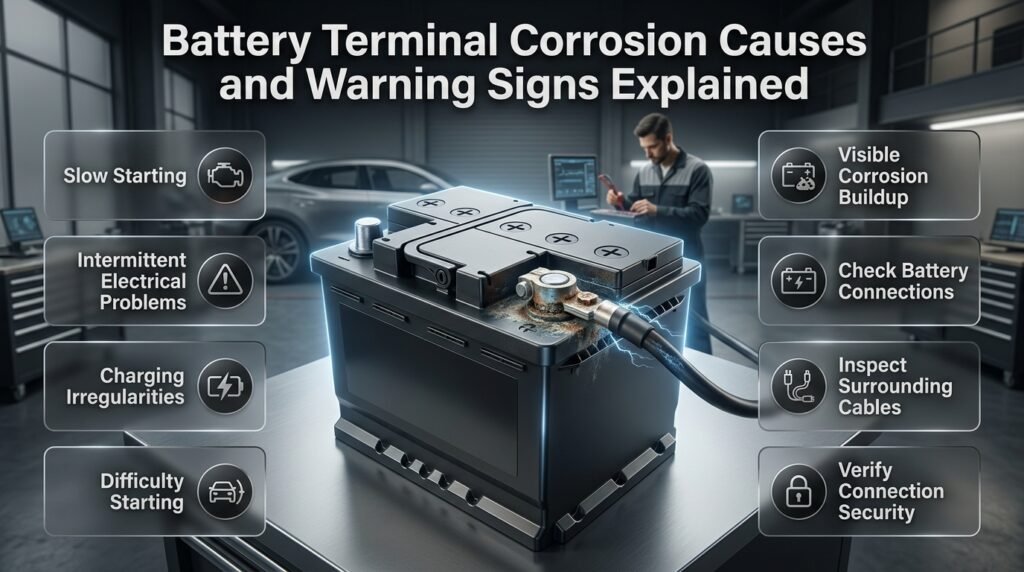
Corrosion can interfere with the electrical connection between the battery and vehicle.
When corrosion develops around terminals or cable connections, electrical resistance can increase. This can interfere with the efficient transfer of electrical current.
Possible symptoms include:
- Slow starting
- Intermittent electrical problems
- Charging irregularities
- Difficulty starting despite an apparently healthy battery
- Visible buildup around battery connections
Battery connections should be inspected during routine maintenance and especially when battery problems repeatedly occur.
The condition of the surrounding cables and terminals also matters. Cleaning a visible connection without determining why corrosion has developed or whether the connection remains secure may not provide a complete solution.
8. Aftermarket Electrical Accessories
Aftermarket equipment can introduce additional electrical loads that were not part of the vehicle’s original design configuration.
Common examples include:
- Dash cameras
- Tracking systems
- Security systems
- Amplifiers
- Additional lighting
- Entertainment equipment
- Charging devices
- Remote-start equipment
The equipment itself may not be defective. The installation method can be the problem.
For example, an accessory that should switch off with the vehicle may continue receiving power while parked. Over time, that additional consumption can reduce battery charge.
When investigating repeated discharge, tell the technician about every aftermarket electrical accessory installed on the vehicle.
This information can significantly narrow the diagnostic process.
9. Faulty Electronic Control Modules
Modern vehicles contain numerous electronic control modules.
These systems are designed to manage vehicle functions and, in many cases, enter low-power or sleep states when the vehicle is parked.
If a module fails to shut down correctly, it can potentially continue consuming electrical power.
This can be difficult to identify through a simple visual inspection because the problem may not produce an obvious physical symptom.
A professional diagnostic process may involve:
- Confirming the battery is healthy.
- Confirming the charging system is functioning correctly.
- Allowing the vehicle to enter its normal parked state.
- Measuring electrical consumption.
- Identifying an abnormal circuit.
- Isolating the relevant component.
- Testing the suspected module or system.
This is where advanced Engine Diagnostics and vehicle electrical diagnostics become valuable.
10. Extreme Heat and Battery Deterioration
Temperature has a major influence on automotive batteries.
High ambient temperatures can accelerate chemical and physical deterioration inside a battery. This is particularly relevant in hot climates such as Dubai.
Heat does not mean that every battery failure is automatically caused by climate. However, sustained exposure to high temperatures can contribute to accelerated aging.
Heat-related stress can contribute to:
- Faster battery deterioration
- Reduced long-term battery performance
- Internal degradation
- Shorter useful service life
- Greater vulnerability when the battery is already weak
Drivers in hot climates should therefore pay attention to battery condition rather than waiting until the vehicle refuses to start.
Preventive testing can identify a battery that is becoming unreliable before it produces a complete roadside breakdown.
11. Excessive Electrical Demand
A vehicle’s electrical system supports many components simultaneously.
Depending on the vehicle, electrical demand can come from:
- Air conditioning
- Headlights
- Infotainment
- Charging ports
- Cooling fans
- Audio systems
- Heated equipment
- Safety systems
- Electronic control modules
High electrical demand does not necessarily mean the battery is faulty.
However, if the charging system or battery is already weak, heavy electrical demand can expose the problem.
Dubai’s climate makes air-conditioning use especially important. Drivers may use climate-control systems extensively, particularly during periods of extreme heat.
A properly functioning vehicle should be designed to handle normal electrical loads, but unusual symptoms under high demand deserve investigation.
How Driving Conditions Can Affect Battery Discharge
Two vehicles with identical batteries can experience very different battery behavior because they are used differently.
Consider two driving patterns.
Vehicle A
- Regular longer journeys
- Fewer engine starts
- Consistent operating periods
- Limited aftermarket equipment
Vehicle B
- Many short trips
- Frequent engine starts
- Heavy traffic
- Extensive accessory use
- Long periods parked
Vehicle B may be more likely to experience an undercharged battery, particularly if the battery is already aging or the charging system is not operating at its best.
This is why battery diagnosis should include questions about how the vehicle is actually used.
Repeated Battery Discharge After Installing a New Battery
One of the most important warning signs is when a newly installed battery repeatedly becomes discharged.
A new battery should not automatically be assumed to be defective.
If the problem continues after replacement, investigate:
- Alternator operation
- Parasitic drain
- Battery terminals
- Ground connections
- Electrical accessories
- Correct battery specification
- Vehicle charging strategy
- Electronic modules
- Driving pattern
This is exactly why professional Car Service should focus on diagnosis rather than simply changing parts.
If the new battery is repeatedly discharged by an unresolved electrical fault, replacing it again is unlikely to solve the root problem.
Battery Type and Correct Vehicle Specification
Not every automotive battery is suitable for every vehicle.
Modern vehicles can have different electrical requirements and battery technologies.
Some vehicles use AGM batteries, while others may use EFB or conventional battery designs depending on their specifications.
Start-stop vehicles can place additional demands on battery systems because the engine may be switched off and restarted frequently during normal driving.
Installing the wrong battery specification can create problems with performance, charging behavior, or battery life.
For drivers considering an AGM replacement, the AGM battery replacement service in Dubai can be relevant when the vehicle specifically requires AGM technology.
The correct battery should always be selected according to the vehicle manufacturer’s requirements rather than choosing only by physical size or price.
Why Battery Brand and Quality Matter
Battery quality can influence reliability, but brand selection should come after determining the correct battery specification for the vehicle.
Different vehicles and applications may use different battery capacities and technologies.
For drivers comparing replacement options, EuroSwift’s dedicated battery services include Amaron car battery replacement in Dubai, which can be considered when an Amaron battery is appropriate for the vehicle.
Likewise, drivers whose vehicles require Bosch batteries can review the Bosch car battery replacement service as part of their replacement research.
The key point is that the best battery is not necessarily the most expensive battery. It is the battery that correctly matches the vehicle’s requirements, electrical system, dimensions, capacity, and intended use.
When Exide, Panasonic, FIAMM, or AC Delco May Be Relevant
Battery selection should remain vehicle-specific, but drivers may encounter different established battery brands during the replacement process.
For vehicles suited to Exide products, EuroSwift provides an Exide battery replacement service in Dubai.
Panasonic is another battery option that may be relevant depending on the vehicle’s requirements. More information is available through the Panasonic battery replacement service.
For drivers considering FIAMM, the FIAMM battery replacement service provides another vehicle-specific replacement option.
AC Delco is also among the battery brands available through EuroSwift’s service offering, with the AC Delco car battery replacement service providing another option where the vehicle specification is compatible.
The important principle remains the same: diagnose first, select the correct specification second, and replace the battery only when testing confirms replacement is appropriate.
Tuflong Battery as Another Replacement Option
Some vehicles may also be compatible with Tuflong battery products.
If a Tuflong battery is appropriate for the vehicle, drivers can review the Tuflong car battery replacement service when comparing replacement solutions.
Regardless of brand, a professional installation should verify the physical fit, electrical specifications, terminal arrangement, and vehicle requirements.
Brand alone should never be used as a substitute for proper battery diagnosis.
How Professionals Diagnose Repeated Battery Discharge
A systematic inspection is much more reliable than guessing.
Step 1: Visual Battery Inspection
The technician examines:
- Battery case
- Terminals
- Cables
- Mounting
- Corrosion
- Visible damage
- Connection condition
This identifies obvious physical problems.
Step 2: Battery Testing
The battery is evaluated to determine whether it can provide sufficient starting performance and whether it can retain an appropriate charge.
Step 3: Charging-System Testing
The alternator and related charging components are checked to determine whether the battery receives proper support while the engine is operating.
Step 4: Electrical Drain Testing
If the battery is healthy but repeatedly dies while parked, electrical consumption may need to be measured after the vehicle has entered its normal sleep state.
Step 5: Accessory Inspection
Aftermarket equipment is reviewed for possible abnormal power consumption.
Step 6: Electronic Diagnostics
Where necessary, vehicle diagnostic equipment can help identify faults involving electronic systems or control modules.
Step 7: Root-Cause Repair
Only after identifying the actual fault should the appropriate repair or replacement be carried out.
Symptoms vs Possible Causes
Understanding symptoms can help drivers communicate more useful information to a technician.
| Symptom | Possible Cause |
|---|---|
| Slow engine cranking | Weak battery, poor connection, starter issue |
| Battery dies overnight | Parasitic drain or weak battery |
| Battery dies after several days parked | Battery condition, standby drain, inactivity |
| Battery warning while driving | Charging-system problem |
| New battery repeatedly discharges | Electrical drain or charging fault |
| Problems after short journeys | Undercharging or battery deterioration |
| Random starting failure | Connection, battery, starter, or electrical issue |
| Electrical accessories stay active | Accessory or module fault |
| Multiple electrical warnings | Charging or electronic-system issue |
These are diagnostic clues rather than definitive conclusions.
Why Repeated Jumpstarts Are Not a Repair
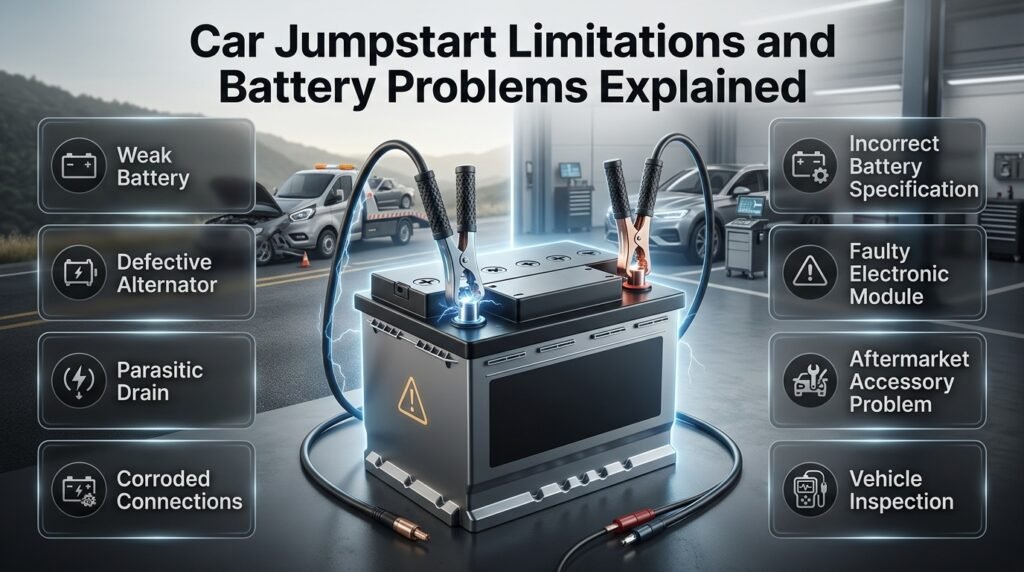
A jumpstart can be useful when a vehicle cannot start because its battery is discharged.
However, jumpstarting does not repair:
- A weak battery
- A defective alternator
- A parasitic drain
- Corroded connections
- Incorrect battery specification
- A faulty electronic module
- An aftermarket accessory problem
If the same problem keeps returning, repeated jumpstarts simply restore temporary starting capability.
For an immediate breakdown, Car Jumpstart support may help restore mobility, while proper Vehicle Inspection should identify why the battery discharged.
For vehicles stranded because of a wider fault, Roadside Assistance can be useful as the immediate recovery step before diagnostic work is performed.
When You Should Consider Battery Replacement
Battery replacement becomes appropriate when testing confirms that the battery is no longer capable of providing reliable performance.
Typical indicators can include:
- Battery cannot hold an appropriate charge
- Starting performance remains weak after proper charging
- Battery testing confirms poor condition
- Battery has suffered internal deterioration
- Physical damage is present
- Battery repeatedly fails despite a healthy charging system and no abnormal drain
However, replacement should be considered only after ruling out other major causes.
A failed battery may be the result of another problem, and installing another battery without addressing that problem can create another discharge cycle.
Understanding Battery Prices in Dubai
Battery price is influenced by several factors, so there is no single price that applies to every vehicle.
Factors may include:
- Battery technology
- Battery capacity
- Brand
- Vehicle type
- Start-stop requirements
- AGM or EFB specification
- Installation requirements
- Availability
- Vehicle electronics
- Required battery registration or adaptation
Drivers comparing options can review EuroSwift’s car battery prices in Dubai 2026 guide for a broader understanding of the factors affecting replacement cost.
The cheapest battery is not necessarily the most economical choice if it is unsuitable for the vehicle.
Common Mistakes When a Battery Keeps Dying
Replacing the battery without testing the alternator
This can leave a charging fault unresolved.
Assuming the new battery is automatically the correct battery
Battery technology and specification matter.
Ignoring aftermarket equipment
An incorrectly installed accessory can continuously consume power.
Checking only battery voltage
Voltage provides useful information but does not always reveal the complete condition of the battery or charging system.
Repeatedly jumpstarting the car
Jumpstarting restores temporary starting ability but does not identify the cause.
Ignoring slow cranking
Slow starting can be an early warning of battery or starting-system problems.
Waiting until the vehicle completely fails
Preventive inspection is usually more convenient than emergency recovery.
Preventive Battery Maintenance Checklist
A simple maintenance routine can reduce the risk of unexpected battery problems.
Battery condition
✔ Check battery health periodically.
Terminals
✔ Keep connections secure and inspect for corrosion.
Charging system
✔ Test alternator performance if battery discharge becomes frequent.
Driving pattern
✔ Pay attention if most journeys are extremely short.
Accessories
✔ Check aftermarket electronics for abnormal power consumption.
Long-term parking
✔ Prepare the vehicle appropriately before extended inactivity.
Warning signs
✔ Investigate slow cranking or repeated jumpstarts.
Battery specification
✔ Ensure replacement batteries match manufacturer requirements.
Electrical problems
✔ Diagnose recurring discharge rather than treating each failure separately.
A Practical Diagnostic Decision Guide
When a battery repeatedly goes flat, the following approach can help organize the investigation.
Battery dies after one night
First investigate battery condition and parasitic electrical drain.
Battery dies after several days
Consider battery condition, standby electrical consumption, and extended inactivity.
Battery becomes weak after repeated short trips
Evaluate battery condition, charging performance, and driving pattern.
Battery becomes discharged while driving
Investigate the charging system immediately.
New battery fails repeatedly
Look beyond the battery and inspect the alternator, electrical drain, accessories, and vehicle electronics.
Battery terminals show corrosion
Inspect the connections, cables, and battery condition.
Multiple electronic warnings appear
A charging-system or electronic-system fault may be involved and professional diagnostics are advisable.
How Dubai Climate Makes Preventive Checks More Valuable
Vehicle maintenance should reflect local operating conditions.
Dubai’s high temperatures can place additional stress on vehicle components, while extensive air-conditioning use can increase electrical demand. Traffic and short urban journeys can also create operating patterns that differ from long-distance highway driving.
For this reason, drivers should not wait for a complete battery failure before paying attention to battery condition.
A preventive Car Inspection can identify developing issues before they become a roadside emergency.
The same principle applies to the rest of the vehicle. Battery performance can sometimes be affected by broader electrical or mechanical conditions, which is why regular Auto Workshop inspections can provide a more complete picture of vehicle health.
When Repeated Battery Discharge Points to a Bigger Vehicle Problem
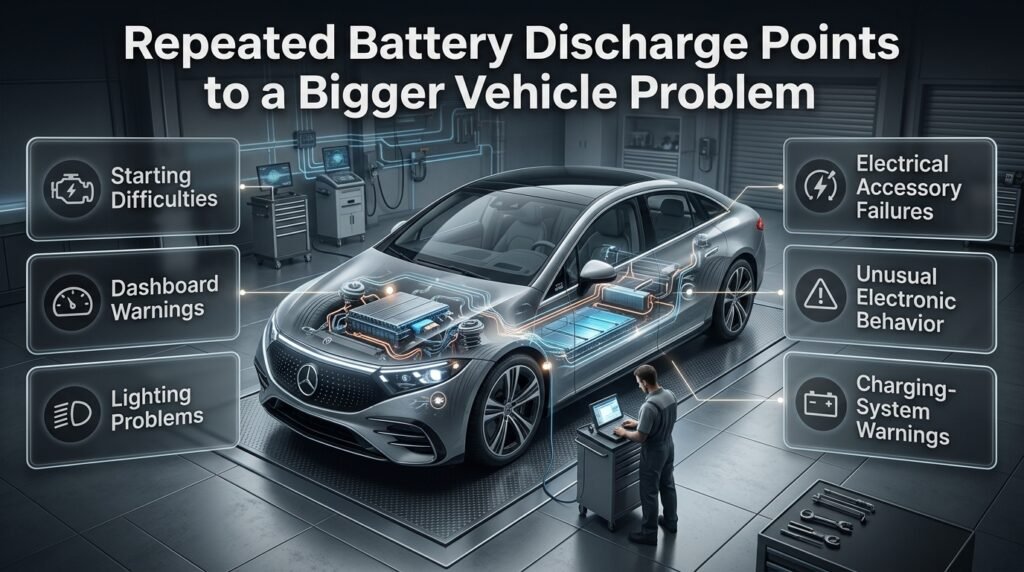
A battery problem can sometimes be an isolated issue, but it can also be part of a larger electrical or mechanical problem.
For example, a charging-system fault may affect more than battery performance. Similarly, a wiring problem may influence multiple electrical systems.
If the vehicle is also experiencing:
- Starting difficulties
- Dashboard warnings
- Lighting problems
- Electrical accessory failures
- Unusual electronic behavior
- Repeated charging-system warnings
then a broader Car Repair inspection may be necessary.
The objective should be to understand the complete vehicle condition rather than treating one symptom in isolation.
Battery Discharge and Preventive Vehicle Maintenance
Battery maintenance should be viewed as part of overall vehicle reliability.
Other components also influence how confidently a vehicle operates, including:
- Engine
- Starter
- Alternator
- Brakes
- Suspension
- Tires
- Cooling system
- Air-conditioning system
- Transmission
- Electrical systems
Regular Vehicle Maintenance helps identify developing problems before they become expensive or inconvenient failures.
A vehicle that receives appropriate preventive maintenance is easier to diagnose because its service history provides useful context.
Modern Automotive Battery Diagnostics
Vehicle electrical systems have become significantly more sophisticated.
Modern vehicles may use intelligent charging systems, battery monitoring sensors, start-stop technology, and electronic energy-management strategies.
As a result, battery diagnosis increasingly involves more than a simple visual inspection.
Depending on the vehicle, technicians may need to consider:
- Battery monitoring systems
- Intelligent alternator control
- Start-stop systems
- Electronic control modules
- Energy-management systems
- Vehicle communication networks
- Battery registration requirements
This means a battery replacement on a modern vehicle may involve electronic procedures as well as physical installation.
The exact process varies according to vehicle make, model, battery technology, and manufacturer requirements.
Battery Discharge Prevention for Different Driving Patterns
Different drivers should think about battery maintenance differently.
Daily commuter
A driver who travels longer distances regularly may have fewer problems related to insufficient recharge time, but battery condition should still be monitored.
Short-distance urban driver
Frequent short journeys can make battery and charging-system checks more important.
Weekend driver
Long periods of inactivity may contribute to discharge.
Luxury vehicle owner
Sophisticated electronic systems can make professional diagnostics particularly valuable when unexplained electrical problems occur.
Commercial or high-use vehicle
Frequent starts and high electrical demand can place greater importance on battery and charging-system condition.
There is no universal maintenance routine that perfectly fits every vehicle.
What a Professional Battery Service Should Include
A quality battery service should focus on reliability rather than simply replacing a component.
Depending on the vehicle and service requirement, professional attention may include:
- Battery condition assessment
- Battery specification verification
- Terminal inspection
- Cable inspection
- Charging-system testing
- Electrical diagnostics
- Battery installation
- Battery registration where required
- Post-installation testing
This approach reduces the possibility of installing a battery that is unsuitable for the vehicle or leaving an electrical fault unresolved.
Repeated Battery Discharge: Repair or Replacement?
The decision can be simplified by separating the problem into two questions:
Can the battery still perform properly?
and
Why did it discharge?
If the battery is healthy but something is draining it, repair the electrical problem.
If the battery has failed but the vehicle’s charging system and electrical system are healthy, replacement may be appropriate.
If both the battery and charging system are affected, both issues may need attention.
This distinction is essential because replacing a failed battery without correcting an underlying charging or electrical problem can result in another failure.
Why does my car battery keep dying even after I replace it?
When a new battery repeatedly goes flat, the battery itself may not be the real problem. A replacement battery starts with a fresh charge, but if the vehicle has an electrical drain, charging-system fault, poor connection, or incorrectly installed accessory, that same problem can discharge the new battery just as it did the old one.
This is one of the most important situations where replacing parts without diagnosis can become expensive. The battery and alternator should be checked together, and if both appear healthy, the vehicle should be inspected for abnormal electrical consumption while parked.
What should be checked:
Battery condition and ability to hold a charge
Alternator and charging-system performance
Battery terminals and ground connections
Aftermarket accessories such as dash cameras or alarms
Electrical modules that may remain active after the vehicle is switched off
Abnormal parasitic electrical draw
Professional recommendation: If the replacement battery develops exactly the same problem as the previous one, don’t immediately buy another battery. Find the underlying cause first.
Why does my car battery die overnight?
A battery that works normally during the day but is dead or significantly weaker the following morning deserves attention. One of the main possibilities is a parasitic electrical drain, meaning something continues consuming power after the vehicle has been switched off and should have entered its normal low-power state.
Modern vehicles naturally use a small amount of electricity while parked for systems such as security, memory, keyless entry, and other electronic functions. The concern is excessive consumption from a faulty component, accessory, lighting circuit, relay, wiring issue, or electronic module.
Common areas to investigate:
Interior or trunk lights that remain on
Aftermarket dash cameras
Alarm or tracking systems
Faulty relays
Infotainment equipment
Wiring faults
Electronic modules that fail to enter sleep mode
Alternator-related electrical leakage
The timing is an important clue: if the car starts normally after being driven but repeatedly struggles after sitting overnight, a parked electrical drain or weak battery should be investigated rather than assuming the starter is the problem.
Can a bad alternator cause repeated car battery discharge?
Yes, a charging-system problem can repeatedly leave the battery undercharged. The alternator is responsible for supplying electrical power while the engine is running and replenishing energy used from the battery. If charging performance is inadequate, the battery can gradually lose its ability to provide reliable starting power.
The important point is that a battery and alternator are part of the same system. Installing a new battery without checking the charging system can result in the replacement battery becoming discharged again.
A professional charging-system inspection may consider:
Alternator output
Voltage regulation
Charging wiring
Battery connections
Drive-belt condition where applicable
Charging-system warning signals
Vehicle-specific electronic charging controls
A battery that repeatedly becomes weak after normal driving should therefore receive both battery and charging-system testing. If the alternator is the underlying problem, repairing the charging system is more important than repeatedly replacing batteries.
Can short trips cause a car battery to keep discharging?
Frequent short trips can contribute to repeated battery discharge because starting the engine consumes electrical energy, while a very short journey may provide limited opportunity for the charging system to replenish what was used.
The problem becomes more noticeable when short trips are repeated throughout the day. For example, several brief journeys with multiple engine starts can gradually leave the battery undercharged, particularly when the battery is already aging or the vehicle has high electrical demands.
Short-trip driving can be more demanding when combined with:
Frequent engine starts
Heavy traffic
Extensive air-conditioning use
High electrical accessory use
An aging battery
A charging system that is not operating efficiently
This does not automatically mean the alternator has failed. The vehicle’s actual battery condition and charging performance should be tested before reaching that conclusion.
Professional recommendation: If most of your driving consists of short urban journeys and the battery repeatedly becomes weak, mention your driving pattern during the inspection. It can be an important part of the diagnosis.
Why does my car battery keep dying even after I replace it?
The most effective way to prevent repeated battery discharge is to identify the root cause, rather than repeatedly charging or jumpstarting the battery. A healthy battery should be able to perform its normal starting role when the vehicle’s charging and electrical systems are functioning correctly.
Start by checking the battery’s condition and the charging system. If both are satisfactory, investigate whether the vehicle is experiencing excessive electrical consumption while parked. Battery terminals, ground connections, aftermarket accessories, and electronic modules should also be considered.
A professional prevention checklist includes:
Test the battery when repeated discharge begins
Check alternator and charging performance
Inspect battery terminals and cables
Look for abnormal electrical drain while parked
Review aftermarket electrical accessories
Pay attention to repeated short-trip driving
Avoid leaving lights and accessories operating unnecessarily
Check the vehicle before extended periods of inactivity
Replace the battery only when testing confirms it is no longer reliable
The key is to stop treating every flat battery as an isolated incident. If the same battery problem keeps returning, the pattern itself is a diagnostic clue.
Conclusion
Repeated car battery discharge is rarely something drivers should ignore, especially when the same problem keeps returning after charging, jumpstarting, or installing a new battery. The real cause may be an aging battery, weak charging system, parasitic electrical drain, poor terminal connection, frequent short trips, long periods of inactivity, aftermarket accessories, or a fault within the vehicle’s electrical system.
The most reliable solution is to diagnose the complete starting and charging system instead of assuming that every discharge means the battery needs replacement. Battery condition, alternator performance, electrical connections, and parked-current consumption should be checked systematically. This approach helps identify the root cause and prevents unnecessary battery replacements.
For Dubai drivers, high temperatures, heavy air-conditioning use, traffic conditions, and frequent short journeys can make preventive battery inspection even more valuable. Paying attention to slow cranking, repeated jumpstarts, overnight discharge, or dashboard warnings can help identify a developing problem before it becomes a roadside emergency.
Ultimately, reliable battery performance depends on more than the battery itself. Proper Battery Replacement, Car Service, Vehicle Inspection, Engine Diagnostics, and preventive Vehicle Maintenance can help keep the entire electrical system working as it should. When a battery repeatedly goes flat, don’t simply recharge it and wait for the next failure—find out why it is happening and fix the underlying cause.

Leave a Reply