
Introduction
Unexpected Car Battery Discharge | An unexpected car battery discharge can be one of the most frustrating vehicle problems, especially when the car was working normally the previous day and suddenly refuses to start. Sometimes the battery becomes weak overnight; in other cases, the vehicle starts normally but develops repeated starting problems after several days of parking.
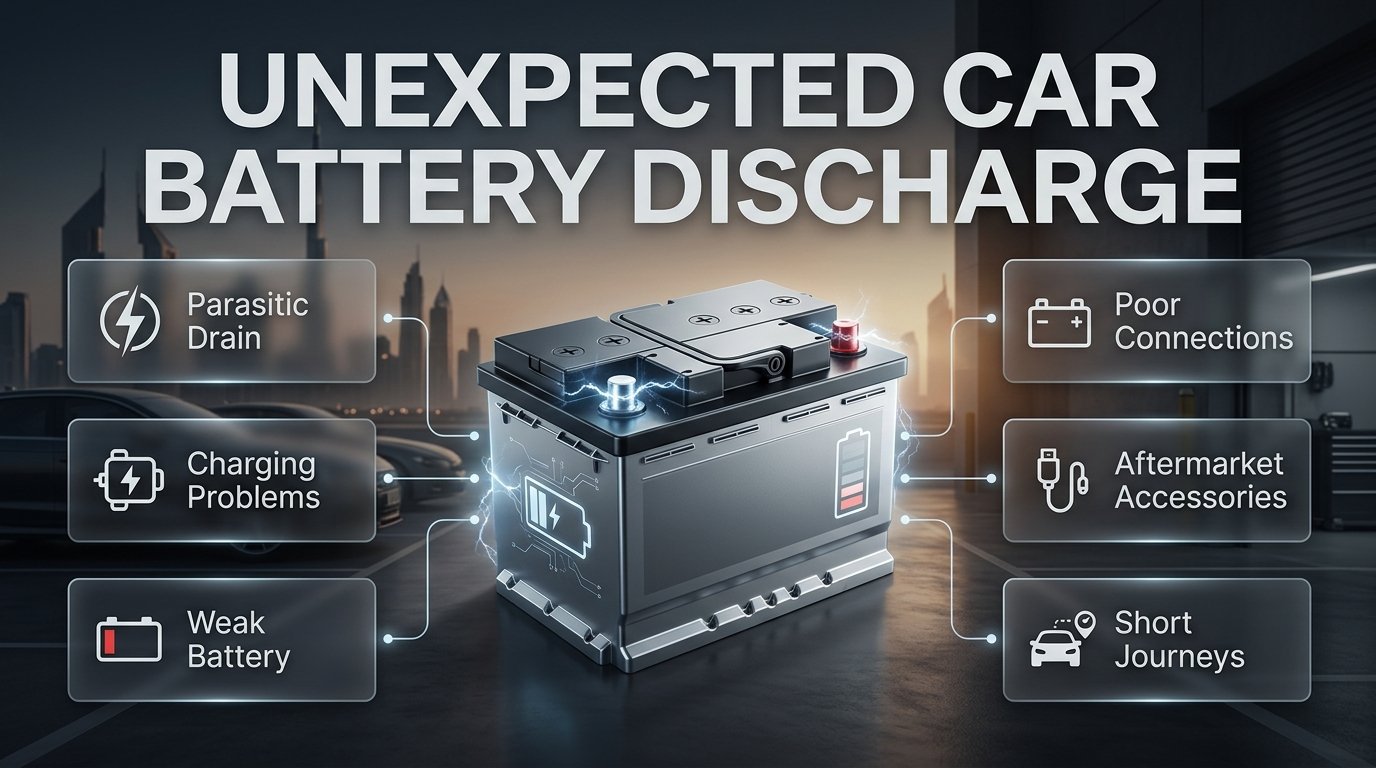
The important thing to understand is that a discharged battery does not always mean the battery itself is defective. Excessive electrical consumption, parasitic drain, charging-system problems, poor battery connections, aftermarket accessories, frequent short journeys, and battery aging can all contribute to unexpected discharge.
For Dubai drivers, local operating conditions deserve additional consideration. High temperatures, extensive air-conditioning use, traffic congestion, and frequent stop-and-go driving can place considerable demands on a vehicle’s electrical system. A battery that is already approaching the end of its useful service life may therefore become noticeably unreliable.
If you are experiencing repeated battery discharge, professional inspection from EuroSwift Auto Services can help determine whether the problem is actually the battery or another part of the vehicle’s electrical and charging system. Proper diagnosis is important because replacing a battery without finding the underlying cause can allow the same problem to return.
This guide explains the major causes of unexpected car battery discharge, how professionals diagnose it, what different symptoms can indicate, how Dubai conditions affect battery performance, and what drivers can do to prevent repeated starting failures.
What Does Unexpected Car Battery Discharge Mean?
An unexpected car battery discharge occurs when the battery loses enough stored electrical energy that it can no longer provide adequate power for the vehicle’s starting and electrical requirements.
Every vehicle has some level of electrical consumption, even after the engine has been switched off. Modern cars contain numerous electronic control modules, security systems, memory functions, sensors, communication systems, and convenience features.
Under normal conditions, these systems should enter an appropriate low-power or sleep state after the vehicle has been parked.
The problem occurs when:
- The battery cannot hold enough charge.
- The vehicle consumes excessive electrical power while parked.
- The alternator does not adequately recharge the battery.
- Electrical connections restrict proper current flow.
- An accessory continues drawing power.
- The battery has been repeatedly undercharged.
- The vehicle is used mainly for short journeys.
Therefore, battery discharge is better understood as a symptom that requires diagnosis rather than automatically being treated as proof that the battery needs replacement.
A professional approach begins by separating three possibilities:
Battery condition + charging performance + electrical consumption
All three can influence whether a vehicle starts reliably.
Why Does a Car Battery Discharge Unexpectedly?
There is rarely one universal cause of battery discharge. Two vehicles can show exactly the same starting symptom while having completely different underlying problems.
A battery may discharge because of an internal loss of capacity, excessive current consumption while parked, insufficient charging during operation, or a combination of several factors.
The most common areas to investigate are:
| Potential cause | How it can contribute |
|---|---|
| Aging battery | Reduced ability to store usable energy |
| Parasitic drain | Excessive electrical consumption while parked |
| Lights left active | Continuous unnecessary power consumption |
| Faulty accessory | Device remains powered after parking |
| Charging-system fault | Battery is not adequately replenished |
| Poor terminal connection | Can interfere with electrical performance |
| Short journeys | Limited time available for recharging |
| Long-term parking | Standby consumption gradually reduces charge |
| Incorrect battery specification | Battery may not suit vehicle requirements |
| Extreme operating conditions | Can accelerate battery deterioration |
Identifying which category applies to the vehicle is more valuable than simply installing another battery.
Common Causes of Unexpected Car Battery Discharge
1. Aging or Weak Battery
One of the most straightforward causes is a battery that has lost part of its original capacity.
A battery can continue starting a vehicle for some time while its internal performance gradually declines. The driver may not notice the deterioration until the vehicle is left parked for a longer period or the battery experiences increased demand.
An aging battery may show symptoms such as slower cranking, repeated jumpstart requirements, or difficulty starting after parking.
However, battery age alone should not be used as the only reason for replacement. Testing should determine whether the battery still performs adequately.
2. Parasitic Electrical Drain
A parasitic drain occurs when a vehicle consumes more electrical energy than expected after being switched off.
Some standby consumption is normal because modern vehicles need to maintain essential functions.
The problem is excessive or abnormal consumption.
Potential sources can include:
- Interior lighting
- Trunk or boot lighting
- Glove-box lighting
- Audio equipment
- Dash cameras
- Security equipment
- Tracking systems
- Aftermarket electronics
- Relays
- Control modules
- Modified wiring
A small abnormal drain may not flatten the battery immediately. Instead, it may gradually reduce the available charge over several hours or days.
This is one reason a vehicle can appear perfectly normal during driving but fail to start after being parked.
Battery Discharge Overnight
A battery that dies overnight requires a slightly different diagnostic thought process from one that becomes weak after several weeks.
When a vehicle is parked overnight, the battery should generally retain enough energy to start the engine the following morning if the battery is healthy and the vehicle’s electrical system is operating correctly.
If the battery repeatedly becomes discharged overnight, possible areas of investigation include:
- Battery condition
- Excessive standby consumption
- Lighting circuits
- Aftermarket accessories
- Faulty electronic modules
- Charging performance from the previous drive
- Battery connections
The timing of the failure can provide an important clue.
| When the vehicle fails | Possible diagnostic direction |
|---|---|
| Several hours after parking | Significant electrical consumption |
| Next morning | Battery condition or overnight drain |
| After several days | Battery capacity or standby consumption |
| After weeks of storage | Storage-related discharge or battery condition |
| After every drive | Charging or battery problem |
These are diagnostic directions rather than automatic diagnoses. Proper testing is still required.
Lights and Accessories That Can Drain a Battery
One of the easiest causes to overlook is a light or accessory that remains active after the vehicle has been parked.
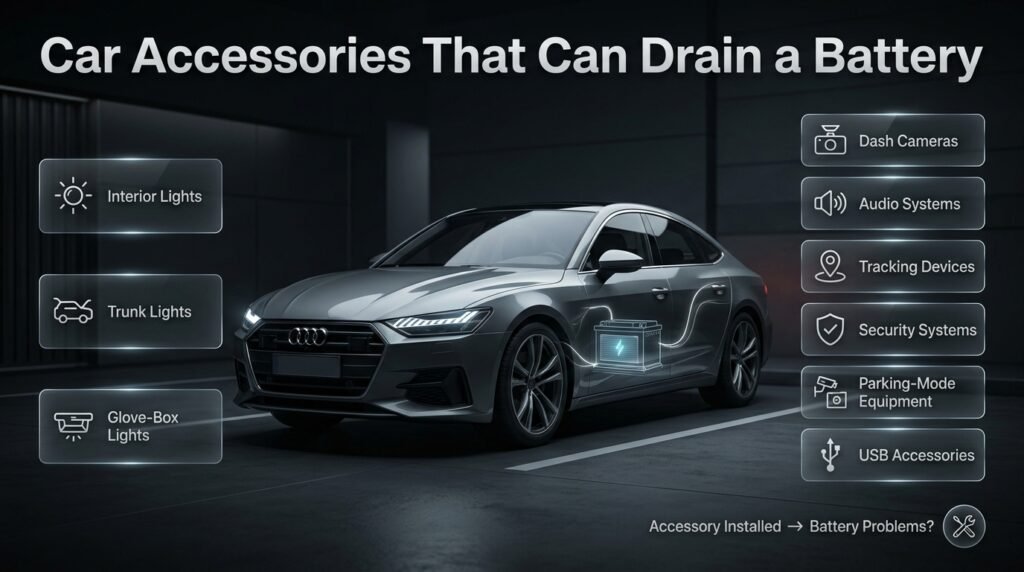
Interior lights, trunk lights, glove-box lights, or certain exterior lighting systems can potentially remain active because of a switch, latch, sensor, or control-system issue.
Aftermarket electronics are another important consideration.
Examples include:
- Dash cameras
- Audio systems
- Tracking devices
- Security systems
- Parking-mode equipment
- USB accessories
- Additional lighting
Some devices can continue consuming electricity without producing an obvious visible sign.
If battery problems began shortly after an accessory was installed, that timing should be mentioned during a professional inspection.
Can a Good Battery Still Discharge?
Yes.
A relatively new battery can still become discharged if the vehicle has an electrical fault or charging problem.
For example, a healthy battery connected to a circuit that continuously consumes excessive power can eventually lose enough charge to prevent the engine from starting.
Similarly, a new battery may repeatedly become undercharged if the charging system is not replenishing it correctly.
This creates an important diagnostic distinction:
A new battery does not automatically prove that the vehicle’s electrical system is healthy.
If a recently installed battery begins experiencing the same problem as the previous battery, replacing it again without diagnosis may simply repeat the cycle.
How the Charging System Can Cause Battery Discharge
The battery stores electrical energy, while the charging system replenishes energy when the engine is running.
The alternator and associated components play a major role in maintaining the vehicle’s electrical supply.
If charging performance is inadequate, the vehicle may gradually consume more energy than it replaces.
Possible contributing issues can include:
- Alternator problems
- Charging-system wiring
- Poor connections
- Belt-related issues where applicable
- Electrical control faults
- Charging-system component failure
A vehicle may continue operating for some time even when charging performance is below normal. Eventually, the battery can become sufficiently undercharged that starting performance deteriorates.
This is why charging-system testing is an important part of repeated battery-discharge diagnosis.
Battery Discharge Caused by Short Trips
Frequent short journeys can create a difficult operating pattern for the battery.
Starting the engine requires a substantial amount of electrical energy. During a very short drive, the vehicle may not operate long enough for the charging system to fully replenish the energy used during starting and other electrical demands.
If this happens repeatedly, the battery can remain at a lower state of charge.
This does not necessarily mean short journeys will always cause battery failure. The impact depends on the vehicle, battery condition, electrical demand, driving pattern, and charging system.
Drivers who mainly use their vehicles for very short trips should therefore pay attention to early signs of weak starting performance.
Dubai Climate and Unexpected Battery Discharge
Dubai’s climate can be particularly demanding on vehicle batteries.
High temperatures can accelerate battery aging and place additional stress on components under the bonnet. Vehicles also rely heavily on air-conditioning systems during normal operation, increasing electrical and mechanical demands.
Traffic conditions can add another dimension. Frequent congestion and stop-and-go driving may create a different charging and operating pattern from steady highway driving.
These conditions do not automatically mean a vehicle will experience battery discharge. However, they can expose weaknesses that might otherwise remain unnoticed.
For Dubai drivers, regular Vehicle Inspection and preventive Vehicle Maintenance can therefore be useful, particularly when the battery is already showing signs of reduced performance.
Signs of an Unexpectedly Discharging Battery
The battery may provide several warning signs before complete failure.
Slow Engine Cranking
If the engine turns over noticeably more slowly than usual, the battery may have reduced starting capability.
However, slow cranking can also have other causes, so diagnosis should not rely on this symptom alone.
Clicking During Starting
Repeated clicking when attempting to start the vehicle can occur when insufficient electrical power reaches the starter system.
Dim Interior or Dashboard Lights
Unusually dim lighting can indicate low battery voltage or an electrical supply issue.
Repeated Jumpstarts
If the vehicle requires frequent jumpstarts, the underlying problem should be investigated rather than treating each incident separately.
Electronic Resets
Low voltage can sometimes cause electronic systems to reset or display unusual warnings.
The exact behavior depends on the vehicle.
Symptoms vs Possible Causes
| Symptom | Possible area to investigate |
|---|---|
| Slow starting | Battery or starting system |
| Battery flat after parking | Battery condition or electrical drain |
| Battery flat after driving | Charging system |
| New battery repeatedly discharges | Electrical drain or charging |
| Interior light remains on | Lighting circuit or switch |
| Frequent jumpstarts | Battery, charging, or electrical fault |
| Warning messages after low voltage | Vehicle electronics affected by low supply |
| Problem began after accessory installation | Aftermarket electrical equipment |
This table is useful as a starting point, but it should not replace professional diagnosis.
How Professionals Diagnose Unexpected Car Battery Discharge
Professional diagnosis should be systematic rather than based on guesswork.
Battery Inspection
The first stage is determining the condition and specification of the battery.
A technician may inspect:
- Battery condition
- State of charge
- Starting performance
- Battery age
- Physical condition
- Terminal condition
- Correct battery specification
A battery that has lost significant performance may need replacement.
Terminal and Ground Inspection
Battery terminals and ground connections are essential parts of the electrical path.
A loose, damaged, or heavily contaminated connection can create resistance and interfere with electrical performance.
The inspection may include:
✔ Positive terminal
✔ Negative terminal
✔ Ground connections
✔ Battery clamps
✔ Relevant cables
✔ Visible wiring
A problem with a connection should be addressed before concluding that the battery itself has failed.
Why Voltage Testing Alone Is Not Enough
A voltage reading is useful but does not tell the entire story.
A battery may show an apparently reasonable voltage while still having insufficient starting capability or reduced internal capacity.
Professional battery assessment can involve several factors rather than relying on one number.
These may include:
- Resting voltage
- State of charge
- Starting performance
- Load behavior
- Battery age
- Charging performance
- Electrical consumption
This broader approach helps avoid unnecessary replacement.
Testing for Parasitic Drain
When the battery and charging system do not explain repeated discharge, technicians may investigate standby electrical consumption.
The vehicle may need to be locked and allowed to enter its normal sleep state before meaningful measurements can be made.
If abnormal consumption is confirmed, the technician can work through relevant circuits and systems to identify the source.
Potential areas include:
- Interior lighting
- Trunk circuits
- Accessories
- Infotainment
- Security systems
- Control modules
- Modified wiring
The objective is not merely to confirm that the battery is empty. It is to identify why the battery became empty.
Why Replacing the Battery Immediately Can Be a Mistake
A discharged battery creates an obvious symptom: the car does not start.
That can make replacement seem like the quickest solution.
Sometimes replacement is exactly what the vehicle needs.
But if the battery was discharged because of an electrical drain, the new battery can eventually discharge as well.
The same situation applies when a charging-system fault is present.
Therefore, a professional diagnosis should ask:
Why did the battery discharge?
rather than simply:
Can we install another battery?
This distinction can save unnecessary expense and prevent repeated roadside problems.
Choosing the Correct Replacement Battery
When replacement is actually required, the battery should match the vehicle’s requirements.
Important considerations can include:
- Battery technology
- Capacity
- Starting requirements
- Physical dimensions
- Terminal configuration
- Manufacturer specification
- Start-stop requirements
- Vehicle energy-management system
Modern vehicles may use technologies such as AGM or EFB depending on their design.
Installing a battery simply because it fits physically may not be sufficient.
AGM Batteries and Unexpected Discharge
AGM batteries are used in many vehicles with higher electrical demands and start-stop systems.
They are designed differently from conventional flooded batteries and can be suitable for vehicles that require this technology.
If your vehicle specifically requires AGM technology, the replacement should meet the appropriate specification.
EuroSwift’s AGM Battery Replacement service provides a dedicated reference for drivers looking for this type of battery solution.
The key point is that battery technology should be selected according to vehicle requirements rather than personal preference alone.
Battery Brand Selection
Brand selection can also become relevant when replacement is necessary, but compatibility should come first.
For example, drivers researching different replacement options can review EuroSwift’s dedicated pages for Amaron Battery, Bosch Battery, and Tuflong Battery.
Other available battery options include Exide Battery, Panasonic Battery, and FIAMM Battery.
For vehicles requiring another established option, EuroSwift also provides information about AC Delco Battery.
These pages should be used as supporting resources when the battery type and vehicle requirements have already been established, rather than inserting every brand into every battery-related article.
Battery Replacement vs Electrical Diagnosis
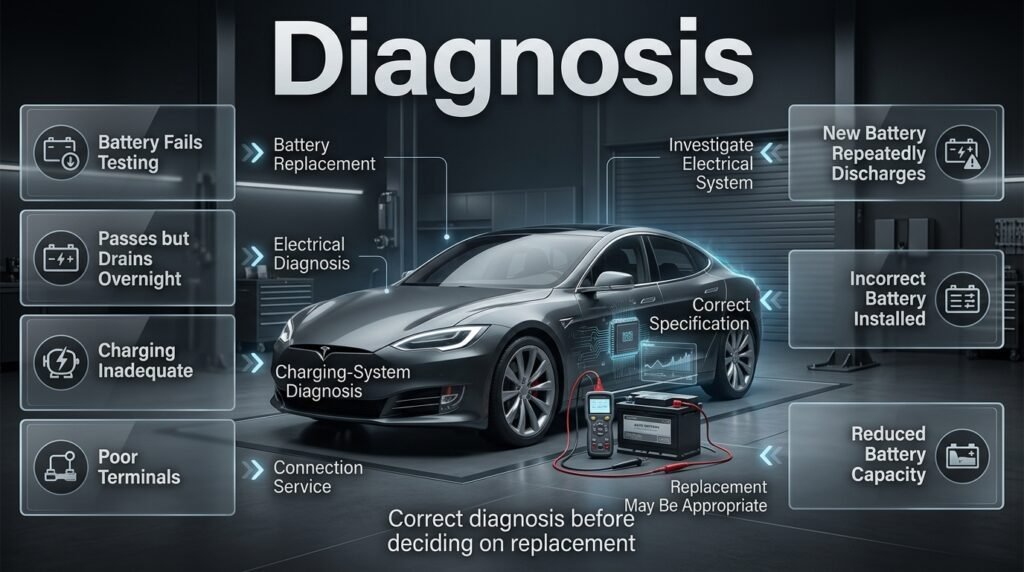
Not every discharged battery requires replacement.
The following comparison can help explain the difference:
| Finding | More appropriate direction |
|---|---|
| Battery fails testing | Battery replacement |
| Battery passes testing but vehicle drains overnight | Electrical diagnosis |
| Battery is healthy but charging is inadequate | Charging-system diagnosis |
| Terminals are poor | Connection service |
| New battery repeatedly discharges | Investigate electrical system |
| Incorrect battery installed | Correct specification |
| Battery has reduced capacity | Replacement may be appropriate |
This distinction is particularly important for vehicles with complex electronic systems.
What to Do If Your Battery Dies While You Are Away From Home
A completely discharged battery can become a roadside problem, particularly if the vehicle is parked in a remote area, shopping location, workplace, or residential parking facility.
The immediate objective is safe recovery.
A professional Car Jumpstart may restore temporary starting capability when the correct equipment and procedures are used.
However, a jumpstart should not be considered proof that the vehicle has been repaired.
If the battery repeatedly dies, the vehicle should receive a proper inspection.
For drivers who need assistance at the roadside, Roadside Assistance can provide a practical first response before further diagnosis or battery replacement is arranged.
What Happens After a Jumpstart?
After a successful jumpstart, drivers sometimes assume that simply driving for a while will permanently solve the problem.
That is not always the case.
The vehicle may start because external electrical assistance temporarily restored sufficient energy.
The next questions should be:
- Is the battery healthy?
- Is the alternator charging correctly?
- Was there excessive electrical consumption?
- Did something remain switched on?
- Is the battery specification correct?
- Is there an electrical connection problem?
If the vehicle immediately returns to normal and the incident was caused by a one-time oversight, further action may be limited.
Repeated incidents require more attention.
Unexpected Battery Discharge During Long-Term Parking
A vehicle that remains unused for an extended period can gradually lose battery charge.
Even a properly functioning vehicle has some standby electrical consumption.
The longer the vehicle remains parked, the more important battery condition and storage planning become.
Before extended storage, consider:
✔ Battery condition
✔ Expected storage period
✔ Vehicle environment
✔ Standby electrical consumption
✔ Manufacturer recommendations
✔ Previous battery history
If a battery has already shown signs of weakness, extended parking can expose the problem much more quickly.
Battery Discharge After a Holiday or Long Trip
A common scenario is returning from a trip and discovering that the vehicle will not start.
If the car was parked for several days or weeks, several factors may need to be considered.
A healthy battery can gradually lose charge through normal standby consumption, while an aging battery may lose usable capacity more quickly.
If the battery was already partially discharged before the vehicle was parked, the situation can become more pronounced.
After the vehicle is recovered, repeated discharge should not be ignored.
Aftermarket Accessories and Battery Problems
Aftermarket equipment can be useful, but it also changes the vehicle’s electrical load.
A professionally installed accessory should be integrated correctly with the vehicle’s electrical system.
Potential issues can arise when equipment is:
- Connected to an inappropriate circuit
- Left in a permanent power state
- Poorly wired
- Incorrectly grounded
- Configured for continuous operation
- Installed without considering vehicle sleep behavior
If the battery problem appeared soon after electrical modification, that history should be communicated to the technician.
This can significantly narrow the diagnostic process.
Common Mistakes Drivers Should Avoid
Replacing Multiple Batteries Without Diagnosis
Repeated replacement can become expensive and may never solve the underlying issue.
Assuming a New Battery Cannot Fail
New batteries can experience problems, but repeated discharge should also trigger an investigation of the vehicle.
Ignoring the Alternator
A battery depends on the charging system to replenish energy during operation.
Leaving Accessories Connected
Even small devices can contribute to discharge when they remain powered for long periods.
Treating Every Flat Battery as the Same Problem
The cause of one isolated incident may be completely different from a repeated overnight discharge.
Relying Only on Voltage
Voltage provides useful information but is not a complete battery-health assessment.
How to Prevent Unexpected Car Battery Discharge
Preventive maintenance is more effective when it focuses on the entire electrical system rather than the battery alone.
Practical prevention checklist
✔ Check battery condition periodically.
✔ Keep battery terminals and connections in good condition.
✔ Investigate slow cranking early.
✔ Avoid unnecessary electrical accessories while parked.
✔ Check interior and trunk lights.
✔ Inspect aftermarket equipment if discharge occurs repeatedly.
✔ Test charging performance when battery problems appear.
✔ Use the correct battery specification.
✔ Consider battery condition before long-term storage.
✔ Do not repeatedly rely on jumpstarts without diagnosis.
✔ Arrange professional Vehicle Inspection when discharge becomes recurrent.
How Often Should the Battery Be Checked?
There is no single inspection interval that applies to every vehicle.
Battery condition depends on:
- Vehicle design
- Battery technology
- Climate
- Driving pattern
- Parking habits
- Electrical demand
- Battery age
- Previous discharge events
However, battery condition can reasonably be included during routine Car Service or Vehicle Inspection, especially when the vehicle is used extensively or has shown starting symptoms.
A preventive inspection is generally easier to manage than an unexpected roadside failure.
Battery Discharge and Overall Vehicle Reliability
The battery does not operate in isolation.
Vehicle reliability depends on several connected systems.
A starting problem may involve:
- Battery
- Alternator
- Starter
- Wiring
- Ground connections
- Engine management
- Electrical control modules
- Security systems
- Accessories
This is why broader automotive services can sometimes overlap with battery diagnosis.
For example, a vehicle receiving Car Service may also require Engine Diagnostics, Electrical Repair, Mechanical Repair, or Vehicle Inspection depending on the symptoms discovered.
Battery reliability should therefore be viewed as one component of overall vehicle maintenance.
When Professional Battery Inspection Is Recommended
Professional diagnosis becomes especially valuable when:
- The battery repeatedly dies.
- A recently installed battery develops the same problem.
- The vehicle needs frequent jumpstarts.
- The battery discharges overnight.
- Electrical accessories remain active.
- The problem started after an electrical modification.
- The vehicle has complex electronic systems.
- Charging tests do not explain the discharge.
- Battery voltage appears normal but starting remains unreliable.
- The vehicle is being prepared for extended storage.
The goal is to identify the root cause rather than repeatedly treating the starting symptom.
Cost Factors When Replacing a Car Battery in Dubai
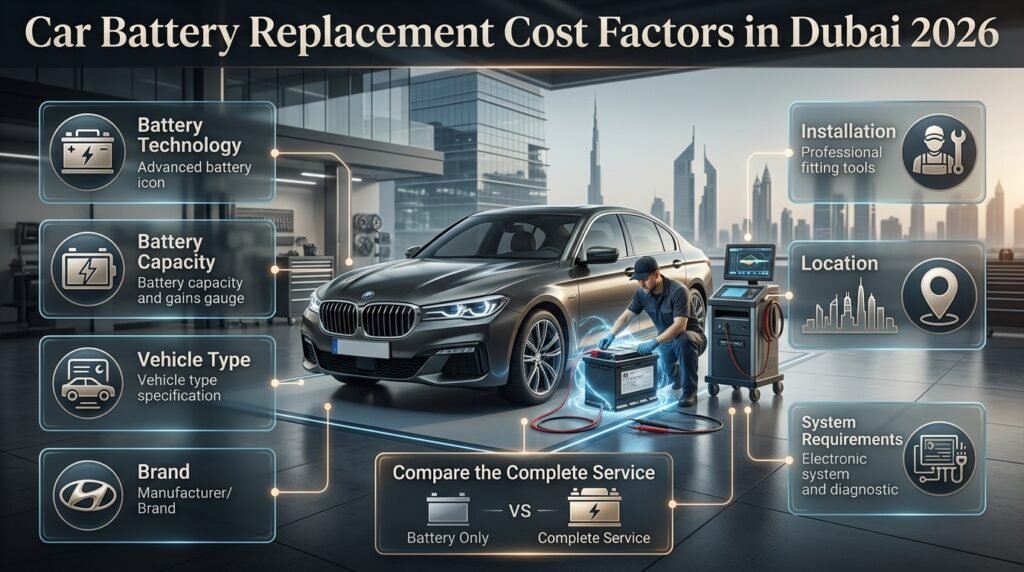
Battery replacement pricing varies according to vehicle and battery requirements.
Important cost factors can include:
| Cost factor | Why it affects price |
|---|---|
| Battery technology | Advanced technologies can cost more |
| Battery capacity | Higher-capacity batteries may cost more |
| Vehicle type | Some vehicles require specialized specifications |
| Brand | Prices differ between manufacturers |
| Installation | Professional fitting may add service value |
| Location | Mobile or roadside service can affect overall cost |
| System requirements | Some modern vehicles may require additional procedures |
Drivers comparing prices should therefore compare the complete service, not only the battery itself.
For a broader understanding of battery pricing, EuroSwift’s Car Battery Prices in Dubai 2026 guide can be used as a supporting resource.
Why Professional Installation Matters
Battery replacement is not always as simple as removing one battery and installing another.
Modern vehicles can have battery-management systems and electronic requirements that differ from older vehicles.
Depending on the vehicle, appropriate procedures may be required after replacement.
Professional installation can also provide an opportunity to inspect:
- Battery terminals
- Ground connections
- Battery tray
- Relevant cables
- Charging performance
- Battery specification
This makes replacement more than simply swapping a component.
Modern Battery Diagnosis and Vehicle Electronics
Today’s vehicles contain considerably more electronic equipment than older vehicles.
Features such as:
- Start-stop systems
- Advanced infotainment
- Driver assistance systems
- Connected services
- Security systems
- Electronic control modules
- Energy-management systems
can increase the importance of correct battery specification and electrical diagnosis.
As vehicle electronics become more sophisticated, battery diagnosis increasingly requires an understanding of how different systems interact.
A technician should therefore consider the vehicle as an integrated electrical system rather than treating the battery as an isolated component.
Future Trends in Vehicle Battery Management
Automotive electrical systems are continuing to evolve.
Modern vehicles are increasingly designed around sophisticated energy management, higher electrical loads, start-stop technology, and electrified powertrains.
This means battery monitoring and charging management are becoming more integrated with vehicle electronics.
For conventional petrol and diesel vehicles, correct battery selection and charging-system diagnosis remain important.
For hybrid and electric vehicles, battery architecture becomes significantly more complex and should be assessed according to the manufacturer’s systems and safety procedures.
The wider industry direction is clear: vehicle electrical diagnosis is becoming increasingly technology-driven.
Professional Troubleshooting Checklist
When investigating unexpected car battery discharge, a structured checklist can prevent important details from being missed.
Battery Checks
✔ Battery age
✔ Battery specification
✔ State of charge
✔ Starting performance
✔ Physical condition
✔ Terminal condition
Charging Checks
✔ Alternator performance
✔ Charging behavior
✔ Charging connections
✔ Relevant wiring
✔ Associated components
Electrical Checks
✔ Interior lighting
✔ Trunk lighting
✔ Glove-box lighting
✔ Accessories
✔ Aftermarket equipment
✔ Standby electrical consumption
Vehicle History
✔ Recent battery replacement
✔ Recent electrical work
✔ Recent accessory installation
✔ Long-term parking
✔ Frequent jumpstarts
✔ Short-trip driving pattern
This checklist gives technicians useful information before more advanced diagnosis begins.
Unexpected Car Battery Discharge: Quick Diagnostic Guide
| Situation | What to investigate first |
|---|---|
| Battery dies overnight | Electrical drain and battery condition |
| Battery dies after several days | Battery capacity and standby consumption |
| Battery dies after long storage | Battery condition and storage factors |
| Battery dies while driving | Charging-system performance |
| New battery dies repeatedly | Electrical drain or charging problem |
| Battery has slow cranking | Battery and starting-system condition |
| Problem started after accessory installation | Accessory wiring and standby consumption |
| Battery shows acceptable voltage but car struggles | Battery performance testing and starting system |
This guide can help drivers understand the diagnostic direction without assuming a specific fault.
Why does my car battery suddenly discharge overnight?
An overnight battery discharge usually means the vehicle either has a battery that can no longer retain enough usable charge or something is consuming more electrical power than it should while the car is parked. Modern vehicles naturally use a small amount of electricity for systems such as security, memory, clocks, and electronic modules, so the battery does not become completely electrically inactive when the engine is switched off. The concern is when the vehicle continues drawing excessive power after its systems should have entered their normal low-power state.
The first thing to consider is what changed before the battery started going flat. If the problem appeared after installing a dash camera, tracker, alarm, audio equipment, or another electrical accessory, that equipment deserves attention. Interior, trunk, or glove-box lights that fail to switch off can also create a hidden drain. A battery that is already weak can make the same problem appear even more quickly.
Important points to check:
Battery condition and remaining capacity
Interior, trunk, and glove-box lighting
Aftermarket electrical accessories
Charging-system performance
Vehicle modules that may not enter sleep mode
Battery terminals and electrical connections
If the battery repeatedly dies overnight, replacing it immediately is not always the best first decision. A proper Vehicle Inspection and electrical diagnosis can establish whether the battery is actually failing or whether another circuit is responsible.
How can I tell if my car has a parasitic battery drain?
A parasitic drain means an electrical circuit continues consuming an abnormal amount of battery power while the vehicle is switched off and parked. A small amount of standby consumption is normal because modern vehicles need to maintain certain electronic functions. The important issue is whether the electrical system settles into its expected sleep state and remains within the manufacturer’s specified limits.
The pattern of the problem can provide a useful clue. For example, if the car starts normally after a drive but repeatedly has a flat battery after sitting overnight or for a couple of days, an abnormal electrical draw becomes one possible area to investigate. A new battery developing exactly the same symptom is another strong reason to look beyond the battery itself.
Common sources include:
A control module that remains active
Aftermarket dash cameras or security equipment
Trunk or glove-box lights
Faulty switches or latches
Relays that do not switch off correctly
Electrical modifications or wiring problems
Certain charging-system faults
Professional diagnosis normally involves allowing the vehicle’s systems to shut down properly and then measuring electrical consumption. The exact acceptable draw varies by vehicle, so the manufacturer’s specification should take priority over a universal number.
The key point is that a flat battery tells you what happened; a drain test helps determine why it happened.
Can a bad alternator cause unexpected car battery discharge?
A charging-system problem can absolutely lead to repeated battery discharge. The battery supplies electrical energy for starting and supports the vehicle’s electrical systems, while the alternator and charging system replenish energy while the engine is operating. If charging performance is inadequate, the battery can gradually remain undercharged even though the vehicle continues to start for a while.
There is also another possibility involving the alternator itself. Certain internal faults, such as a leaking diode, can allow unwanted current flow when the vehicle is parked. That can create a battery-drain symptom even though the alternator’s primary problem is not simply “low charging.”
This is why battery and alternator testing should be considered together when discharge happens repeatedly.
A professional charging-system check may consider:
Alternator performance
Battery charging behavior
Electrical connections
Charging-system wiring
Battery condition
Warning-light history
Whether the battery is being adequately replenished
If the alternator is not charging correctly, installing another battery alone will not resolve the underlying problem. The charging fault needs to be addressed so the replacement battery can operate under the conditions it was designed for.
Why does my new car battery keep dying?
When a new car battery keeps dying, the battery should not automatically be blamed. A replacement battery can be perfectly serviceable while another problem in the vehicle continues to discharge it. Repeated failure of a new battery is therefore an important diagnostic clue rather than simply a reason to purchase another replacement.
There are several possibilities. The charging system may not be replenishing the battery properly. Alternatively, an electrical circuit may continue drawing power while the vehicle is parked. Incorrect battery specification, poor connections, or an accessory installed after the original battery was replaced can also deserve investigation.
A useful professional approach is to work through the problem in stages rather than replacing components based on assumption.
The inspection should consider:
Whether the new battery passes appropriate testing
Whether the alternator is charging correctly
Whether excessive standby electrical consumption exists
Whether battery terminals are secure
Whether aftermarket equipment is involved
Whether the correct battery specification was installed
Whether the previous battery had the same symptoms
If two batteries have experienced the same discharge pattern, it becomes particularly important to investigate the vehicle rather than simply replacing the second battery. This is where professional Battery Replacement combined with electrical diagnosis can provide a more reliable solution.
What should I do if my car battery keeps discharging unexpectedly?
If the battery has discharged once, first consider whether something simple was left operating, such as a light or accessory. However, repeated unexpected discharge should be treated as a diagnostic problem, particularly when the vehicle becomes difficult to start after normal parking.
A jumpstart may restore temporary starting ability, but it does not establish why the battery discharged. If the underlying issue is parasitic drain, inadequate charging, a weak battery, or an electrical fault, the same problem can return after the next parking period.
A professional inspection should normally separate the problem into three main areas: battery condition, charging performance, and parked electrical consumption. Connections and recently installed accessories should also be considered because they can influence the electrical system.
For a recurring problem, consider checking:
Battery health and starting performance
Alternator and charging-system operation
Battery terminals and ground connections
Excessive parked electrical consumption
Interior and trunk lighting
Aftermarket accessories
Recent electrical modifications
Vehicle history and previous jumpstarts
For Dubai drivers, getting the issue checked early is especially sensible when the vehicle is regularly exposed to demanding heat and heavy daily use. The objective should not simply be to get the car started again—it should be to find the reason the battery discharged and prevent the same failure from happening again.
Conclusion
An unexpected car battery discharge is rarely something that should be solved by simply installing another battery without finding the reason behind the failure. A weak or aging battery can certainly be responsible, but parasitic electrical drain, charging-system problems, poor connections, aftermarket accessories, and frequent short journeys can also leave a vehicle unable to start.
For Dubai drivers, paying attention to battery performance is particularly important because demanding temperatures, heavy traffic, extensive air-conditioning use, and daily driving conditions can place additional stress on an already weakened electrical system. Early inspection can often identify a developing problem before it turns into an inconvenient roadside breakdown.
If your battery repeatedly loses charge, the most reliable approach is to evaluate the complete system rather than focusing on one component. Battery condition, charging performance, electrical consumption, terminals, wiring, and installed accessories should all be considered when the same problem keeps returning.
Professional Battery Replacement is appropriate when testing confirms that the battery has reached the end of its useful service life. When the battery itself is healthy, however, services such as Vehicle Inspection, Engine Diagnostics, Car Service, Car Jumpstart, Roadside Assistance, and Electrical Repair may be more relevant to identifying the actual cause.
The objective is not simply to get the vehicle started today. It is to find the reason for the discharge, correct the underlying fault, and restore dependable starting performance for the journeys ahead.

Leave a Reply