
Introduction
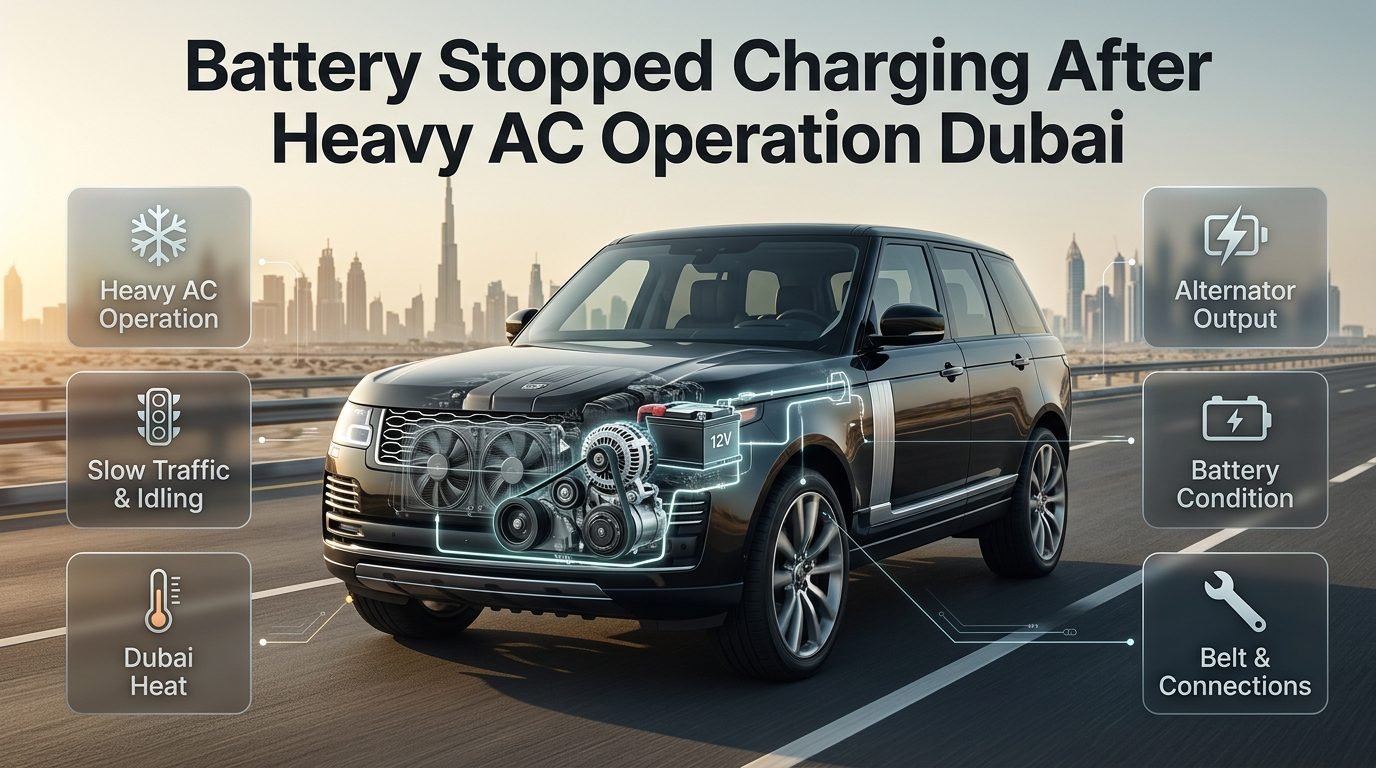
Battery Stopped Charging After Heavy AC Operation Dubai | When a car battery appears to stop charging after heavy AC operation in Dubai, it is easy to assume that the air conditioner has caused the battery problem. In many cases, however, the AC is only exposing an existing weakness in the vehicle’s electrical or charging system.
Dubai driving conditions can place considerable demand on a vehicle. Long periods of AC operation, slow-moving traffic, frequent idling, high temperatures, cooling fans and multiple electrical accessories can all increase the workload on the charging system. A healthy alternator and properly maintained battery should normally handle these conditions, but a weak component may struggle when demand increases.
EuroSwift Auto Services provides professional automotive support for drivers dealing with battery, charging and vehicle electrical problems.
The important point is to determine why the battery is not maintaining its charge rather than immediately replacing it. The cause could be the battery itself, alternator output, a slipping belt, poor electrical connections, excessive electrical load or another charging-system fault.
Can Heavy AC Operation Stop a Car Battery From Charging?
Heavy AC operation can contribute to battery discharge, but normal AC use should not make a healthy vehicle stop charging its battery.
When the AC is running, several systems may consume additional electrical power. The blower motor, cooling fans, climate-control electronics and other components may operate simultaneously. The AC compressor also creates additional mechanical load on the engine.
The alternator has to supply electrical power while the engine is running and replenish energy used from the battery. If the alternator is healthy and the charging system is functioning correctly, it should generally manage normal vehicle demand.
The problem becomes noticeable when the charging system is already weak.
Possible causes include:
- Weak or aging alternator
- Worn alternator components
- Slipping serpentine belt
- Poor battery terminal connection
- Corroded cables
- Weak battery
- Excessive electrical demand
- Faulty charging-system wiring
- Electrical control-system problems
Therefore, if your battery repeatedly stops maintaining charge after extended AC operation, the correct approach is charging-system diagnosis, not simply blaming the AC.
Why Dubai Conditions Can Expose Charging Problems
Dubai’s climate creates demanding operating conditions for automotive electrical components.
During very hot weather, the AC may remain active for most of the journey. Traffic congestion can also keep the engine at low RPM for extended periods while the blower, cooling fans and other electrical equipment continue operating.
The battery itself is also exposed to high temperatures under the hood. Heat can accelerate battery deterioration, meaning an older battery may have significantly less reserve capacity than it had when new.
This creates a situation where a driver may notice the problem after a long AC session even though the actual weakness developed gradually.
Heavy AC Use Can Reveal an Existing Fault
Consider this sequence:
- The battery is already aging.
- The alternator has slightly reduced output.
- The vehicle spends a long time in traffic.
- AC and cooling systems operate continuously.
- Electrical demand increases.
- The charging system struggles to maintain the required balance.
- The battery loses charge.
- The driver discovers the problem when attempting to restart the vehicle.
In this situation, AC operation did not necessarily “kill” the battery. It revealed a charging or battery weakness that was already present.
How the Alternator Charges the Battery
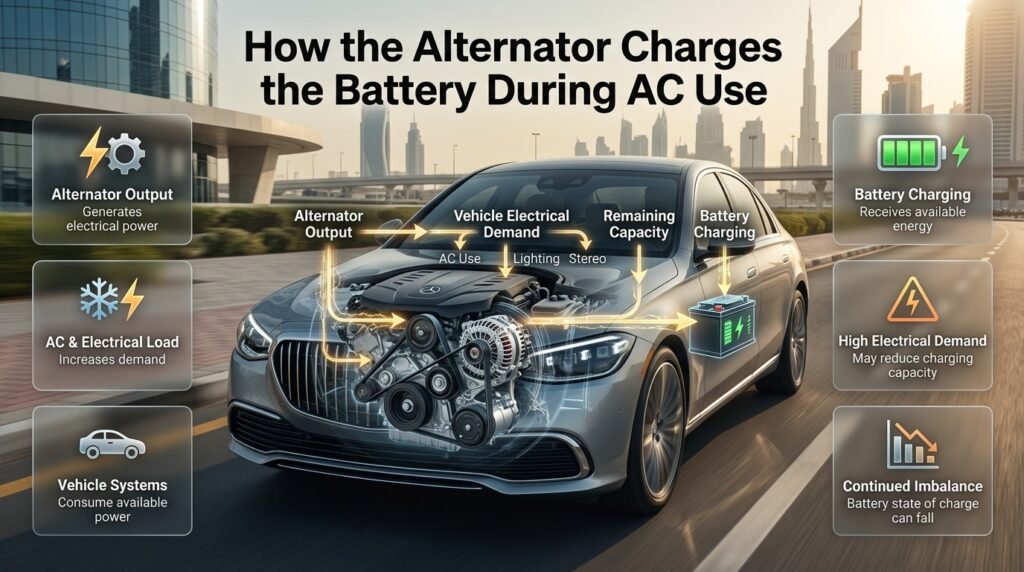
The alternator is responsible for generating electrical power while the engine is running.
Its output supports the vehicle’s electrical systems and replenishes energy consumed by the battery. The exact charging strategy varies between vehicles, particularly in newer models with intelligent energy-management systems.
When electrical demand rises, the charging system needs to respond appropriately.
A simplified relationship is:
Alternator output → vehicle electrical demand → remaining capacity available for battery charging
If vehicle demand becomes too high compared with available charging output, the battery may temporarily supply some of the required electrical energy.
If this situation continues, the battery’s state of charge can gradually fall.
This is why a battery that becomes weak after long AC operation deserves a complete charging-system inspection.
Signs Your Alternator May Be Struggling
A charging-system problem can produce several warning signs before the vehicle completely fails.
Watch for:
- Battery warning light on the dashboard
- Headlights becoming dim
- Interior lights fluctuating
- Slow engine cranking
- Electrical accessories behaving unusually
- Battery repeatedly becoming discharged
- Vehicle struggling to restart
- Unusual belt noise
- Electrical symptoms becoming more noticeable when AC is switched on
One particularly useful clue is when electrical symptoms become stronger when several accessories are operating simultaneously.
Professional Recommendation
Do not judge alternator health from one symptom alone. A professional technician should test the charging system under appropriate operating conditions and compare its behavior with the vehicle’s specifications.
This is especially important when a relatively new battery repeatedly becomes discharged.
Battery Problem or Alternator Problem?
A discharged battery and a charging-system fault can look very similar.
| Symptom | Possible Cause |
|---|---|
| Old battery repeatedly loses charge | Battery deterioration |
| New battery becomes discharged again | Charging or electrical problem |
| Battery warning light while driving | Possible charging fault |
| Dim lights at idle | Charging output or electrical issue |
| Belt squealing | Belt or pulley problem |
| Corroded terminals | Poor electrical connection |
| Vehicle starts with jumpstart but later loses power | Possible charging-system failure |
These symptoms are useful clues, but they do not replace professional testing.
For example, a battery may be completely discharged because the alternator is not charging it. Replacing that battery without repairing the alternator can simply create the same problem again.
What Happens When You Run AC While Idling?
Extended idling is particularly relevant to Dubai driving.
At idle, the engine is operating at relatively low speed. Depending on the vehicle and alternator design, charging output can differ from what is available at higher engine speeds.
At the same time, the vehicle may be operating:
- AC compressor
- Cabin blower
- Cooling fans
- Headlights
- Infotainment system
- Navigation
- Phone chargers
- Electronic control modules
If the electrical demand becomes greater than available alternator output, the battery may help supply the difference.
A healthy charging system should be designed to manage normal operating loads, but an aging or faulty system may struggle.
This is one reason why a vehicle can appear completely normal during highway driving but show electrical symptoms during prolonged traffic and AC use.
Could the AC Compressor Cause the Problem?
The AC compressor places mechanical load on the engine when it operates, but normal compressor operation should not cause a healthy charging system to stop charging the battery.
However, a mechanical problem involving the compressor, pulley or belt system can increase load on the engine’s accessory drive.
A technician may therefore inspect the relationship between:
- AC compressor operation
- Serpentine belt condition
- Belt tension
- Alternator rotation
- Pulley operation
- Charging output
The objective is not to assume that the compressor is defective. The objective is to determine whether AC operation is creating an abnormal load or simply revealing an existing charging weakness.
The Importance of the Serpentine Belt
The alternator relies on the vehicle’s belt-drive system.
If the belt is worn, loose, damaged or slipping, the alternator may not rotate properly. In some cases, the problem becomes more obvious when accessory loads increase.
A technician should inspect:
- Belt surface
- Belt tension
- Belt alignment
- Tensioner
- Pulleys
- Alternator drive
- Signs of slipping or wear
A belt problem should not be ignored simply because the vehicle still starts.
If the alternator is not being driven correctly, the battery may gradually lose charge.
Professional Battery and Charging-System Diagnosis
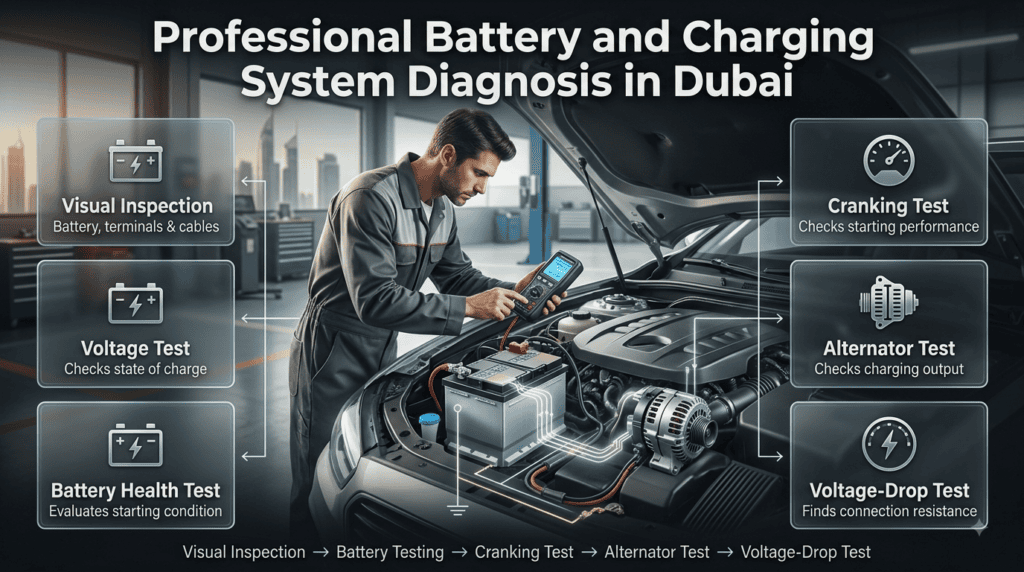
When a customer reports that the battery stopped charging after heavy AC operation, diagnosis should be systematic.
Visual Battery Inspection
The technician first examines the battery, terminals and cables.
Important checks include:
- Battery case condition
- Terminal corrosion
- Cable tightness
- Battery mounting
- Signs of leakage or physical damage
Poor connections can create resistance in the charging circuit and may produce symptoms that look like a battery or alternator failure.
Battery Voltage Test
Resting voltage can provide useful information about the battery’s state of charge.
However, voltage alone cannot determine overall battery health.
A battery can show reasonable voltage while still having reduced starting capability.
Battery Health Test
A dedicated battery tester provides more useful information about the battery’s starting performance and condition.
This helps distinguish between:
Battery deterioration and battery discharge caused by another problem.
Cranking Test
The battery can also be evaluated while starting the engine.
Weak cranking performance may point toward battery deterioration, poor connections or another starting-system problem.
Alternator Charging Test
The alternator should be tested while the engine is running.
The technician can assess charging behavior under different electrical loads, including conditions involving the AC and other accessories.
Voltage-Drop Testing
Voltage-drop testing can identify excessive resistance in cables, terminals and grounding connections.
This is important because an alternator can potentially produce appropriate output while poor wiring prevents that power from reaching the battery correctly.
Charging-System Tests and Their Purpose
| Test | What It Helps Determine |
|---|---|
| Resting voltage | Battery state of charge |
| Battery health test | Battery starting capability |
| Cranking test | Battery performance during starting |
| Alternator test | Charging-system output |
| Load testing | System behavior under electrical demand |
| Voltage-drop test | Cable and connection resistance |
| Belt inspection | Mechanical alternator drive condition |
| Electrical scan | Electronic system faults |
A combination of tests provides a much clearer picture than relying on one measurement.
Why Replacing the Battery Alone May Not Solve the Problem
This is one of the most common mistakes when dealing with repeated battery discharge.
Imagine that the alternator is producing insufficient charging output. The battery becomes discharged after repeated AC-heavy driving.
A new battery is installed.
The vehicle starts perfectly.
For some time, everything appears normal.
But the original charging fault remains.
Eventually, the replacement battery also becomes discharged.
The driver may then assume that the new battery was defective, when the actual problem was the charging system.
This is why Car Battery Replacement should be based on battery testing and supported by appropriate charging-system checks when repeated discharge is involved.
When Battery Replacement Is Actually Necessary
Battery replacement is appropriate when testing confirms that the battery has deteriorated beyond reliable service.
Possible indicators include:
- Reduced starting capability
- Significant internal deterioration
- Failure during battery testing
- Repeated deep discharge
- Physical battery damage
- Inability to retain sufficient charge
The replacement battery must also match the vehicle’s requirements.
Technicians may need to verify:
- Battery technology
- Capacity
- Physical dimensions
- Terminal position
- Starting capability
- Vehicle electrical requirements
For some vehicles, an AGM or EFB battery may be required rather than a conventional battery.
Choosing the Right Battery for Your Vehicle
Battery selection should be based on vehicle compatibility, not simply brand popularity or the lowest price.
Depending on the vehicle, drivers may encounter established battery options such as Amaron Battery, Bosch Battery, and Tuflong Battery.
Vehicles with higher electrical requirements may use AGM Battery, while other applications may be compatible with Exide Battery, Panasonic Battery, FIAMM Battery or AC Delco Battery.
The important consideration is whether the selected battery is correct for the vehicle’s specifications and electrical system.
How Dubai Heat Can Accelerate Battery Problems
High temperatures can affect battery performance and service life.
A battery already approaching the end of its useful life may become less reliable when exposed to prolonged heat.
The combination of heat and electrical demand can make the weakness easier to notice.
For example:
High temperature + aging battery + heavy AC use + traffic = greater electrical stress
This does not mean every battery will fail under these conditions. It means battery condition becomes more important in demanding environments.
Regular battery testing can identify deterioration before the vehicle becomes completely dependent on a jumpstart.
Common Mistakes Dubai Drivers Should Avoid
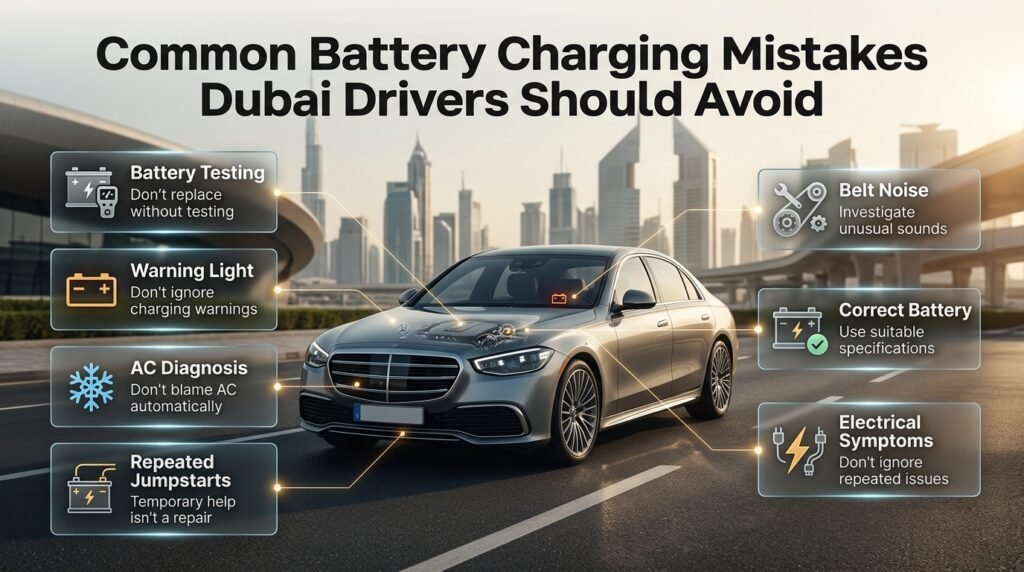
Replacing the Battery Without Testing
A discharged battery is not automatically a failed battery.
Ignoring the Battery Warning Light
A warning light can indicate a charging-system problem rather than a simple battery issue.
Assuming AC Is the Root Cause
AC operation may reveal an existing electrical weakness rather than directly causing the failure.
Repeatedly Using Jumpstarts
A jumpstart may restore temporary starting ability but does not repair the underlying charging problem.
Ignoring Belt Noise
Squealing or unusual belt sounds can be an important clue.
Installing an Incorrect Battery
A battery with unsuitable specifications may create compatibility and reliability problems.
Continuing to Drive With Electrical Symptoms
Repeated dimming, flickering or starting problems should be investigated before a complete breakdown occurs.
Preventive Battery Maintenance for Dubai Drivers
A preventive approach can reduce the risk of unexpected battery failure.
During routine [Vehicle Inspection], technicians can examine battery condition, charging performance, electrical connections and belt condition.
Drivers should pay attention to:
- Slow engine cranking
- Battery warning lights
- Repeated jumpstarts
- Electrical fluctuations
- Corroded terminals
- Belt noises
- Battery age
- Difficulty restarting after long AC use
If several symptoms appear together, professional inspection is more appropriate than waiting for complete battery failure.
When Roadside Assistance Is Appropriate
If the vehicle refuses to restart after extended AC operation, forcing it to continue operating may not be practical.
This can be especially inconvenient when the vehicle is:
- Stuck in traffic
- Parked outdoors
- Unable to restart
- Showing multiple electrical warnings
- Experiencing unusual belt noises
- Losing electrical power
A professional Car Jumpstart can provide temporary starting assistance where appropriate, but a jumpstart should not be considered the final repair when the cause of discharge is unknown.
For vehicles that cannot safely be driven, Roadside Assistance can provide a practical route toward professional diagnosis.
Repair or Replace: What Does the Vehicle Actually Need?
The correct solution depends on diagnostic findings.
| Confirmed Problem | Likely Solution |
|---|---|
| Battery failed testing | Battery replacement |
| Alternator undercharging | Charging-system repair |
| Belt slipping | Belt or drive-system repair |
| Corroded connection | Connection cleaning/repair |
| Excessive electrical drain | Electrical diagnosis |
| Multiple charging faults | Comprehensive repair |
| Battery healthy but discharged | Find the cause of discharge |
This approach avoids unnecessary parts replacement.
The purpose of diagnosis is to identify the component responsible for the problem rather than replacing several parts through trial and error.
Understanding Battery Cost Before Replacement
Battery pricing varies according to battery technology, capacity, brand, vehicle requirements and installation considerations.
A premium battery is not automatically the best option for every vehicle. Conversely, the cheapest battery may not provide the required specifications.
Drivers comparing options can use a detailed Car Battery Price Guide to understand the factors that influence battery pricing in Dubai.
The important point is to compare correct specifications and expected suitability, not price alone.
How EuroSwift Auto Services Can Help Diagnose the Problem
When a battery stops maintaining charge after heavy AC operation, the correct solution starts with diagnosis.
EuroSwift Auto Services can be considered when the vehicle requires battery assessment, charging-system inspection or related automotive diagnosis.
Depending on the findings, the vehicle may require battery testing, alternator inspection, electrical diagnosis or appropriate [Mechanical Repair]. If other symptoms are present, services such as [Engine Diagnostics], [Vehicle Inspection] or [Emergency Car Repair] may also become relevant.
The key principle is simple: identify the actual fault before replacing components.
Practical Troubleshooting Guide
| What You Notice | What You Should Do |
|---|---|
| Battery becomes weak after long AC use | Test battery and charging system |
| Battery repeatedly goes flat | Inspect alternator and electrical system |
| Battery warning light appears | Arrange charging-system diagnosis |
| Lights dim when electrical load increases | Test charging output under load |
| Belt makes unusual noise | Inspect belt and pulleys |
| New battery becomes discharged | Check alternator immediately |
| Vehicle will not restart | Use professional roadside assistance |
| Battery passes testing but keeps discharging | Investigate electrical drain |
These symptoms should be treated as diagnostic clues rather than automatic diagnoses.
Modern Vehicle Charging Technology
Today’s vehicles increasingly use intelligent electrical management systems.
Start-stop technology, battery monitoring sensors, energy-management systems and advanced battery technologies have changed how vehicles manage electrical power.
Some modern vehicles do not operate their charging systems exactly like older vehicles. Charging behavior can change according to vehicle operating conditions, battery status and electrical demand.
This means professional diagnosis increasingly requires appropriate testing equipment and vehicle-specific procedures.
Simply measuring voltage once may not provide enough information.
Latest Automotive Development
Battery monitoring sensors can help modern vehicles monitor electrical energy usage and battery condition. Vehicles equipped with these systems may require correct battery specifications and appropriate installation procedures.
This makes correct battery selection increasingly important.
Future of Automotive Battery and Charging Systems
Vehicle electrical systems will continue becoming more sophisticated.
Even conventional petrol and diesel vehicles now depend on numerous electronic systems, while hybrid and electric vehicles introduce significantly more advanced energy-management technologies.
Future maintenance will increasingly involve:
- Battery health monitoring
- Intelligent charging
- Advanced diagnostic equipment
- Electronic energy management
- Improved battery technologies
- Vehicle-specific system testing
- Preventive electrical diagnostics
For Dubai drivers, this means electrical maintenance will remain an increasingly important part of modern vehicle servicing.
Can heavy AC operation cause a car battery to stop charging in Dubai?
Heavy AC operation can increase the electrical and mechanical load on a vehicle, particularly when the car is sitting in traffic or idling for long periods. However, normal AC operation should not by itself make a properly functioning charging system stop charging the battery. When the problem appears specifically after prolonged AC use, it is often worth checking whether the alternator, battery, belt system or electrical connections are already becoming weak.
In Dubai, extended AC use combined with high temperatures can make an existing weakness much easier to notice. A battery that was already losing capacity may cope with normal driving but struggle after prolonged electrical demand.
Important points to check:
Battery health and ability to hold charge
Alternator charging performance
Battery terminals and cable connections
Serpentine belt condition
Electrical load and charging behavior at idle
Any battery or charging warning light
The key is not to blame the AC immediately. Heavy AC use may reveal the problem rather than being the actual root cause. A professional charging-system inspection can separate an AC-related load issue from an underlying battery or alternator fault.
How do I know if the alternator is not charging the battery properly?
One of the strongest clues is that the battery keeps becoming discharged even after the vehicle has been driven or the battery has recently been replaced. Other warning signs can include dim or flickering lights, electrical accessories behaving unusually, a battery warning light, slow restarting and repeated jump-start requirements. These symptoms can occur because the alternator is not providing enough electrical power to operate the vehicle and replenish the battery.
A particularly important distinction is between a battery that cannot hold charge and a battery that is not receiving sufficient charge. They can feel almost identical to the driver.
Watch for these warning signs:
Battery warning light while the engine is running
Headlights becoming dimmer
Electrical accessories becoming inconsistent
Battery repeatedly going flat
Vehicle starting after a jump but developing the same problem again
Unusual belt or alternator-related noise
If several of these symptoms appear together, replacing the battery without testing the charging system can leave the actual problem unresolved. A professional inspection should evaluate the battery and alternator together rather than treating them as completely separate components.
Should I replace the battery if it stops charging after using the AC?
Battery replacement should depend on the battery’s actual condition, not simply on the fact that it became discharged. A battery can become flat because the alternator is not replenishing it correctly, because of poor electrical connections, or because another electrical problem is consuming power. A battery can also genuinely be worn out and unable to retain sufficient charge.
This is why professional testing matters before buying another battery.
A proper inspection should consider:
Battery age and condition
Starting performance
Battery health test results
Charging-system output
Terminal and cable condition
Alternator performance
Belt and pulley condition
If the battery has failed testing, Battery Replacement may be the correct solution. If the battery is healthy but the alternator is undercharging, repairing the charging system is more important.
Replacing a good battery will not repair a faulty alternator. In fact, the replacement battery can eventually become discharged for exactly the same reason.
Why does my car battery become weak after long AC use and Dubai traffic?
Long periods of AC operation can coincide with several demanding conditions at once. The vehicle may be stationary or moving slowly, while the cabin blower, cooling fans, electronic systems and other accessories continue operating. At low engine speed, the charging system may have less available output than it does during higher-speed driving, depending on the vehicle’s design.
Dubai’s heat can add another factor because extreme temperatures can accelerate battery deterioration. An aging battery therefore has less reserve when the vehicle experiences prolonged electrical demand.
The combination may look like this:
High outside temperature
Extended AC operation
Slow-moving traffic
Long periods of idling
Aging battery
Increased electrical demand
If the vehicle’s charging system is healthy, normal operation should generally be manageable. If the battery repeatedly becomes weak under these conditions, it is a good indication that the battery and charging system deserve professional testing rather than simply assuming that Dubai’s heat or the AC is solely responsible.
What should I check when my battery stops charging after heavy AC operation?
The best approach is to inspect the complete charging system rather than replacing individual components based only on symptoms. Battery and alternator problems can produce very similar signs, so a systematic inspection helps identify the actual cause.
A professional inspection should generally include:
Battery condition: Check whether the battery can still provide adequate starting performance and retain charge.
Charging system: Test whether the alternator is producing appropriate output for the vehicle.
Battery terminals: Look for corrosion, looseness or poor electrical contact.
Cables and grounds: Check for excessive resistance or damaged connections.
Serpentine belt: Inspect for wear, looseness or slipping that could affect alternator operation.
Electrical load: Evaluate charging behavior when the vehicle’s electrical systems are operating.
Dashboard warnings: Take battery or charging-system warning lights seriously.
If the battery warning light appears while driving, the issue should not be ignored because it can indicate a charging-system fault rather than simply a weak battery.
The professional goal is simple: find out whether the battery is failing, the alternator is undercharging, or another component is causing the battery to lose charge. That approach prevents unnecessary battery replacement and gives the vehicle a much better chance of remaining reliable in Dubai’s demanding driving conditions.
Conclusion
A battery that stops charging after heavy AC operation in Dubai should not automatically be blamed on the air-conditioning system or treated as a simple battery failure. Extended AC use, traffic, idling and high temperatures can place greater demand on the vehicle’s electrical system and may expose an existing weakness in the battery, alternator, belt or electrical connections.
The most reliable solution is to diagnose the complete charging system before replacing any component. Battery health, alternator performance, charging output, terminals, cables and belt condition should all be considered when the problem keeps returning.
For Dubai drivers, preventive Battery Replacement, Vehicle Inspection, Car Service and electrical-system testing can help identify problems before the vehicle becomes stranded. If the battery repeatedly loses charge after AC operation, professional diagnosis is a better long-term solution than relying on repeated jumpstarts or replacing batteries without finding the actual cause.
Leave a Reply