
Introduction
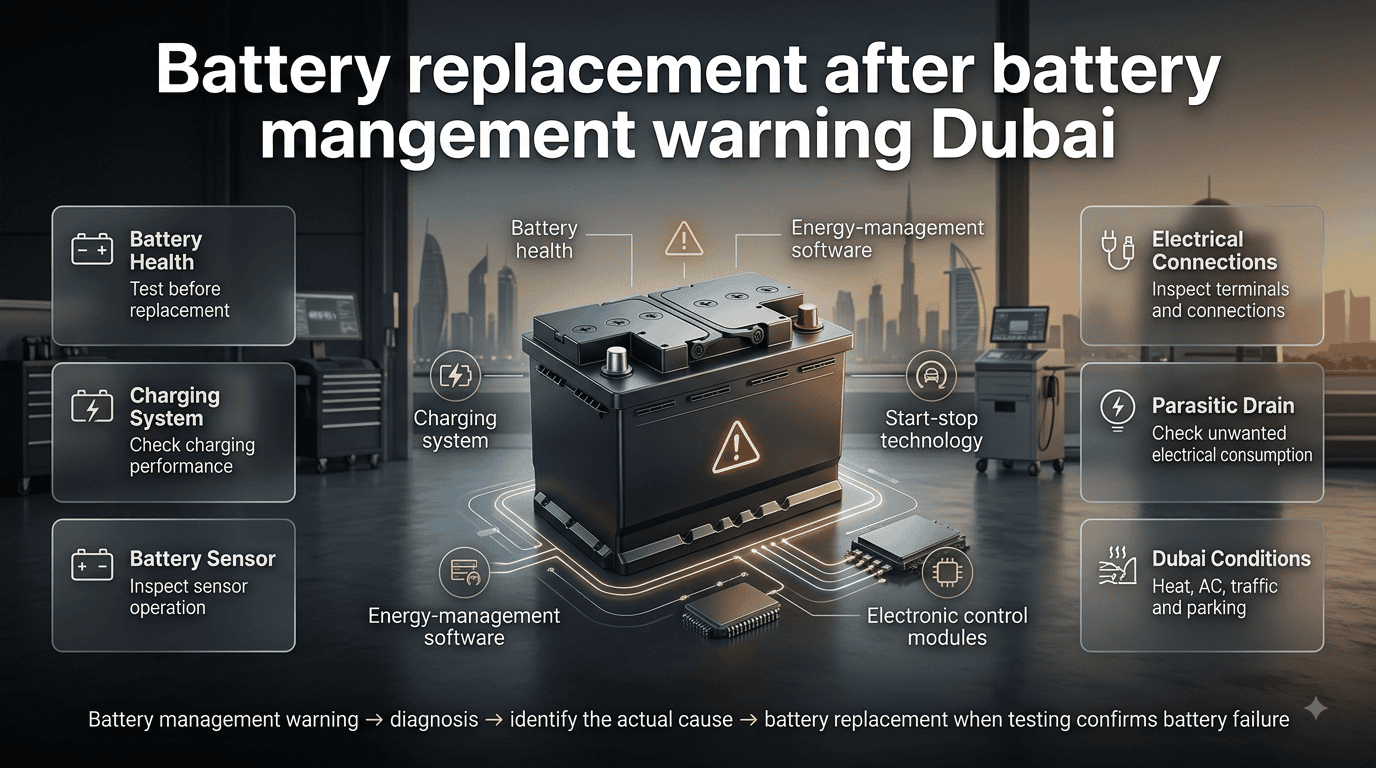
Battery replacement after battery management warning Dubai | A battery management warning can be more than a simple indication that your car battery is getting weak. In modern vehicles, the battery is closely connected with the charging system, battery sensor, energy-management software, start-stop technology, and several electronic control modules. When the vehicle detects abnormal battery performance, low charge, or an electrical-system irregularity, it may display a battery management warning.
For Dubai drivers, this warning deserves particular attention. High temperatures, long periods of air-conditioning use, heavy traffic, short daily journeys, and extended parking can all place additional demands on a vehicle’s electrical system. A warning that appears once may have a different cause from one that keeps returning after every few days.
Most importantly, battery replacement should not automatically be the first response to a battery management warning. The battery, charging system, battery sensor, electrical connections, and possible parasitic drain should be evaluated before deciding what needs to be replaced.
When testing confirms that the battery has reached the end of its useful service life, professional Battery Replacement in Dubai can restore reliable starting performance while also providing an opportunity to check the vehicle’s wider electrical system.
1. What Is a Battery Management Warning?
A battery management warning is a message or dashboard indication generated when the vehicle detects an abnormal condition involving its battery or electrical energy-management system.
The exact warning varies between manufacturers. Some vehicles may display a battery symbol, while others may use messages referring to battery charge, battery monitoring, electrical system service, or energy management.
The warning can be associated with several different conditions, including:
- Low battery state of charge
- Reduced battery capacity
- Battery deterioration
- Charging-system problems
- Alternator issues
- Battery sensor faults
- Excessive electrical consumption
- Poor battery-terminal connections
- Incorrect battery specification
- Battery-management configuration problems
This means the warning should be viewed as a diagnostic signal rather than an automatic replacement instruction.
A battery can be temporarily discharged and still be healthy. Likewise, a battery can show acceptable voltage while having lost significant starting capacity.
That distinction is particularly important when deciding between recharging, further diagnosis, and complete battery replacement.
2. Why Modern Vehicles Monitor the Battery So Closely
Older vehicles generally had simpler electrical systems. Modern cars depend on a much larger network of electronic components.
A typical modern vehicle can contain numerous modules responsible for:
- Engine management
- Safety systems
- Lighting
- Climate control
- Infotainment
- Driver assistance
- Central locking
- Security
- Communication
- Start-stop operation
All of these systems depend on stable electrical power.
Modern vehicles therefore use battery monitoring and energy-management systems to understand how much electrical energy is available and how that energy should be distributed.
The system may monitor battery voltage, current, temperature, charging behavior, and other operating conditions.
When the vehicle detects that available electrical energy is becoming insufficient, it may temporarily deactivate certain non-essential functions or display a warning to the driver.
This is one reason why a battery management warning should not simply be cleared and forgotten.
3. Does a Battery Management Warning Always Mean the Battery Needs Replacement?
No. This is one of the most important points for vehicle owners.
A warning may appear because the battery is temporarily undercharged rather than permanently damaged.
For example, consider a vehicle that has been parked for several days. During that period, security systems, control modules, and other electronics may continue using small amounts of electrical energy. If the battery was already partially discharged, its state of charge may fall low enough to trigger a warning.
After proper charging, the battery may still pass a professional test.
On the other hand, an older battery may repeatedly become weak because its internal capacity has deteriorated. In that situation, charging can provide temporary improvement but cannot restore the battery’s original condition.
A professional diagnosis should therefore establish which situation applies.
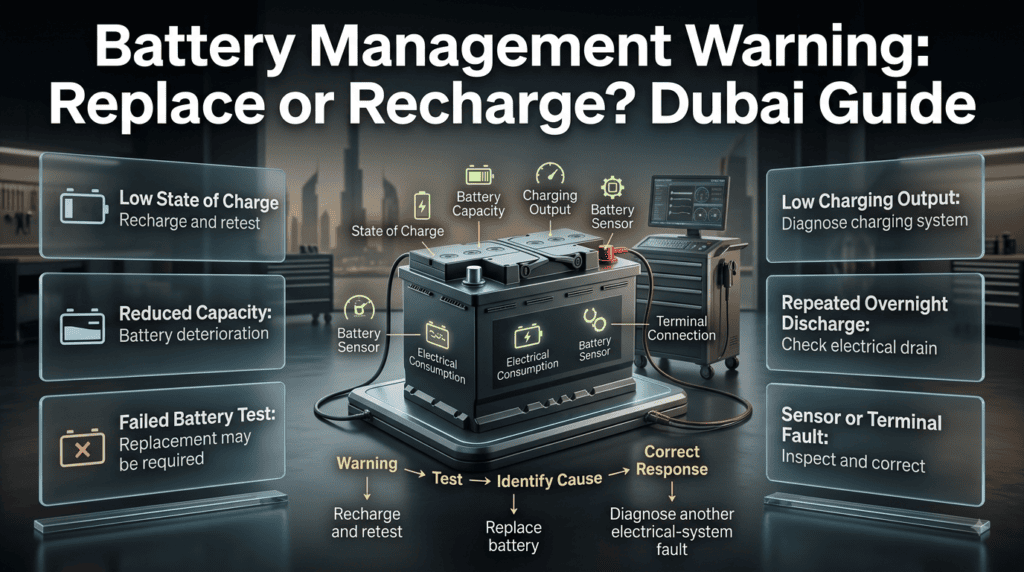
| Condition | What it may indicate | Appropriate response |
|---|---|---|
| Low state of charge | Battery may still be usable | Recharge and retest |
| Reduced capacity | Battery deterioration | Replacement may be required |
| Failed battery test | Insufficient performance | Replace battery |
| Low charging output | Charging-system fault | Diagnose charging system |
| Repeated overnight discharge | Possible electrical drain | Check parasitic consumption |
| Battery sensor fault | Incorrect monitoring | Diagnose sensor/system |
| Poor terminal connection | Electrical resistance | Inspect and correct connection |
4. Common Causes of Battery Management Warnings in Dubai
Dubai’s operating environment can make electrical-system problems more noticeable.
Extreme Heat
High temperatures can accelerate battery aging and place additional stress on battery components.
A vehicle parked outside for extended periods can experience substantial heat exposure. Under-bonnet temperatures can become even higher during operation.
Over time, repeated thermal stress can contribute to battery deterioration.
Short Daily Journeys
Short trips are common in urban driving.
A vehicle may use significant electrical energy during engine starting and initial operation, while the journey itself may be too short to fully restore the energy consumed.
If this pattern continues for weeks or months, the battery can gradually remain at a lower state of charge.
Heavy Traffic
Stop-and-go traffic changes how the charging system operates compared with longer uninterrupted journeys.
When combined with high electrical demand from climate control, lighting, infotainment, and other equipment, the overall electrical load can become significant.
Long Parking Periods
A vehicle that sits unused for several days may gradually lose battery charge.
This becomes more important when the battery is already aging or the vehicle has additional electrical accessories.
Battery Age
Battery deterioration is a natural part of vehicle ownership.
As a battery ages, its ability to store energy and deliver starting current can decline. A battery may continue functioning for some time before its reduced capacity becomes obvious.
5. Signs That the Battery May Actually Need Replacement
The battery should receive closer attention when the warning is accompanied by noticeable changes in vehicle behavior.
Slow Engine Cranking
A starter motor that turns more slowly than normal can indicate reduced battery starting capability.
Repeated Starting Problems
If the car starts normally after a long drive but struggles after being parked overnight, battery condition should be investigated.
Frequent Battery Warnings
One isolated warning can have several explanations. Repeated warnings are more significant and justify a proper diagnostic inspection.
Start-Stop System Not Operating
Some modern vehicles disable start-stop functionality when battery conditions are unsuitable.
This does not automatically prove battery failure, but persistent unavailability can be an important clue.
Multiple Electrical Warnings
Low voltage can sometimes cause several electronic systems to report faults simultaneously.
In such cases, replacing the battery without scanning and testing the vehicle can result in an incomplete diagnosis.
6. Battery Test Before Replacement
A professional battery test is one of the most useful steps before purchasing a replacement.
The technician should consider more than simple battery voltage.
A complete assessment may include:
- Open-circuit voltage
- State of charge
- Starting performance
- Battery capacity
- Battery age
- Physical condition
- Terminal condition
- Charging performance
The result should then be considered alongside the vehicle’s symptoms.
For example, a battery showing acceptable voltage immediately after charging may still fail a performance test because it cannot maintain sufficient capacity under load.
This is why relying only on a dashboard warning or a basic voltage reading can produce the wrong conclusion.
7. Charging-System Inspection Is Equally Important
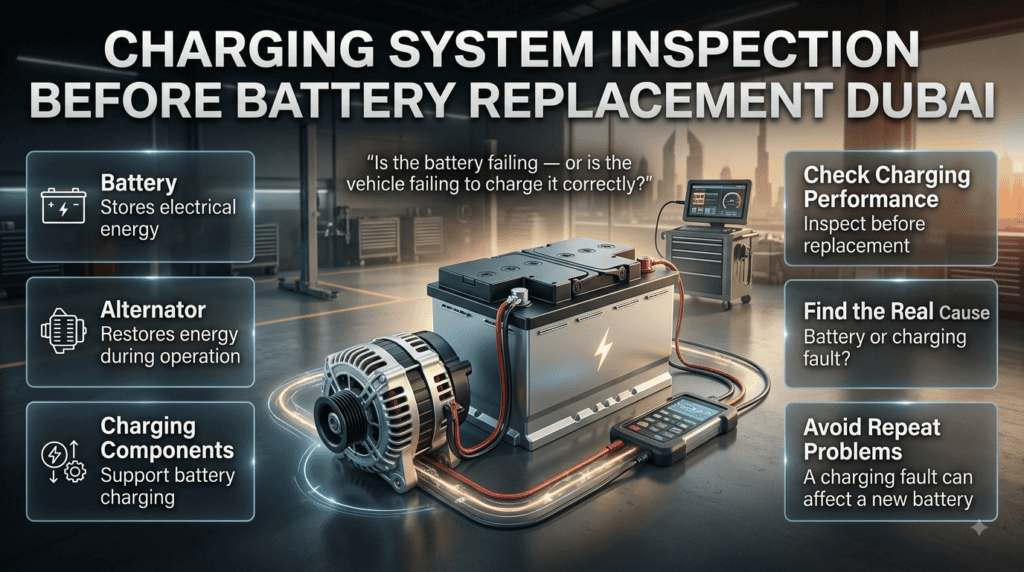
The battery and alternator work together.
The battery provides stored electrical energy for starting and vehicle operation, while the charging system restores energy during engine operation.
If the alternator or associated charging components are not functioning correctly, a healthy battery may gradually become undercharged.
This creates an important diagnostic question:
Is the battery failing, or is the vehicle failing to charge the battery correctly?
A professional inspection should therefore evaluate charging-system performance before a replacement decision is finalized.
If the battery is replaced but the charging problem remains, the new battery can eventually develop the same symptoms.
8. Could a Battery Sensor Cause the Warning?
Yes.
Many modern vehicles use an intelligent battery sensor to monitor electrical conditions.
Depending on the vehicle, this sensor can monitor parameters such as:
- Battery voltage
- Current flow
- Temperature
- Charging behavior
- Energy consumption
If the sensor or its connection develops a problem, the vehicle may receive incorrect information about battery condition.
This means a battery management warning does not always originate from the battery itself.
A diagnostic scan and electrical inspection can help determine whether the warning relates to battery condition, sensor data, or another part of the energy-management system.
9. Battery Management Warning After a Jumpstart
A jumpstart can restore enough electrical power to start the engine, but it does not repair the underlying cause of the battery problem.
If a weak battery has been jumpstarted, the vehicle may appear completely normal while the engine is running because the charging system is supplying electrical power.
The problem may only become obvious again after the vehicle is parked.
After a jumpstart, it is sensible to determine why the battery became discharged.
Possible explanations include:
- Aging battery
- Battery left discharged
- Excessive electrical consumption
- Charging-system problem
- Long parking period
- Short-trip driving pattern
- Faulty electrical component
A jumpstart should therefore be considered a temporary recovery solution rather than a substitute for diagnosis.
10. Battery Replacement vs Battery Recharging
One of the most common customer questions is whether a weak battery should be recharged or replaced.
The answer depends on the battery’s actual condition.
A relatively healthy battery that was accidentally discharged may only require proper charging and testing.
A battery with significant capacity loss, repeated starting problems, or a failed professional test is more likely to require replacement.
| Situation | Likely approach |
|---|---|
| Battery accidentally discharged once | Charge and test |
| Battery passes performance testing | Monitor condition |
| Battery repeatedly loses charge | Investigate cause |
| Battery repeatedly fails testing | Replacement likely |
| Battery physically damaged | Replacement required |
| Alternator undercharging | Repair charging system |
| Excessive electrical drain | Find and repair drain |
The goal is not simply to install a new component. The goal is to restore dependable electrical performance.
11. Choosing the Correct Replacement Battery
Once testing confirms that replacement is necessary, the next step is selecting the correct battery.
Battery selection should consider:
- Battery technology
- Capacity
- Cold-cranking performance
- Physical dimensions
- Terminal arrangement
- Polarity
- Manufacturer specification
- Vehicle electrical requirements
A battery that physically fits the vehicle is not automatically the correct battery.
This is particularly important for modern vehicles with start-stop systems and sophisticated energy management.
For drivers researching different battery options, EuroSwift’s Amaron Battery, Bosch Battery, and Tuflong Battery pages can provide more context about individual battery options.
12. AGM and EFB Batteries in Modern Vehicles
Battery technology has become increasingly important as vehicles have adopted start-stop systems and higher electrical loads.
AGM Batteries
Absorbent Glass Mat batteries are commonly used in vehicles requiring strong cycling performance and higher electrical capability.
They are particularly common in certain start-stop and premium vehicle applications.
For vehicles requiring AGM technology, EuroSwift’s AGM battery replacement service provides a relevant resource.
EFB Batteries
Enhanced Flooded Batteries are also used in selected start-stop vehicles and are designed for greater cycling capability than many conventional batteries.
Conventional Batteries
Traditional lead-acid batteries remain appropriate for many vehicles that do not require advanced battery technology.
The correct choice depends on the vehicle.
13. Why Professional Battery Replacement Is Different
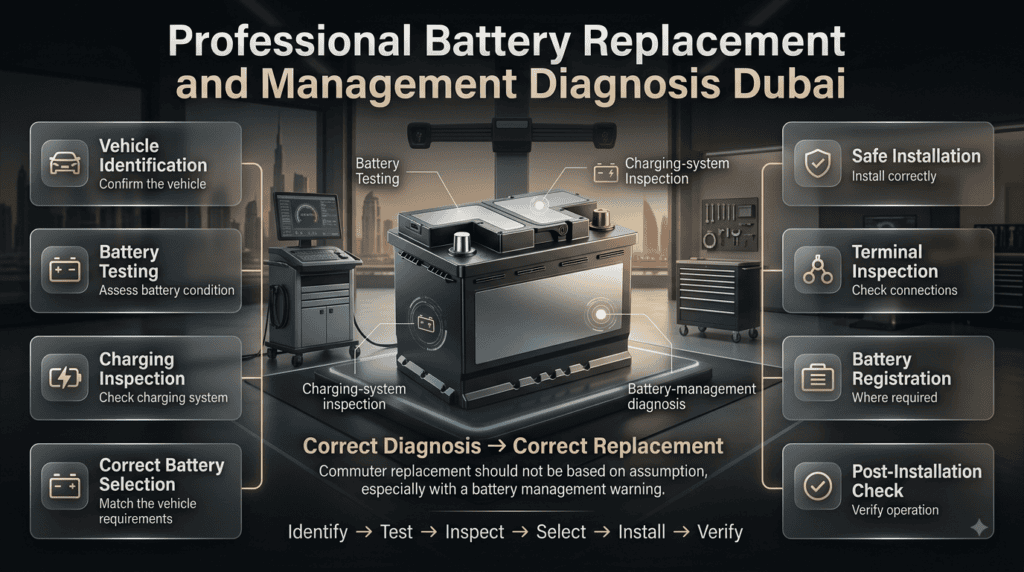
Modern battery replacement is not always a simple matter of removing an old battery and installing a new one.
A professional service can combine:
- Vehicle identification
- Battery testing
- Charging-system inspection
- Correct battery selection
- Safe installation
- Terminal inspection
- Battery-management diagnosis
- Battery registration where required
- Post-installation verification
This approach is particularly valuable when a battery management warning is involved because the warning itself may be connected to another electrical-system condition.
The objective should always be correct diagnosis followed by correct replacement, rather than replacement based on assumption alone.
14. Battery Registration After Replacement
Replacing the physical battery is only one part of the process on many modern vehicles. Some vehicles use an intelligent battery management system that needs to recognize that the old battery has been replaced.
Depending on the manufacturer and vehicle configuration, the replacement procedure may involve battery registration, adaptation, coding, or another manufacturer-specific electronic process.
The exact requirement is not the same for every vehicle. Some cars may only require registration, while others may need additional configuration if the battery capacity or technology has changed.
This is why battery replacement should be handled according to the vehicle’s specific requirements rather than using the same procedure for every car.
A proper post-installation check can also confirm whether the original battery management warning has been resolved or whether another fault remains stored in the vehicle.
15. What Happens If the New Battery Is Not Registered?
If a vehicle requires battery registration and the procedure is skipped, the battery-management system may continue operating according to information associated with the previous battery.
This can become more relevant in vehicles where charging behavior is actively controlled according to battery condition and usage.
However, it would be incorrect to assume that every vehicle will experience the same problem. The effect depends entirely on the vehicle’s electrical architecture and manufacturer requirements.
The better approach is to verify the specific vehicle rather than treating battery registration as a universal requirement.
A professional battery service should therefore establish:
- Whether registration is required
- Whether adaptation is required
- Whether battery technology has changed
- Whether battery capacity has changed
- Whether diagnostic faults remain
- Whether charging performance is normal
This provides a much stronger foundation for reliable Battery Replacement.
16. Can a Battery Management Warning Disappear After Driving?
Sometimes the warning may disappear after the battery receives additional charge, but that does not necessarily mean the underlying problem has been solved.
For example, a battery that has become discharged may recover enough charge during driving for the vehicle to operate normally again. However, if the battery has lost significant capacity, the same warning may return after the vehicle is parked.
The same principle applies to an electrical-system fault. Temporary improvement does not prove that the charging system, battery sensor, or electrical consumption is functioning correctly.
If the warning repeatedly disappears and returns, the pattern itself becomes useful diagnostic information.
Instead of repeatedly driving the vehicle until the warning disappears, the better approach is to identify why the warning appeared in the first place.
17. Why a New Battery Can Become Weak Again
One of the most frustrating situations for a vehicle owner is replacing a battery and then experiencing another battery warning shortly afterward.
When this happens, the new battery should not automatically be blamed.
The underlying problem may include:
Alternator Undercharging
If the charging system is not supplying sufficient energy, the battery may gradually lose charge during normal use.
Parasitic Electrical Drain
A component may continue consuming electricity while the vehicle is parked.
Vehicle Not Entering Sleep Mode
Modern vehicles contain multiple electronic modules. If a module remains active when it should enter its normal low-power state, it can contribute to battery discharge.
Faulty Battery Sensor
Incorrect sensor information can affect how the vehicle manages battery charging and electrical consumption.
Incorrect Battery Specification
A battery with unsuitable technology or specifications may not be appropriate for the vehicle’s energy-management system.
Poor Connections
Loose, damaged, or corroded connections can interfere with reliable electrical current flow.
Repeated battery replacement without investigating these possibilities can result in unnecessary expense.
18. Battery Drain While the Car Is Parked
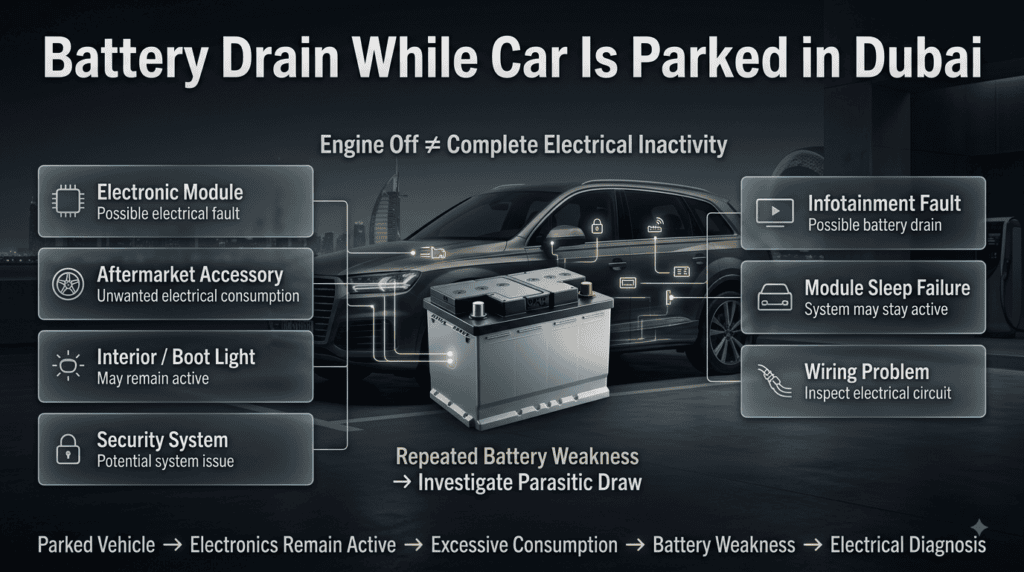
A vehicle does not become completely electrically inactive the moment the engine is switched off.
Security systems, communication modules, memory functions, and other electronics may continue consuming small amounts of energy.
Normally, the vehicle is designed to manage this consumption and enter appropriate low-power states.
The concern arises when electrical consumption remains unusually high.
Possible reasons include:
- Faulty electronic module
- Aftermarket accessory
- Interior or boot light remaining active
- Security-system issue
- Infotainment-related fault
- Vehicle module failing to enter sleep mode
- Electrical wiring problem
If a vehicle repeatedly has a weak battery after sitting overnight or for a few days, a parasitic-draw investigation can be more useful than immediately installing another battery.
19. Battery Management Warning and Start-Stop Systems
Start-stop technology places additional demands on the vehicle’s battery because the engine may be switched off and restarted repeatedly during normal driving.
The vehicle’s energy-management system therefore needs reliable information about battery condition.
If the battery does not have sufficient charge or the system determines that operating conditions are unsuitable, start-stop functionality may be temporarily disabled.
Drivers sometimes interpret this as a separate mechanical problem, but it can be an early indication that the vehicle’s battery condition or charging strategy needs attention.
Persistent start-stop unavailability should therefore be considered alongside other symptoms rather than viewed in isolation.
20. Dubai Heat and Battery Management Problems
Dubai’s climate makes battery condition particularly important.
High temperatures can accelerate battery aging, while vehicles frequently operate with substantial climate-control demand. Parking conditions can also expose the battery and surrounding components to significant heat.
This does not mean every battery will fail simply because the vehicle operates in Dubai. Battery quality, vehicle design, driving habits, maintenance, and battery age all matter.
However, the local environment can make an aging battery less forgiving.
For Dubai drivers, useful preventive habits include:
- Testing an older battery before long journeys
- Investigating repeated warning messages
- Checking the charging system when battery problems occur
- Avoiding unnecessary electrical accessories
- Inspecting battery terminals
- Testing the battery after a major discharge
- Addressing repeated overnight battery drain
21. Battery Replacement Before a Long Dubai Journey
A battery management warning should receive particular attention before a long road trip.
A vehicle that starts normally every morning can still have a battery approaching the end of its useful service life.
The risk becomes more inconvenient when the vehicle is driven far from home or outside the usual service area.
Before an extended journey, drivers can consider a basic electrical-system inspection covering:
- Battery condition
- Charging performance
- Battery terminals
- Battery age
- Warning history
- Starting performance
- Electrical-system fault codes
If the battery fails testing, replacing it before the journey can be more sensible than waiting for a starting failure during the trip.
22. Battery Warning After Extended Vehicle Parking
Vehicles that remain parked for several days or weeks can develop low battery charge.
Even when the ignition is switched off, certain vehicle systems may continue using electricity.
A healthy battery may tolerate normal standby consumption, but an older or partially discharged battery can eventually reach a low state of charge.
If the vehicle has been parked for an extended period and displays a battery management warning afterward, the first step should be to determine whether the battery is simply discharged or has suffered permanent capacity loss.
Proper charging followed by battery testing can help distinguish these situations.
If the battery repeatedly becomes weak after parking, further investigation for abnormal electrical consumption may be necessary.
23. Battery Management Warning During the Evening Commute
A warning that appears during an evening commute can be particularly concerning because the vehicle may already be operating with headlights, air conditioning, infotainment, climate controls, and other electrical equipment.
If the warning appears while driving, it is important to distinguish between a low battery condition and a charging-system problem.
A charging-system fault can be more serious because the vehicle may be relying increasingly on the battery while the engine is running.
Drivers should pay attention to additional symptoms such as:
- Increasing electrical warnings
- Headlights becoming noticeably weaker
- Unusual dashboard behavior
- Multiple systems switching off
- Difficulty restarting after stopping
When several electrical symptoms occur together, professional diagnosis should take priority over simply replacing the battery.
24. How Professional Battery Diagnostics Work
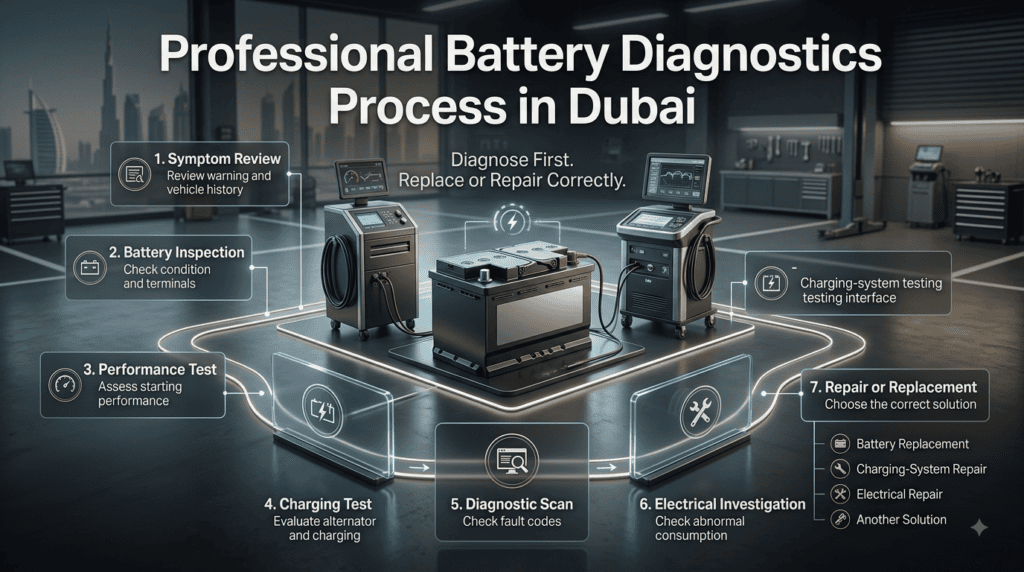
A proper inspection should follow a logical sequence rather than replacing components based on assumptions.
Step 1: Customer Symptom Review
The technician determines when the warning appeared and whether the vehicle has recently experienced starting problems, extended parking, jumpstarts, or repeated battery discharge.
Step 2: Battery Inspection
The battery is checked for age, condition, physical damage, terminal condition, and specification.
Step 3: Battery Performance Test
The battery is tested to determine whether it can deliver the required starting performance and maintain sufficient capacity.
Step 4: Charging-System Test
The alternator and charging system are evaluated to determine whether the battery is receiving appropriate charging.
Step 5: Diagnostic Scan
Relevant fault codes and battery-management information are checked.
Step 6: Electrical Consumption Investigation
If the battery repeatedly discharges while parked, abnormal electrical consumption may need to be investigated.
Step 7: Replacement or Repair Decision
Only after these checks should the technician decide whether the vehicle needs a new battery, charging-system repair, electrical repair, or another solution.
This approach reduces unnecessary parts replacement and improves the likelihood of solving the actual problem.
25. Battery Brands Available for Different Vehicle Applications
Once a replacement is confirmed, brand selection becomes the next consideration.
Different vehicles can require different battery specifications, so brand selection should always follow compatibility.
Depending on vehicle requirements and availability, drivers may consider brands such as:
- Amaron
- Bosch
- Tuflong
- Exide
- Panasonic
- FIAMM
- AC Delco
For drivers researching specific options, EuroSwift provides dedicated resources for Exide Battery Replacement, Panasonic Battery Replacement, and FIAMM Battery Replacement.
AC Delco is another option for suitable vehicle applications, with further information available through EuroSwift’s AC Delco Battery Replacement resource.
The important point is that the battery should be selected according to the vehicle specification rather than simply choosing whichever brand is cheapest or most familiar.
26. What Determines Car Battery Replacement Cost in Dubai?
The price of battery replacement can vary considerably depending on the vehicle and battery specification.
Several factors can influence the overall cost.
| Cost factor | Why it matters |
|---|---|
| Battery technology | AGM can differ in price from conventional types |
| Battery capacity | Larger-capacity batteries can cost more |
| Vehicle type | Luxury and advanced vehicles may require specific batteries |
| Battery brand | Pricing varies between manufacturers |
| Installation | Professional fitting may be included or charged separately |
| Battery registration | Some vehicles require additional diagnostic procedures |
| Emergency location | Mobile or roadside service can affect service cost |
| Additional diagnosis | Electrical faults may require separate testing |
The cheapest battery is not necessarily the most economical choice if it does not match the vehicle’s requirements.
Drivers comparing current Dubai battery costs can also review EuroSwift’s Car Battery Prices in Dubai 2026 guide for a broader understanding of the factors that influence pricing.
27. Common Mistakes After a Battery Management Warning
Replacing the Battery Without Testing
A warning does not automatically prove battery failure.
Ignoring the Alternator
A charging-system problem can quickly affect a replacement battery.
Repeatedly Using Jumpstarts
A jumpstart gets the vehicle moving but does not identify the reason for the discharge.
Choosing Only by Price
The cheapest battery may not have the correct technology, capacity, or starting specification.
Installing the Wrong Battery Type
Modern vehicles can require AGM, EFB, or another specific battery technology.
Ignoring Battery Registration
Where the vehicle requires registration or adaptation, skipping the procedure can create an incomplete replacement process.
Clearing Warning Messages Without Diagnosis
Removing a warning from the dashboard does not necessarily repair the fault that generated it.
Replacing Multiple Batteries Without Finding the Drain
If the vehicle repeatedly loses charge while parked, the underlying electrical consumption needs to be investigated.
28. Professional Recommendation for Dubai Drivers
The most sensible approach after a battery management warning is to classify the problem before purchasing a replacement.
If the battery has simply become discharged and passes testing, proper charging and monitoring may be enough.
If the battery has lost capacity or repeatedly fails professional testing, replacement is more appropriate.
If the warning is caused by the alternator, battery sensor, parasitic drain, poor connection, or another electrical problem, that issue needs to be addressed as well.
For drivers who need help while stranded, Car Jumpstart and Roadside Assistance can be relevant emergency solutions, while a proper Vehicle Inspection is more appropriate when the warning repeatedly returns.
The key principle is simple: do not treat the warning message as the diagnosis. Find the cause first.
Does a battery management warning mean the car battery needs to be replaced?
A battery management warning does not automatically mean that the battery has failed. The warning indicates that the vehicle has detected an abnormal condition involving the battery, charging system, battery monitoring sensor, or overall electrical energy management. A battery may simply have a low state of charge and still be capable of reliable operation after proper charging. On the other hand, an older battery can show a reasonable voltage reading while having lost enough capacity to become unreliable.
The right decision should therefore come from testing rather than the warning message alone. A professional inspection can evaluate battery condition, starting performance, charging-system operation, connections, and relevant diagnostic information before recommending replacement.
Important points to consider:
A low-charge battery may only need proper charging and retesting.
A battery that repeatedly fails a performance test is a stronger replacement candidate.
An alternator or charging fault can create battery-related warnings.
Repeated battery discharge should be investigated before installing another battery.
The correct replacement battery must match the vehicle’s requirements.
For Dubai drivers, this diagnostic approach is especially useful because heat, driving patterns, and electrical loads can contribute to battery deterioration. The objective should be to identify the reason for the warning first and replace the battery only when testing confirms that replacement is necessary.
What should be checked before replacing a battery after a battery management warning?
Before replacing the battery, the technician should determine whether the battery is actually defective or whether another part of the vehicle’s electrical system is responsible for the warning.
The inspection normally starts with the battery itself, including its state of charge, starting capability, physical condition, age, and terminal connections. The charging system should then be evaluated because an alternator or charging fault can leave even a good battery continually undercharged. If the battery repeatedly loses power while the vehicle is parked, abnormal electrical consumption may also need to be investigated.
A useful professional assessment can include:
Battery condition and performance testing
Charging-system inspection
Battery terminal and cable inspection
Battery sensor evaluation
Diagnostic fault-code scanning
Investigation of repeated battery drain
Verification of the correct battery specification
This prevents a common mistake: installing a new battery while leaving the original electrical fault untouched.
If the battery is healthy but the alternator is undercharging it, the new battery can eventually develop the same symptoms. Similarly, if an electrical module continues consuming excessive power while the vehicle is parked, replacing the battery alone will not solve the underlying problem.
Why does my new car battery keep getting weak after replacement?
When a recently replaced battery becomes weak again, the battery itself should not immediately be blamed. Repeated failure after replacement is often a reason to investigate the vehicle’s charging system and electrical consumption more carefully.
A faulty charging system can prevent the battery from receiving the energy it needs during normal driving. Another possibility is parasitic electrical drain, where a vehicle component continues consuming more electricity than expected while the vehicle is parked. Loose or corroded connections, incorrect battery specifications, and battery-management issues can also contribute to repeated problems.
Common areas that should be investigated include:
Alternator and charging performance
Excessive electrical consumption while parked
Battery terminals and cables
Battery monitoring sensor
Incorrect battery capacity or technology
Vehicle modules that fail to enter their normal low-power state
Aftermarket electrical accessories
This is particularly important in Dubai because drivers may use their vehicles heavily for short journeys while relying extensively on air conditioning. A new battery should not repeatedly become weak under normal use without a reason.
If a replacement battery fails again, the professional approach is diagnose the vehicle rather than simply replacing the battery for a second time.
Does a new battery need to be registered after battery replacement?
Some modern vehicles require the battery to be registered, reset, or adapted after replacement, but this is not a universal requirement for every vehicle. The exact procedure depends on the vehicle’s manufacturer, model, electrical architecture, battery technology, and sometimes the battery’s capacity.
On vehicles that use battery-management systems, the vehicle may need to recognize information about the newly installed battery, such as its chemistry or capacity. Some systems also adjust charging behavior based on battery condition and specifications.
This makes battery replacement on electronically advanced vehicles different from simply removing the old battery and installing another one.
Before completing the replacement, it is worth confirming:
Whether the vehicle requires battery registration
Whether adaptation or coding is required
Whether the replacement uses the same battery technology
Whether battery capacity has changed
Whether diagnostic faults remain after installation
Whether the charging system is operating correctly
The important point is not to assume that registration is required—or unnecessary—on every car. The vehicle-specific procedure should determine what is done after installation.
Is it safe to keep driving after a battery management warning appears?
Whether a vehicle can continue to be driven depends on what caused the warning and whether other symptoms are present. A warning associated with a temporarily low battery charge is different from a warning caused by a charging-system problem.
If the alternator or another part of the charging system is not functioning correctly, the vehicle may increasingly depend on the stored energy in the battery while driving. In that situation, continuing to drive can eventually result in loss of electrical power and a starting problem after the vehicle is stopped.
Drivers should take the warning more seriously when it appears together with:
Slow or difficult engine starting
Multiple electrical warnings
Unusual dashboard behavior
Dimming lights
Repeated battery discharge
Start-stop system becoming persistently unavailable
A charging-system warning
A single warning does not necessarily mean immediate battery failure, but a recurring warning should not simply be cleared and ignored.
For Dubai motorists, getting the battery and charging system checked early can be much more convenient than discovering the problem when the vehicle will no longer start. A proper diagnosis also helps determine whether the vehicle actually needs Battery Replacement, charging-system repair, or another form of electrical service.
Conclusion
A battery management warning should never be treated as an automatic instruction to replace the battery. In modern vehicles, the warning can be connected to battery deterioration, low charge, alternator performance, battery sensors, electrical connections, or excessive power consumption while the vehicle is parked. Identifying the actual cause is therefore more important than simply installing a new battery.
For Dubai drivers, this becomes even more relevant because high temperatures, frequent air-conditioning use, short journeys, heavy traffic, and extended parking can place additional demands on the vehicle’s electrical system. If the warning keeps returning, professional testing can determine whether the battery has genuinely reached the end of its useful life or whether another electrical issue needs attention.
When replacement is confirmed, choosing the correct battery technology and specification is essential. Modern vehicles may also require battery registration or adaptation after installation. A professional approach should therefore cover battery testing, charging-system inspection, correct battery selection, proper installation, and post-replacement verification.
Ultimately, the best strategy is simple: diagnose first, replace when necessary, and always investigate repeated battery problems instead of repeatedly changing batteries. This approach helps protect vehicle reliability, reduce unnecessary expenses, and give Dubai drivers greater confidence in their vehicle’s electrical system.
Leave a Reply