
Introduction
Battery Replacement Before Weekend Road Trip Dubai | A weekend road trip from Dubai can be an enjoyable break from the usual routine, but a long drive also exposes weaknesses that may remain unnoticed during normal city driving. One of the most important components to check before departure is the car battery. A vehicle may start normally every morning and still have a battery that has gradually lost its ability to provide reliable starting power.
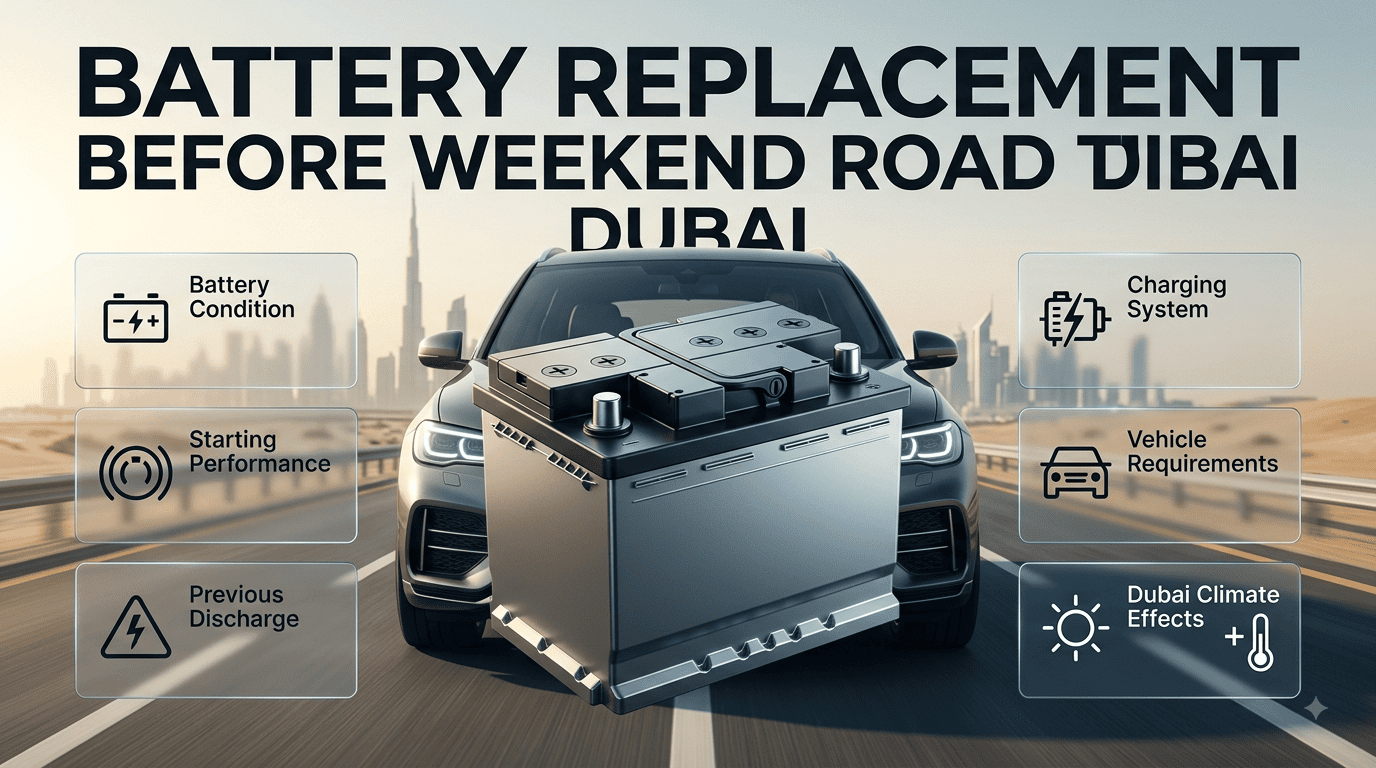
The question of battery replacement before weekend road trip Dubai is therefore not simply about how old the battery is. A better decision considers battery condition, starting performance, previous discharge problems, charging-system health, vehicle requirements and the distance of the planned journey.
Dubai’s climate also makes preventive battery care particularly important. High temperatures, extensive air-conditioning use, traffic congestion, short trips and long parking periods can all affect battery performance over time. Modern vehicles add another consideration because their electrical systems support numerous electronic modules, sensors, comfort features and safety technologies.
Before leaving Dubai for a weekend journey, the sensible approach is to identify battery weakness while there is still time to test, repair or replace the component. This guide explains what to check, when replacement makes sense, how professional testing works and how to decide whether your existing battery is ready for the road.
Why Battery Inspection Matters Before a Weekend Road Trip
A battery problem that is inconvenient in Dubai can become much more difficult when you are several hours away from home.
During an ordinary commute, a driver may have access to a workshop, another vehicle, roadside assistance or other forms of support. A weekend trip is different. The vehicle might be parked outside a hotel, shopping area, tourist destination, fuel station or highway rest area when the battery finally becomes too weak to restart the engine.
This is why pre-trip inspection is about risk management, not automatically replacing every battery.
If the battery is healthy, there may be no reason to replace it simply because a road trip is planned. But if the battery has already shown signs of deterioration, ignoring those signs before a longer journey is unnecessary.
A proper pre-trip check should answer several basic questions:
- Is the battery still capable of providing reliable starting power?
- Has the battery’s performance changed recently?
- Has it been discharged more than once?
- Are the battery terminals and cables in good condition?
- Is the alternator charging correctly?
- Is there an electrical drain while the vehicle is parked?
- Is the current battery the correct specification for the vehicle?
- Does the battery’s condition justify preventive replacement?
These questions are more useful than simply asking whether the battery “still works.”
Why a Car That Starts Every Morning Can Still Have a Weak Battery
One of the most common misconceptions is that a battery must completely fail before replacement becomes necessary.
In reality, battery deterioration can be gradual.
A battery may still have enough available power to start the engine under normal circumstances while having considerably less reserve capacity than when it was new. The driver may notice that the engine takes slightly longer to crank or that the starter sounds different, but because the vehicle continues to start, the warning is often ignored.
The problem can become more obvious after the vehicle is parked for several hours.
For example, a driver might leave Dubai early in the morning, drive for several hours, stop for lunch and then return to a car that does not start. The battery may have been marginal before the trip, but the driver had never experienced a complete failure during normal commuting.
That is why battery condition, rather than simply whether the engine starts today, should be considered before a long journey.
How Dubai Driving Conditions Can Affect Battery Performance
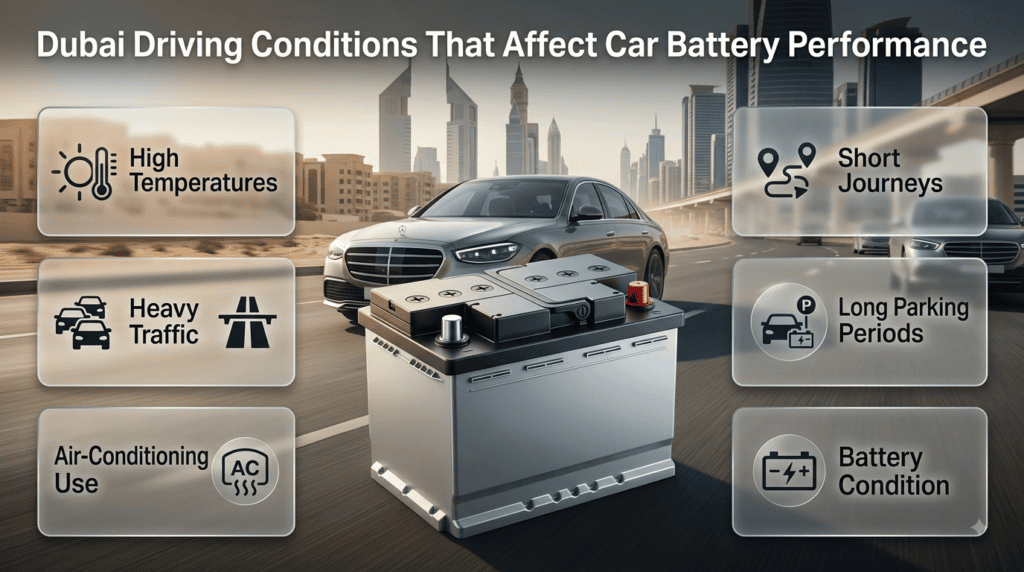
Dubai presents a combination of environmental and driving conditions that can influence automotive batteries.
High temperatures
Heat is one of the major factors associated with accelerated battery deterioration. Prolonged exposure to high temperatures can affect battery chemistry and contribute to reduced service life.
Heavy traffic
Frequent stop-and-go driving changes the vehicle’s operating pattern and may increase the use of electrical systems and air conditioning.
Extensive air-conditioning use
Air conditioning is essential for comfortable driving in Dubai, particularly during hotter months. While the alternator supplies electrical power while the engine is running, a vehicle’s overall electrical system still needs to be in good condition.
Short journeys
Frequent short journeys mean the engine is repeatedly started without necessarily allowing long periods of driving afterward.
Long parking periods
Vehicles that remain parked for extended periods can gradually lose battery charge because modern cars continue to consume small amounts of electrical energy while switched off.
None of these factors means a battery will automatically fail.
The important point is that Dubai drivers should avoid relying on a fixed replacement date without considering actual battery condition.
How Long Should a Car Battery Last in Dubai?
There is no single lifespan that applies to every battery.
Battery service life can be influenced by:
- Battery technology
- Vehicle electrical design
- Climate
- Driving frequency
- Parking habits
- Charging-system performance
- Previous deep discharges
- Electrical accessories
- Battery quality
- Maintenance history
This means two batteries that were installed at approximately the same time can have very different conditions.
One may still perform well, while another may already be struggling with starting demands.
For this reason, battery age should be treated as a risk indicator, not an automatic replacement instruction.
| Battery condition | Recommended action before a weekend trip |
|---|---|
| Relatively new and testing healthy | Continue normal use |
| Older but no symptoms | Consider professional testing |
| Slow engine cranking | Inspect before travelling |
| Repeated jumpstarts | Diagnose battery and charging system |
| Battery repeatedly discharges | Investigate the cause |
| Physical damage or swelling | Professional assessment |
| Weak test result | Replacement may be appropriate |
| New battery repeatedly loses charge | Check charging system or electrical drain |
The combination of age, symptoms and testing provides a much stronger basis for a replacement decision.
Signs Your Battery May Need Replacement Before the Trip
Slow Engine Cranking
A change in engine-cranking speed is one of the simplest signs drivers can notice.
If the starter previously turned the engine quickly but now sounds slower, the battery may have lost some starting capability. However, slow cranking can also be related to the starter motor, poor connections or other electrical problems.
Therefore, the symptom should lead to inspection rather than an automatic battery purchase.
If you notice the same change repeatedly, especially after the vehicle has been parked overnight, it is better to investigate it before travelling.
The Car Needs a Jumpstart More Than Once
A single jumpstart does not automatically mean the battery needs replacement.
Perhaps the headlights were accidentally left on, or the vehicle experienced another temporary discharge.
The situation becomes more significant when jumpstarts happen repeatedly.
Repeated jumpstarts can point toward:
- Battery deterioration
- Charging-system problems
- Electrical leakage
- Poor battery connections
- Excessive accessory consumption
- Long periods of inactivity
If you have recently needed assistance to start the vehicle more than once, it is worth having the complete starting and charging system assessed before a weekend road trip.
A jumpstart gets the engine running. It does not diagnose why the battery became discharged.
The Battery Keeps Going Flat While Parked
A battery that repeatedly loses charge while the vehicle is parked should not simply be replaced without investigating the reason.
Modern vehicles normally consume a small amount of electrical energy while switched off. Certain systems need to remain active to preserve vehicle functions and security features.
However, excessive electrical consumption can discharge a battery.
Possible causes may include:
- Faulty electrical modules
- Aftermarket accessories
- Incorrect accessory installation
- Interior or luggage-compartment lights
- Faulty switches
- Electrical faults
- Battery deterioration
If the same problem occurs after installing a new battery, the underlying electrical drain may still be present.
Dashboard Battery Warning Light
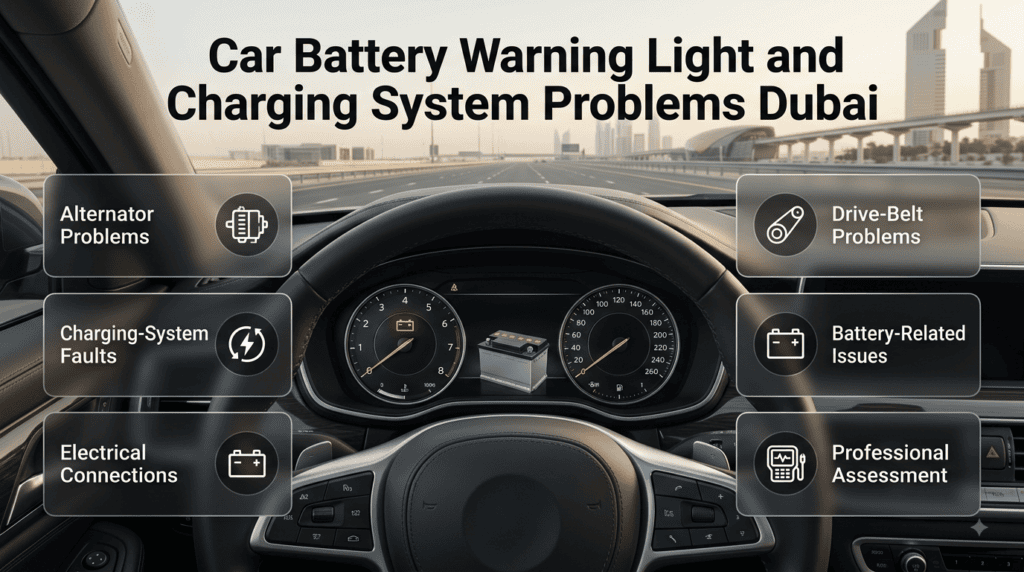
A battery-shaped warning light deserves attention.
Many drivers assume that this warning always means the battery itself is defective. That is not necessarily the case.
The warning may indicate a problem involving the vehicle’s charging system.
Potential causes can include:
- Alternator problems
- Charging-system faults
- Electrical connections
- Drive-belt-related problems on applicable vehicles
- Battery-related issues
This is why replacing the battery without checking the charging system can be an incomplete solution.
If a battery warning light appears before a road trip, the vehicle should be professionally assessed rather than relying on a new battery as a quick fix.
Dimming or Flickering Lights
Unusual changes in electrical performance can also justify an inspection.
For example:
- Headlights appear weaker than usual.
- Interior lights flicker.
- Dashboard illumination changes unexpectedly.
- Electronic accessories behave inconsistently.
- Certain electrical features stop working temporarily.
These symptoms do not prove that the battery is responsible.
The charging system, wiring, connections and other electrical components may also need attention.
This is where proper Engine Diagnostics and electrical-system testing can be more useful than guessing.
Visible Corrosion Around Battery Terminals
Battery terminals need a clean and secure electrical connection.
Visible corrosion around the terminals can interfere with electrical contact and may contribute to starting problems.
However, cleaning the terminals does not automatically mean the battery itself is healthy.
A battery can have clean terminals and still have significant internal deterioration.
Likewise, a vehicle can have a healthy battery but poor terminal connections.
Therefore, the complete battery installation should be inspected.
A Swollen or Physically Damaged Battery
Physical battery damage should never be treated as a minor cosmetic issue.
If the battery case appears swollen, cracked or otherwise damaged, professional assessment is appropriate.
A damaged battery may indicate that the component has experienced an internal or environmental problem that makes continued use questionable.
Before a long journey, it is better to resolve this type of issue rather than hoping the battery will continue working.
Battery Age vs Battery Condition
The age of a battery is useful information, but it should not be the only factor.
Consider two vehicles.
Vehicle A
- Older battery
- Normal starting
- No jumpstarts
- No electrical warning
- Healthy battery test
- Healthy charging system
Vehicle B
- Similar battery age
- Slow starting
- Previous jumpstarts
- Repeated discharge
- Weak test result
Although both batteries have a similar age, Vehicle B presents a much stronger case for replacement before a road trip.
This illustrates why professional testing is valuable.
The goal is not to replace a battery because it has reached a particular birthday. The goal is to determine whether it can continue providing dependable service.
Should You Test the Battery Before a Weekend Road Trip?
If there is any uncertainty about the battery, testing before departure is a sensible step.
A professional battery inspection may evaluate different aspects depending on the battery type and testing equipment.
These can include:
- Resting voltage
- Starting capability
- Battery condition
- Available capacity
- Terminal condition
- Charging-system performance
A proper assessment provides more useful information than simply looking at the battery’s age.
It can also prevent a common mistake: replacing the battery when another component is actually causing the problem.
Why a Simple Voltage Check Does Not Tell the Whole Story
A basic voltage reading can provide useful information, but it does not necessarily tell you everything about battery health.
A battery may show a reasonable voltage while still having reduced ability to deliver the current required during engine starting.
Think of it this way:
Voltage tells you something about the battery’s electrical state.
Starting performance tells you more about its ability to perform a critical job.
This is why professional battery testing can be more informative than a single voltage measurement.
Battery Problem or Alternator Problem?
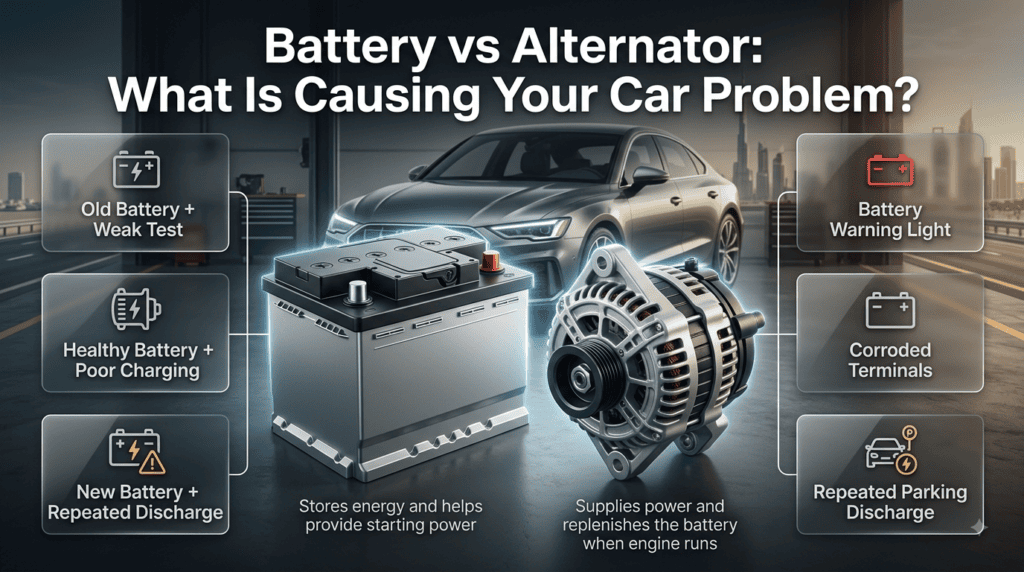
This distinction is extremely important before a weekend road trip.
The battery stores electrical energy and provides the high current needed to start the engine.
The alternator, when operating correctly, helps supply electrical power and replenish the battery while the engine is running.
If the alternator is not charging correctly, a battery may become discharged even if the battery itself is relatively new.
Consider this example:
A driver notices that the car repeatedly struggles to start.
The driver replaces the battery.
The car starts normally for a while.
A few days or weeks later, the battery becomes weak again.
The driver may assume the replacement battery was defective.
But if the charging system was never checked, an alternator or charging-system problem could have remained unresolved.
| Situation | Possible direction |
|---|---|
| Old battery + weak test result | Battery replacement |
| Healthy battery + poor charging | Charging-system diagnosis |
| New battery + repeated discharge | Electrical/charging investigation |
| Battery warning light | Charging-system inspection |
| Corroded terminals | Connection inspection |
| Battery repeatedly dies while parked | Parasitic-drain investigation |
This is why professional Vehicle Inspection can be useful before a longer journey.
What Is Parasitic Battery Drain?
Parasitic drain describes electrical consumption that continues while the vehicle is parked.
Some electrical consumption is normal because modern vehicles need certain systems to remain active.
The problem occurs when consumption is excessive.
Potential causes may include:
- Aftermarket equipment
- Faulty control modules
- Interior lighting problems
- Trunk or glovebox lights
- Faulty switches
- Electrical accessories
- Wiring faults
If the battery repeatedly becomes weak after the car has been parked, replacing the battery without investigating the electrical system may only provide a temporary solution.
A new battery cannot compensate indefinitely for an unresolved electrical drain.
Why Short Daily Trips Can Hide Battery Problems
Short journeys are common in city driving.
A driver might:
- Start the vehicle.
- Drive a short distance.
- Park.
- Switch the engine off.
- Repeat the process several times.
Every engine start uses electrical energy.
The charging system replenishes energy while the vehicle is running, but short driving periods may provide less opportunity for the system to restore the energy consumed during repeated starting.
This does not mean short trips automatically damage a battery.
The concern becomes greater when short journeys are combined with:
- An aging battery
- High electrical demand
- Frequent starts
- Long parking periods
- High temperatures
- Previous discharge events
For drivers who mostly use their vehicles for short Dubai journeys, testing the battery before a longer weekend trip can provide useful reassurance.
When Does Battery Replacement Make More Sense?
Battery replacement becomes more reasonable when the evidence indicates that the existing battery is no longer dependable.
For example:
Stronger reasons to replace
- Battery fails a professional test.
- Starting performance has deteriorated significantly.
- The battery repeatedly loses charge.
- The battery has required multiple jumpstarts.
- The battery has visible physical damage.
- The battery has reached advanced age and shows other warning signs.
- The vehicle requires a specific battery type that the existing unit no longer provides adequately.
Reasons to test rather than immediately replace
- Battery is older but still performs normally.
- There are no starting problems.
- The battery has not repeatedly discharged.
- The vehicle’s charging system appears normal.
- There are no visible signs of damage.
This distinction helps prevent unnecessary spending.
Choosing the Correct Battery for Your Vehicle
If replacement is necessary, choosing the right battery is just as important as deciding to replace it.
Drivers sometimes make the mistake of selecting a battery based only on:
- Price
- Brand popularity
- Physical size
- Availability
These factors matter, but they are not enough.
Battery compatibility can depend on:
- Physical dimensions
- Terminal arrangement
- Capacity
- Starting specification
- Battery technology
- Vehicle electrical system
- Manufacturer requirements
- Start-stop system requirements
The correct replacement should be selected according to the vehicle’s specifications.
AGM, EFB and Conventional Batteries
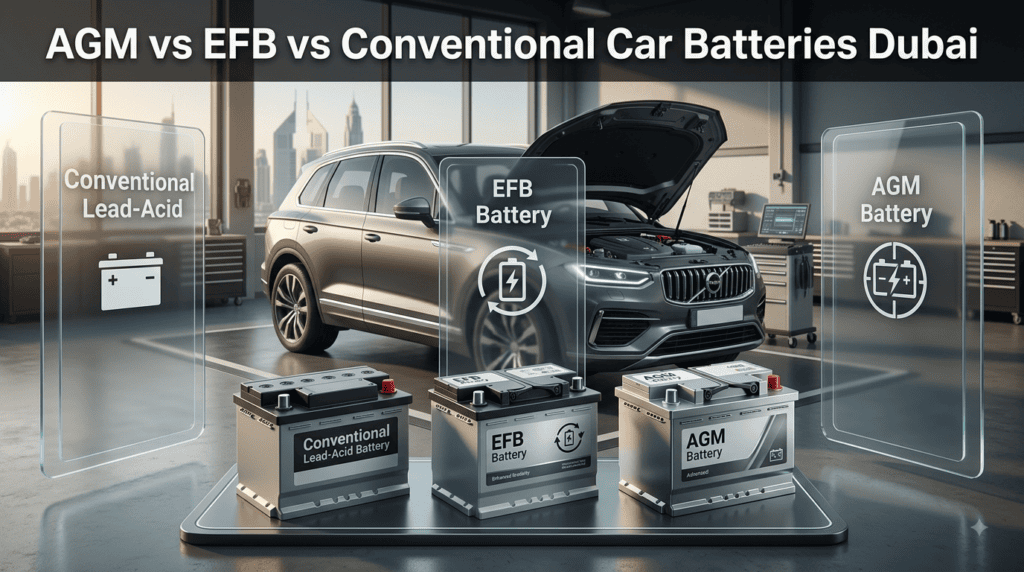
Modern vehicles can use different battery technologies.
Conventional lead-acid batteries
These are widely used in many vehicles and may be appropriate where the manufacturer specifies this type.
EFB batteries
Enhanced Flooded Battery technology is used in certain applications with greater cycling and electrical demands.
AGM batteries
Absorbent Glass Mat batteries are used in many vehicles requiring particular electrical and cycling characteristics.
An AGM-equipped vehicle should not automatically be downgraded to a conventional battery simply because the alternative is cheaper.
If your vehicle requires AGM technology, you can review EuroSwift’s AGM Battery replacement service in Dubai for more information.
The correct choice should always follow the vehicle’s requirements.
Battery Brand Selection Before a Road Trip
Once the correct specification is known, brand selection becomes easier.
Different vehicles can be compatible with different battery brands, provided the battery meets the required specifications.
For drivers researching available options, EuroSwift Auto Services provides dedicated information for several battery brands.
For example, Amaron Battery may be considered where the vehicle’s specification is compatible.
Similarly, drivers can review Bosch Battery options when Bosch is appropriate for the vehicle.
Other available brand-specific resources include Tuflong Battery, Exide Battery, Panasonic Battery, FIAMM Battery and AC Delco Battery.
The important principle remains the same:
Choose the battery according to the vehicle first and the brand second.
Understanding Battery Replacement Cost Before the Trip
Battery price in Dubai can vary depending on several factors.
The final cost may depend on:
- Battery technology
- Battery capacity
- Brand
- Vehicle type
- Battery specification
- Warranty
- Installation
- Mobile replacement requirements
- Availability
Therefore, asking only “How much is a car battery?” does not provide enough information.
A small conventional battery for one vehicle can have very different requirements from a larger AGM battery used in a luxury vehicle.
If you are researching current battery pricing factors, the Car Battery Prices in Dubai 2026 guide can be used as a supporting resource.
Should You Replace the Battery the Day Before Your Road Trip?
Ideally, avoid leaving battery decisions until the last possible moment.
If you already know the battery is questionable, arrange inspection several days before departure.
This gives enough time to:
- Test the battery
- Identify charging problems
- Select the correct replacement
- Install the battery
- Check the electrical system
- Confirm normal starting
- Address any additional vehicle problems
A replacement on the morning of departure may still be necessary if the battery fails unexpectedly, but planned maintenance gives you greater control.
What Should You Do 48 Hours Before Leaving Dubai?
A simple two-day preparation schedule can reduce unnecessary last-minute problems.
48 Hours Before Departure
Check:
✔ Battery age
✔ Starting performance
✔ Dashboard warnings
✔ Tire condition
✔ Engine oil
✔ Coolant
✔ Brake behavior
✔ AC performance
✔ Visible leaks
If anything appears abnormal, arrange an inspection.
24 Hours Before Departure
If testing has identified a weak battery, complete the replacement.
After installation, confirm:
✔ Battery is correctly fitted
✔ Terminals are secure
✔ Battery is properly mounted
✔ Vehicle starts normally
✔ No unexpected warning lights appear
✔ Charging system is operating correctly
This gives you an opportunity to address problems before the journey begins.
Why Battery Replacement Should Be Part of a Wider Pre-Trip Check
Replacing the battery does not automatically make the vehicle ready for a long journey.
A healthy battery cannot compensate for:
- Worn tires
- Poor brakes
- Low engine oil
- Cooling-system problems
- Suspension faults
- Wheel-alignment problems
- AC problems
- Engine issues
This is why battery replacement should be considered within a wider Car Service and preventive-maintenance strategy.
For drivers who need a broader assessment, EuroSwift Auto Services can serve as the central automotive service resource, while the dedicated Car Battery Replacement in Dubai page is more focused on battery-related requirements.
This structure also helps separate battery-specific information from broader vehicle repair needs.
What Should Be Checked After Battery Replacement?
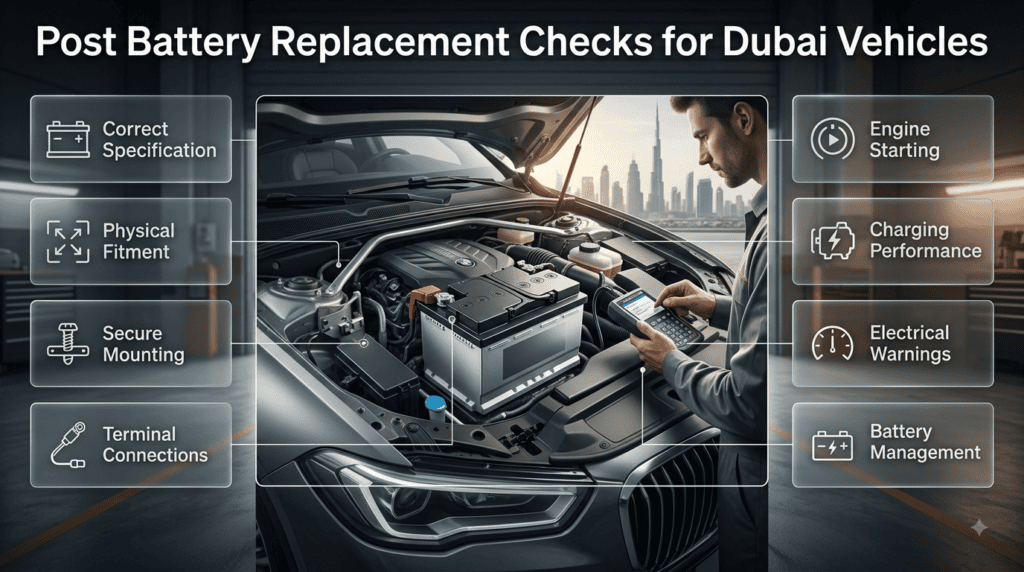
Installing a new battery is an important step, but it should not automatically be considered the end of the job.
After replacement, the technician should confirm that the battery is properly installed and that the vehicle’s electrical system is operating normally.
Important post-replacement checks include:
✔ Correct battery specification
✔ Correct physical fitment
✔ Secure battery mounting
✔ Proper terminal connections
✔ Normal engine starting
✔ Charging-system performance
✔ Absence of unexpected electrical warnings
✔ Appropriate battery-management procedures where required
A battery that is physically the correct size may still be unsuitable if its technology or electrical specification does not match the vehicle.
Modern cars can also use battery-management systems that monitor charging and electrical consumption. On applicable vehicles, the replacement process may require vehicle-specific procedures.
This is another reason why professional Battery Replacement is more than simply removing one battery and installing another.
Does a New Battery Guarantee a Trouble-Free Road Trip?
No.
A new battery removes one potential source of failure, but it does not guarantee that every other component of the vehicle is healthy.
Imagine replacing a weak battery before travelling and then discovering a tire problem halfway through the journey. The battery was correctly replaced, but the vehicle was not fully prepared.
The same principle applies to brakes, cooling systems, engine oil, suspension and air conditioning.
A weekend trip should therefore be treated as an opportunity for preventive vehicle maintenance, not only battery replacement.
The Complete Weekend Road Trip Vehicle Checklist
Before leaving Dubai, check the major systems that can affect reliability.
Battery and Electrical System
✔ Battery condition
✔ Battery terminals
✔ Charging system
✔ Dashboard warning lights
✔ Exterior lights
✔ Interior electrical functions
Tires
✔ Tire pressure
✔ Visible damage
✔ Tread condition
✔ Uneven wear
✔ Spare tire or approved emergency equipment where applicable
Brakes
✔ Brake pedal feel
✔ Unusual brake noise
✔ Steering vibration while braking
✔ Brake warning indicators
Engine
✔ Engine oil
✔ Coolant
✔ Visible leaks
✔ Unusual engine noises
✔ Dashboard warnings
Air Conditioning
✔ Cooling performance
✔ Fan operation
✔ Unusual AC noises
✔ Unusual odors
General Vehicle Condition
✔ Windshield visibility
✔ Wipers
✔ Lights
✔ Mirrors
✔ Fluid levels
✔ Emergency equipment
A professional Vehicle Inspection can be particularly useful if the vehicle has not been checked recently or if several components need attention.
Why Tires Deserve the Same Attention as the Battery
Drivers preparing for a road trip often concentrate on the battery because they are worried about starting problems.
Tires deserve equal attention because they remain in continuous contact with the road throughout the journey.
Before a longer drive, inspect for:
- Incorrect inflation
- Visible cuts
- Bulges
- Uneven tread wear
- Excessive wear
- Foreign objects
- Signs of aging
Tire pressure should be checked according to the vehicle manufacturer’s recommendations rather than a generic number found online.
Remember that the correct pressure can differ between front and rear tires and may also depend on vehicle load.
A battery problem may prevent the car from starting.
A tire problem can affect the vehicle while it is already travelling.
That is why both deserve attention before a weekend journey.
Why Brake Inspection Matters Before a Weekend Drive
Brakes experience repeated use during city driving and highway travel.
Before a road trip, pay attention to changes such as:
- Squealing or grinding sounds
- Increased stopping distance
- Steering vibration while braking
- Brake-pedal changes
- Pulling to one side
- Brake warning lights
These symptoms should not be ignored simply because the vehicle is still stopping.
A professional Brake Repair assessment can determine whether the issue involves brake pads, discs, hydraulic components or another part of the braking system.
The purpose of a pre-trip inspection is to identify these concerns while there is still time to correct them.
Engine Oil and Fluid Checks Before a Weekend Road Trip
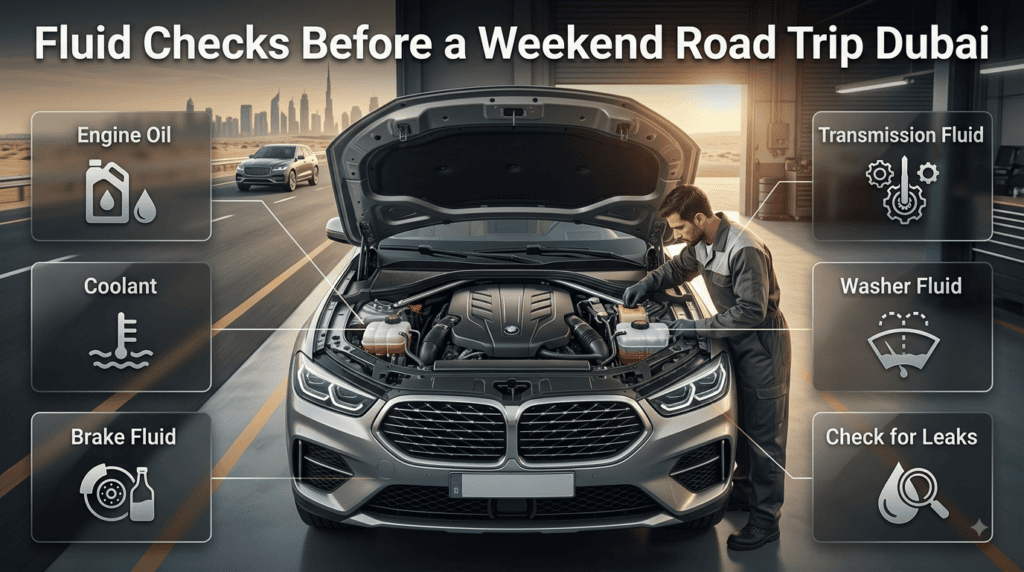
Battery preparation often receives most of the attention, but engine lubrication and cooling are equally important.
Before travelling, check the vehicle manufacturer’s recommended maintenance requirements for:
- Engine oil
- Coolant
- Brake fluid
- Transmission fluid where applicable
- Windshield washer fluid
- Other vehicle-specific fluids
Low fluid levels do not always indicate that the vehicle simply needs topping up.
A recurring reduction in fluid level can indicate a leak or another mechanical issue.
For example, if coolant repeatedly needs to be added, simply topping it up before a trip may hide a cooling-system problem.
Similarly, if the engine oil level is unexpectedly low, the cause should be investigated.
Why AC Performance Matters in Dubai
Air conditioning is not merely a comfort feature during Dubai’s hotter months.
A long journey in a hot cabin can create significant discomfort and driver fatigue.
Before travelling, check whether:
- The AC cools normally.
- Airflow is consistent.
- The blower operates correctly.
- The compressor behaves normally.
- There are unusual noises.
- Cooling performance changes while driving.
If the AC is already weak before the trip, it is better to investigate the problem before departure.
A driver who discovers an AC issue halfway through a long journey has fewer convenient options than someone who identified it while still in Dubai.
What If the Battery Dies During the Road Trip?
If the vehicle does not start after stopping, the first priority should be safety.
Move the vehicle to a safe position where possible and arrange appropriate roadside assistance.
Do not automatically assume that every no-start condition means the battery is dead.
Potential causes can include:
- Discharged battery
- Starter-system fault
- Alternator problem
- Electrical failure
- Fuel-related issue
- Engine-management problem
If the problem is confirmed to be a discharged battery, a professional Car Jumpstart may restore temporary starting capability.
However, a jumpstart should not automatically be treated as a permanent repair.
Jumpstart vs Battery Replacement
These two services solve different problems.
| Situation | Jumpstart | Battery replacement |
|---|---|---|
| Battery temporarily discharged | May help | Not necessarily needed |
| Battery old and weak | Temporary assistance only | May be appropriate |
| Battery repeatedly fails | Not a long-term solution | Requires diagnosis/replacement |
| Alternator not charging | May start vehicle temporarily | Does not solve alternator problem |
| Battery physically damaged | Not appropriate as a solution | Professional replacement assessment |
| Vehicle left lights on | May restore starting | Battery may still be healthy |
The important distinction is:
A jumpstart addresses an immediate no-start situation.
Battery replacement addresses a battery that is no longer suitable for reliable service.
If the same vehicle needs multiple jumpstarts, professional diagnosis should take priority over simply repeating the procedure.
Why Repeated Jumpstarts Are a Warning Sign
One jumpstart can happen to almost any driver.
A pattern of repeated jumpstarts is different.
Suppose the vehicle requires assistance on Monday, starts normally after the jump, and then needs another jump several days later.
That pattern should trigger an investigation.
Possible explanations include:
- Weak battery
- Alternator fault
- Excessive electrical drain
- Poor battery connection
- Vehicle remaining unused for long periods
- Electrical accessory problem
Replacing the battery may solve the problem if the battery is genuinely worn out.
But if the battery continues to discharge afterward, the vehicle needs further diagnosis.
What If the New Battery Goes Flat?
This situation can be frustrating, particularly if the battery was recently replaced.
However, a new battery becoming discharged does not automatically mean the replacement battery was defective.
The vehicle may have another problem.
Possible causes include:
Charging-system fault
The alternator may not be replenishing the battery correctly.
Parasitic drain
An electrical component may continue consuming excessive power while the vehicle is parked.
Loose connection
Poor terminal contact can interfere with charging and starting.
Vehicle usage
Repeated short journeys and extended parking may contribute to battery discharge.
Accessory installation
Aftermarket equipment can sometimes contribute to electrical consumption.
This is why the complete electrical system should be considered when a new battery repeatedly loses charge.
Should You Carry a Portable Jump Starter?
A portable jump starter can be useful emergency equipment for some drivers, provided it is appropriate for the vehicle and used according to the manufacturer’s instructions.
However, emergency equipment should not become an excuse to ignore a known battery problem.
If a battery has already failed testing, repeatedly discharged or shown significant deterioration, carrying emergency equipment does not transform it into a reliable battery.
The better strategy is:
Prevent the foreseeable problem first.
Emergency equipment is a backup, not a replacement for maintenance.
How Far in Advance Should You Replace a Weak Battery?
There is no universal number of days.
The ideal timing depends on the condition of the battery and the driver’s schedule.
However, if you already know the battery is weak, avoiding a last-minute decision is sensible.
Replacing it several days before the journey provides time to:
- Install the correct battery.
- Check starting performance.
- Confirm charging operation.
- Observe the vehicle after installation.
- Address unexpected warning lights.
- Complete any additional repairs.
This is particularly useful when the vehicle has previously experienced electrical problems.
Battery Replacement on the Morning of the Road Trip
Sometimes a battery fails unexpectedly on the morning of departure.
If replacement is genuinely necessary, dealing with it before travelling is preferable to ignoring the failure.
However, there is an important distinction between:
Planned replacement
and
emergency replacement.
Planned replacement gives you time to test and inspect the vehicle.
Emergency replacement solves an immediate problem but may leave less time to investigate whether another electrical issue exists.
For this reason, drivers who already suspect battery weakness should avoid waiting until departure morning.
How to Choose Between Different Battery Brands
Brand is only one part of the selection process.
A battery should first meet the vehicle’s requirements.
After compatibility is confirmed, drivers can compare suitable brands based on factors such as:
- Availability
- Warranty
- Battery technology
- Application
- Specification
- Price
- Service support
For example, a driver researching Amaron Battery should first confirm that the specific Amaron battery is suitable for the vehicle.
The same principle applies to Bosch Battery, Exide Battery, Panasonic Battery, FIAMM Battery, Tuflong Battery and AC Delco Battery.
The right question is not:
“Which brand is universally best?”
The better question is:
“Which battery specification is correct for this vehicle?”
Understanding AGM Battery Requirements
AGM technology is particularly relevant for certain modern vehicles.
AGM batteries can be used in applications involving higher electrical demands and frequent cycling, including certain start-stop vehicle systems.
If the vehicle manufacturer specifies AGM, installing a conventional battery simply because it is cheaper may not be appropriate.
Drivers should therefore identify the original battery type and vehicle requirements before replacement.
For vehicles requiring this technology, the AGM Battery replacement service provides a more focused reference.
This is especially relevant for modern luxury vehicles with extensive electronic systems.
Battery Replacement for Luxury and Premium Vehicles
Luxury vehicles can have more complex electrical architectures than basic vehicles.
They may include:
- Multiple electronic control modules
- Advanced infotainment
- Electronic parking systems
- Driver-assistance systems
- Start-stop technology
- High electrical demand
- Battery-management systems
Therefore, battery replacement should not be treated as a generic one-size-fits-all procedure.
Correct battery technology, capacity and installation procedure matter.
Drivers of premium vehicles may also benefit from a broader Luxury Car Service inspection before undertaking a long journey.
Why Battery Management Systems Matter
Many modern vehicles monitor battery condition and electrical energy flow.
Depending on the vehicle, the battery-management system may monitor:
- Battery state of charge
- Charging behavior
- Electrical consumption
- Battery condition
- Energy management
Some vehicles require specific procedures after battery replacement.
This is another reason why professional installation can be preferable to simply installing a battery without considering the vehicle’s electronic requirements.
A replacement battery should work as part of the vehicle’s complete electrical architecture.
Weekend Road Trip Preparation: 24-Hour Checklist
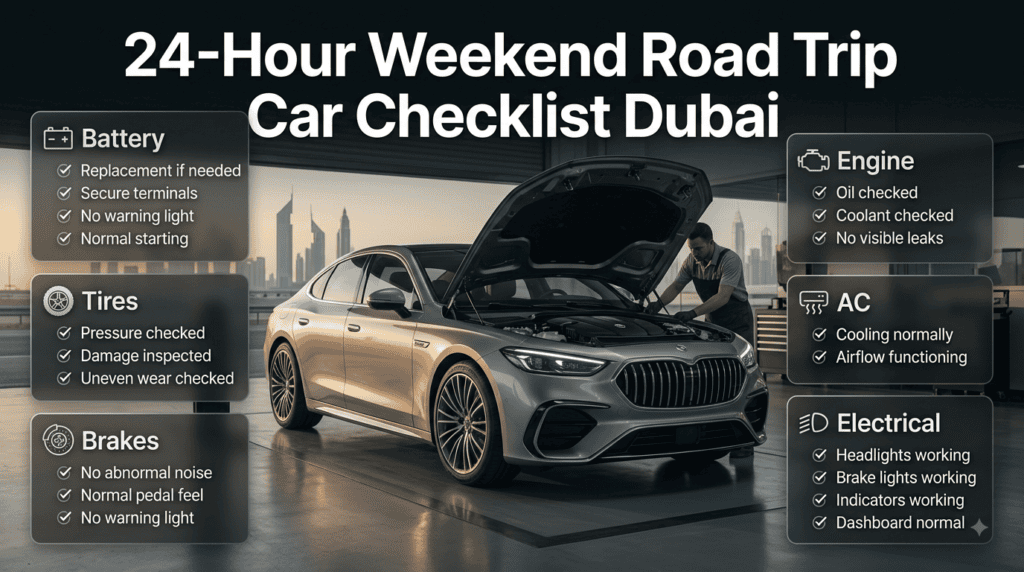
The day before departure should focus on confirming that known issues have been addressed.
Battery
✔ Replacement completed if necessary
✔ Terminals secure
✔ No unexpected warning light
✔ Vehicle starts normally
Tires
✔ Pressure checked
✔ Visible damage inspected
✔ Uneven wear considered
Brakes
✔ No abnormal noise
✔ Normal pedal feel
✔ No warning light
Engine
✔ Oil checked
✔ Coolant checked
✔ No visible leaks
AC
✔ Cooling normally
✔ Airflow functioning
Electrical
✔ Headlights working
✔ Brake lights working
✔ Indicators working
✔ Dashboard normal
This is a simple checklist, but it can prevent obvious problems from being discovered only after departure.
What Drivers Commonly Forget Before a Road Trip
Battery checks are important, but drivers often overlook smaller items.
Windshield wipers
Poor visibility becomes more problematic when weather or road conditions change.
Washer fluid
A clean windshield is essential for safe visibility.
Exterior lights
Check headlights, indicators, brake lights and other required lighting.
Spare tire equipment
If your vehicle uses a spare tire, check its condition and inflation according to manufacturer recommendations.
Emergency equipment
Keep appropriate emergency equipment available according to the vehicle and journey.
Warning lights
Do not ignore dashboard warnings simply because the car is still driving normally.
A road trip is not the right time to discover that a warning light had been appearing for weeks.
Common Battery Mistakes Before Weekend Travel
Mistake 1: Replacing the Battery Without Diagnosing the Cause
If the alternator or electrical system is faulty, the new battery may eventually become discharged.
Mistake 2: Buying Only on Price
A cheap battery that does not meet the vehicle’s requirements may not be a good value.
Mistake 3: Ignoring Slow Starting
Small changes in starting performance can provide useful early warning.
Mistake 4: Waiting Until Departure Morning
Last-minute maintenance leaves little time for additional diagnosis.
Mistake 5: Assuming Every No-Start Is a Battery
Starter, alternator, electrical and other vehicle problems can produce similar symptoms.
Mistake 6: Treating a Jumpstart as a Repair
A jumpstart is assistance, not necessarily a permanent solution.
Mistake 7: Ignoring Repeated Battery Discharge
Repeated discharge requires investigation.
Battery Replacement vs Waiting Until After the Trip
The decision becomes easier when the evidence is organized.
| Situation | Recommended approach |
|---|---|
| Battery tests healthy | Continue using it |
| Battery is older but healthy | Monitor and consider preventive planning |
| Battery has slow starting | Inspect before trip |
| Battery has failed testing | Replace before trip |
| Battery repeatedly goes flat | Diagnose underlying cause |
| Battery warning light appears | Check charging system |
| Battery physically damaged | Professional assessment |
| New battery repeatedly discharges | Investigate electrical system |
The purpose is not to encourage unnecessary replacement.
The purpose is to prevent drivers from knowingly taking a questionable battery on a journey where failure would be particularly inconvenient.
What Does a Professional Pre-Trip Inspection Look Like?
A professional inspection should be systematic.
Step 1: Understand the driver’s concern
The technician should know whether the vehicle has:
- Slow starting
- Previous jumpstarts
- Battery discharge
- Warning lights
- Long parking periods
- Upcoming long-distance travel
Step 2: Inspect the battery
The battery and its physical installation are assessed.
Step 3: Test the battery
Appropriate testing equipment is used according to the battery and vehicle.
Step 4: Check charging performance
The charging system is evaluated when necessary.
Step 5: Inspect connections
Terminals, cables and mounting are checked.
Step 6: Recommend action
The technician determines whether the battery should:
- Remain in service
- Be monitored
- Be replaced
- Be investigated further as part of an electrical diagnosis
This process is much more useful than simply replacing a component based on age.
When Should You Consider Roadside Assistance?
Roadside assistance becomes especially valuable when a vehicle experiences an unexpected problem away from the normal service area.
For example:
- Vehicle does not start
- Battery becomes discharged
- Tire problem occurs
- Vehicle develops a mechanical fault
- Driver cannot safely continue
A dedicated Roadside Assistance service can provide support when the vehicle cannot reasonably be taken to a workshop under its own power.
However, roadside assistance should complement preventive maintenance rather than replace it.
How Battery Maintenance Fits Into Overall Car Maintenance
A battery does not operate independently.
Its performance is connected with the vehicle’s:
- Charging system
- Starting system
- Electrical architecture
- Engine operation
- Driving pattern
This is why battery maintenance should sit within a broader Vehicle Maintenance strategy.
Regular maintenance can identify issues with:
- Engine
- Brakes
- Tires
- Suspension
- Steering
- Electrical system
- Cooling system
- AC
- Transmission
Drivers preparing for a long journey should therefore think beyond one component.
Why Preventive Maintenance Is Better Than Emergency Repair
Preventive maintenance provides one major advantage:
You control the timing.
If a weak battery is identified several days before the trip, the driver can arrange testing and replacement at a convenient time.
If the battery fails after travelling several hours, the driver has to deal with the problem wherever the vehicle happens to be.
The same principle applies to other vehicle systems.
A worn tire discovered at home is a maintenance task.
A tire problem discovered during a long journey is an emergency.
A weak battery identified during inspection is a repair decision.
A dead battery after parking at a destination is a roadside problem.
This difference is why pre-trip inspection is worthwhile.
Latest Automotive Trend: More Electrical Dependence
Modern vehicles are becoming increasingly dependent on electrical systems.
Even petrol and diesel vehicles may contain sophisticated electronic systems controlling:
- Engine functions
- Safety features
- Driver assistance
- Infotainment
- Climate systems
- Charging management
- Vehicle communication
This means battery selection and electrical-system health are increasingly important.
The battery is no longer simply a component that starts the engine and becomes irrelevant afterward.
It forms part of the vehicle’s larger energy-management system.
Future of Automotive Battery Technology
Battery technology will continue developing as vehicles become more electronically sophisticated.
Conventional internal-combustion vehicles will continue using 12-volt electrical systems in many applications, while hybrid and electric vehicles introduce additional high-voltage battery systems.
For conventional vehicles, developments in AGM and other battery technologies are likely to remain relevant as electrical demands increase.
The future focus is therefore not simply on making batteries larger.
It is on improving:
- Energy management
- Battery durability
- Charging efficiency
- Electrical-system integration
- Monitoring
- Start-stop performance
- Vehicle reliability
For Dubai drivers, correct battery selection and regular inspection will remain important even as vehicle technology changes.
Expert Recommendation: How to Decide Before Your Weekend Trip
If your road trip is approaching and you are unsure about the battery, use this simple decision process.
Battery is healthy and recently tested
You probably do not need replacement simply because you are travelling.
Battery is older but shows no symptoms
Consider testing it before the trip.
Battery is slow to start
Have it checked before departure.
Battery has required several jumpstarts
Do not rely on it without diagnosis.
Battery repeatedly discharges
Investigate battery condition, charging system and possible electrical drain.
Battery fails testing
Replacement before the trip is the sensible direction.
Battery warning light appears
Have the charging system inspected rather than assuming the battery is the only problem.
A Practical Weekend Road Trip Preparation Timeline
Three to Seven Days Before the Trip
This is the ideal period to identify problems.
Check:
- Battery condition
- Tire condition
- Brake behavior
- Engine fluids
- AC performance
- Warning lights
- General vehicle condition
If the battery is questionable, arrange testing.
One to Two Days Before the Trip
Complete necessary maintenance.
If battery replacement is required, install the correct specification.
Then confirm normal starting and charging behavior.
The Evening Before Departure
Perform a final visual inspection.
Avoid discovering an obvious problem at the last minute.
Departure Morning
Check:
✔ Vehicle starts normally
✔ No unexpected dashboard warning
✔ Tires appear normal
✔ Lights function
✔ No obvious leaks
✔ AC works appropriately
The purpose is not to inspect every component for hours.
It is to catch obvious issues before the journey begins.
Should I replace my car battery before a weekend road trip in Dubai?
Battery replacement before a weekend road trip is not necessary simply because you are travelling. The better approach is to check the battery’s actual condition before deciding. If the battery starts the engine normally, has no history of repeated discharge or jumpstarts, and performs well on a proper battery test, there may be no reason to replace it just for the trip.
The situation changes when the battery is showing warning signs. Slow engine cranking, repeated jumpstarts, unexplained discharge, electrical irregularities or a poor battery-test result are stronger reasons to consider replacement before travelling. AAA also identifies slow starting, repeated jumpstarts, dim/flickering lights, physical battery damage and an old battery among common warning signs.
Before your trip, check:
Battery age and previous replacement history
Slow or unusual engine cranking
Previous jumpstart requirements
Repeated battery discharge
Battery terminal condition
Dashboard battery or charging warnings
Professional battery-test results
Professional recommendation: If you already suspect that the battery is weak, do not wait until the morning of departure. Testing and replacing it beforehand gives you time to identify a charging-system or electrical problem as well.
How do I know if my car battery is too weak for a long road trip?
A weak battery often gives warning signs before it completely fails. One of the clearest is a noticeable change in starting performance. If the engine takes longer to crank than usual, the starter sounds weaker, or the vehicle occasionally struggles to start, the battery deserves attention before a long journey.
However, symptoms alone do not always prove that the battery is the problem. A starter motor, poor electrical connection or charging-system fault can create similar symptoms. That is why professional testing is more useful than guessing from one symptom.
A battery tester can assess whether the battery is performing within the required specification. A result such as “good” is different from a battery that requires replacement, while a low-charge result may sometimes indicate that the battery needs recharging and retesting rather than immediate replacement.
Warning signs worth taking seriously:
Slow engine cranking
Multiple jumpstarts
Battery repeatedly going flat
Dim or flickering electrical components
Battery warning light
Corroded or damaged connections
Swollen or physically damaged battery case
Poor professional test result
For a weekend trip: Don’t judge the battery only by whether the engine starts today. A battery that is already showing deterioration can become a much bigger inconvenience after several hours of driving and multiple stops.
Does Dubai heat make car battery replacement more important before a road trip?
Dubai’s hot climate is an important consideration when assessing battery condition. High temperatures can contribute to battery deterioration, while heat and vibration are among the factors associated with battery lifespan.
This does not mean that every battery in Dubai needs to be replaced early. Instead, heat should be considered alongside battery age, driving habits, electrical demand, charging performance and previous discharge events.
A battery that is already approaching the end of its useful service life may be less reassuring before a long journey than a recently installed battery that has passed testing.
Dubai drivers should pay particular attention to:
Battery age
Long periods of outdoor parking
Frequent short-distance driving
Repeated starting cycles
Heavy use of vehicle electrical systems
Previous battery discharge
Battery-test results
Professional recommendation: Don’t use Dubai’s heat as the sole reason for replacement. Use it as one factor in a proper battery-health assessment. If the battery is already showing symptoms, getting it tested before a weekend road trip is a much more sensible approach than waiting for failure.
Should I replace the battery or get a jumpstart before a weekend road trip?
A jumpstart and a battery replacement solve two different situations.
A jumpstart can provide temporary assistance when a vehicle’s battery has become discharged. It does not automatically mean the battery has to be replaced. For example, if a light was accidentally left on and the battery is otherwise healthy, recharging and testing may be enough.
Repeated jumpstarts are different. If the same vehicle repeatedly needs external starting assistance, the battery may be deteriorated, or there may be a problem with the alternator, charging system or electrical system. AAA specifically notes that multiple jumpstarts can indicate either a worn battery or another electrical-system problem.
Use this simple decision approach:
One accidental discharge + healthy test: investigate, recharge and monitor.
Repeated jumpstarts: arrange professional diagnosis.
Battery fails testing: replacement is more appropriate.
New battery repeatedly loses charge: investigate the charging/electrical system.
Charging warning appears: don’t assume the battery is the only problem.
Important point: A short drive after a jumpstart should not be treated as proof that an aging battery has recovered. A weak battery can still fail again after the vehicle is parked.
What should I check after replacing my car battery before a Dubai road trip?
After installing a replacement battery, don’t immediately assume the vehicle is completely ready for a long journey. The installation should be followed by checks that confirm the battery is correctly fitted and that the vehicle’s charging system is functioning properly.
The replacement must also match the vehicle’s requirements. Battery type, size, terminal arrangement and electrical specifications matter, and some modern vehicles use battery-management systems that require vehicle-specific procedures. AAA likewise recommends using the vehicle’s specified battery requirements rather than selecting a replacement purely by price or appearance.
After replacement, check:
Correct battery type and specification
Correct physical fitment
Secure battery mounting
Clean and secure terminals
Normal engine starting
Charging-system operation
Dashboard warning lights
Any unusual electrical behavior
Then complete a broader pre-trip inspection covering:
Tires and tire pressure
Brake condition
Engine oil
Coolant
Lights
Windshield wipers
AC performance
Visible fluid leaks
Professional recommendation: The ideal time to discover a second vehicle problem is before leaving Dubai, not halfway through the weekend trip. A properly installed battery combined with a sensible pre-trip inspection gives you much better confidence than simply installing a battery and immediately starting a long journey.
Conclusion
A battery replacement before a weekend road trip in Dubai should be based on the actual condition of the battery and the vehicle, rather than simply its age or the fact that you are travelling. If your car starts normally and the battery passes a proper test, replacement may not be necessary. However, slow cranking, repeated jumpstarts, unexplained battery discharge, warning lights or a poor test result are strong reasons to investigate the battery before departure.
Dubai’s hot climate makes preventive battery care particularly important, but the battery should always be considered as part of the complete vehicle electrical system. A weak alternator, poor terminal connection or parasitic electrical drain can create battery problems even after a replacement.
Before a weekend journey, take the opportunity to inspect the Battery Replacement, charging system, tires, brakes, engine fluids, AC and other essential components. If replacement is required, choose the correct battery specification for your vehicle rather than selecting only by price or brand.
Most importantly, don’t wait for a known battery problem to become a roadside emergency. Testing and addressing the issue while the vehicle is still in Dubai is far easier than dealing with a no-start situation after several hours on the road. A little preventive Vehicle Maintenance before departure can make the difference between a relaxed weekend journey and an unnecessary roadside problem.
Leave a Reply