

Introduction
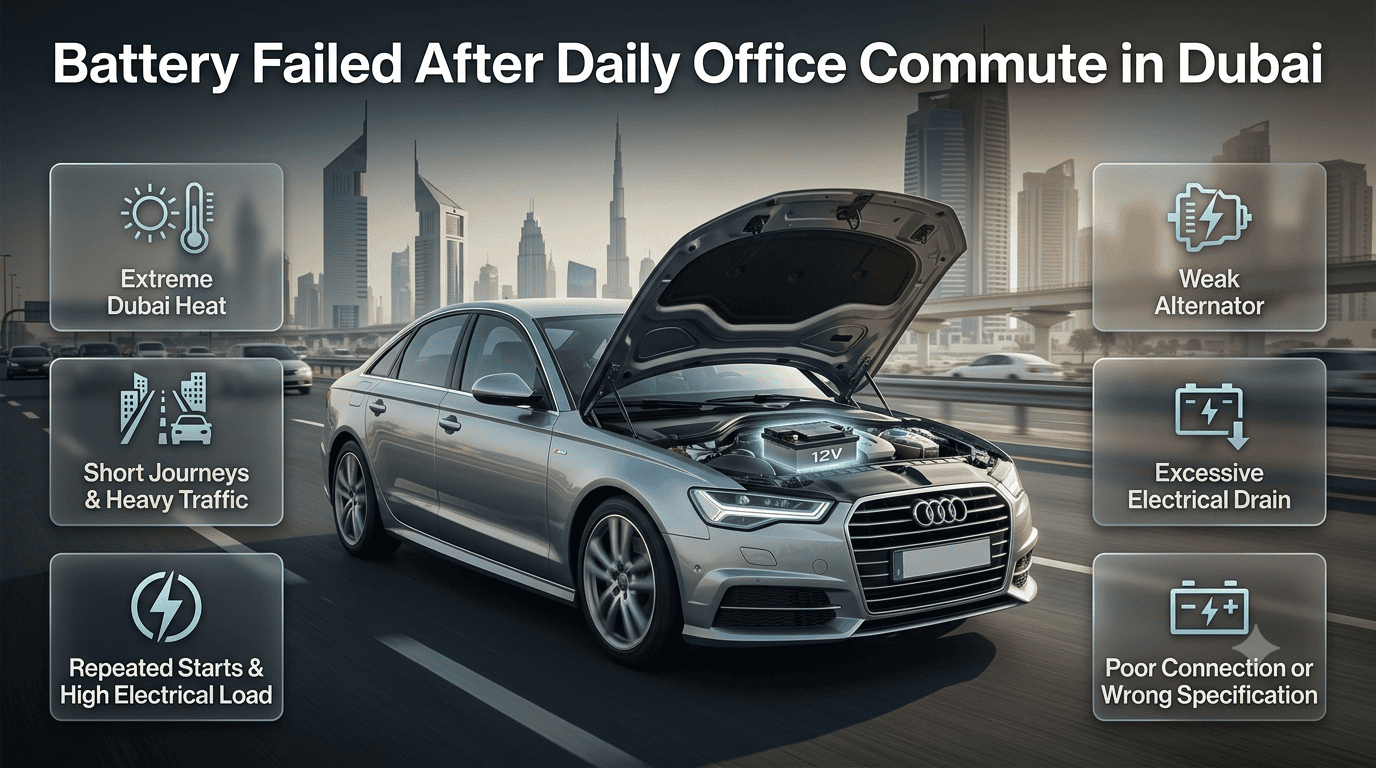
Battery Failed After Daily Office Commute in Dubai | Many drivers assume that regular commuting automatically keeps the battery charged and healthy. However, daily use does not guarantee that the battery is receiving enough charge or operating under ideal conditions. Short journeys, heavy traffic, repeated engine starts, high electrical demand, and Dubai’s extreme temperatures can all contribute to battery deterioration.
A vehicle that starts normally every morning can still develop a weak battery gradually. In some cases, the actual problem may not even be the battery itself. A weak alternator, poor battery connection, excessive electrical drain, or an incorrect battery specification can produce similar symptoms.
For Dubai office commuters, identifying the real cause matters because simply installing another battery may not prevent another breakdown. A proper inspection can determine whether you need a Car Battery Replacement, charging-system repair, electrical diagnosis, or another form of Car Repair.
This guide explains why batteries fail despite regular commuting, what warning signs to watch for, how Dubai driving conditions affect battery performance, and what professional steps can help prevent another unexpected no-start situation.
Why Can a Car Battery Fail Even When You Drive Every Day?
One of the biggest misconceptions about vehicle batteries is that daily driving automatically keeps the battery fully charged.
The alternator does recharge the battery while the engine is running, but the amount of energy restored depends on several factors. Journey length, engine operating conditions, electrical consumption, battery age, and alternator performance all influence the charging process.
Consider a typical Dubai office commute. You may start the engine at home, drive through congested roads, keep the air conditioning running, use navigation and other electronics, park at work for several hours, and then repeat the process in the evening.
The vehicle is being driven every day, but the battery can still become progressively weaker if the overall charging balance is poor.
Daily Driving Does Not Always Mean Healthy Charging
| Driving Condition | Possible Effect on Battery |
|---|---|
| Long-distance highway driving | Gives the charging system more operating time |
| Very short commute | May provide limited recharge time |
| Frequent engine starts | Repeatedly draws energy from the battery |
| Heavy traffic | Can increase electrical demand |
| Continuous air-conditioning use | Adds to overall electrical load |
| Aging battery | Reduced ability to retain charge |
| Weak alternator | Battery may remain undercharged |
| Electrical drain while parked | Battery can lose charge between journeys |
This is why a vehicle can be used every weekday and still experience a dead battery.
If your battery repeatedly becomes weak, professional Car Battery Replacement should not automatically be the first step. The battery and the vehicle’s charging system should be checked first.
How Dubai Heat Can Contribute to Battery Failure
Dubai’s climate deserves special attention when discussing automotive battery problems.
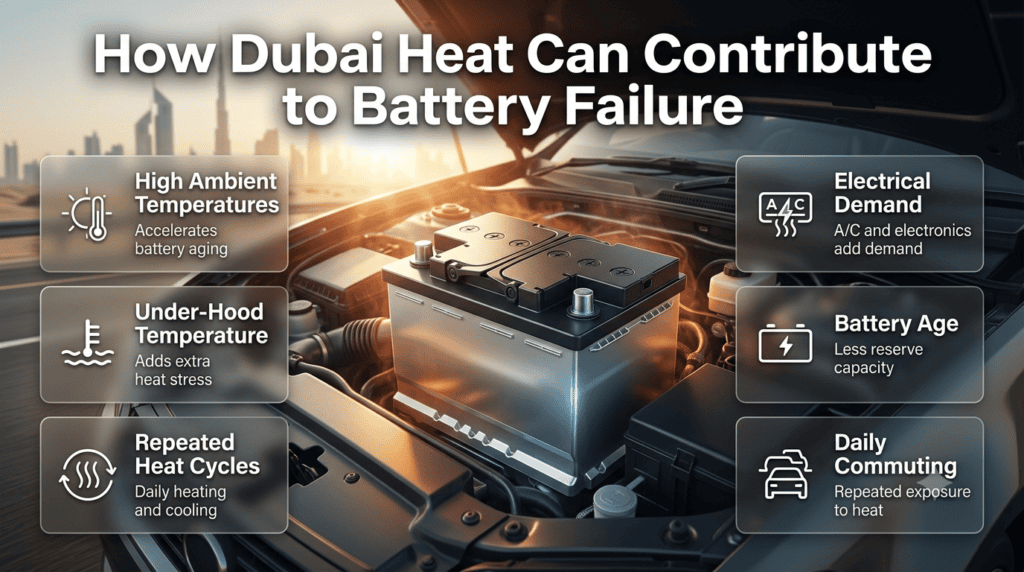
High temperatures can accelerate the deterioration of conventional lead-acid battery components. Continuous exposure to heat can place additional stress on the battery, while temperatures inside the engine compartment can become even more demanding.
The problem can become more noticeable during the hottest periods of the year. A battery that has already experienced gradual deterioration may lose enough performance that it suddenly struggles to start the engine.
Heat Can Affect Battery Reliability in Several Ways
High ambient temperatures: Continuous exposure to extreme heat can accelerate battery aging.
Under-hood temperature: The battery may experience temperatures significantly higher than the surrounding outdoor environment.
Repeated heat cycles: Daily commuting exposes the battery to repeated heating and cooling cycles.
Electrical demand: Air conditioning and other vehicle electronics place additional demand on the electrical system.
Battery age: An older battery may have considerably less reserve capacity when exposed to demanding conditions.
This is one reason why preventive Vehicle Maintenance is particularly important for commuters in Dubai.
The Most Common Reasons a Commuter’s Battery Suddenly Dies
A battery that appears to fail suddenly may actually have been losing capacity for weeks or months.
The final no-start event is often simply the point at which the battery can no longer provide enough power to start the engine.
1. The Battery Has Reached the End of Its Useful Life
Every automotive battery has a finite service life. As it ages, its ability to store and deliver electrical energy gradually decreases.
The vehicle may continue starting normally for a long period even while the battery’s reserve capacity is declining. Eventually, a relatively demanding start or a particularly hot day can expose the weakness.
Typical progression can look like this:
- Engine starts normally
- Starting becomes slightly slower
- Electrical symptoms appear occasionally
- Battery performance becomes inconsistent
- Vehicle eventually fails to start
Drivers often describe the final stage as a sudden battery failure, although the battery may have been deteriorating for some time.
2. Short Office Commutes May Not Fully Recharge the Battery
A short commute can be particularly important when investigating repeated battery problems.
Starting the engine consumes electrical energy. The alternator then works to replenish that energy while the vehicle is running. If the journey is short, there may be limited time for the charging system to restore the battery, particularly when the vehicle is simultaneously powering multiple electrical systems.
If this happens repeatedly throughout the working week, the battery may spend more time partially charged.
That does not mean short trips automatically damage a battery. Rather, repeated short journeys combined with an aging battery or charging-system issue can increase the likelihood of starting problems.
How Heavy Dubai Traffic Affects Battery and Charging Performance
Dubai’s daily commuting environment can involve substantial stop-and-go traffic.
A vehicle operating in congested traffic can spend significant periods moving slowly while the air conditioning, lights, infotainment, cooling fans, navigation, and other electronic systems remain active.
Modern vehicles are designed to handle these loads, but the battery and charging system still need to be in good condition.
Common Electrical Loads During an Office Commute
- Air conditioning
- Headlights
- Infotainment system
- Navigation
- Phone charging
- Cooling fans
- Driver-assistance electronics
- Interior electronics
- Start-stop systems where equipped
The issue is not that these systems should be switched off unnecessarily. They are normal vehicle functions. The important point is that a weak battery or inefficient charging system has less reserve when the vehicle is operating under heavy electrical demand.
If you regularly commute through congested Dubai roads and notice slower starting or repeated battery problems, a professional Vehicle Inspection can help identify whether the issue is battery-related or part of a wider electrical problem.
Can a Weak Alternator Make Your Battery Fail?
Yes. This is one of the most important points to understand before replacing a battery.
The alternator supplies electrical power while the engine is running and helps maintain the battery’s charge. If the alternator is not operating correctly, the battery may gradually lose its available charge even though you drive the vehicle every day.
This can create a misleading situation:
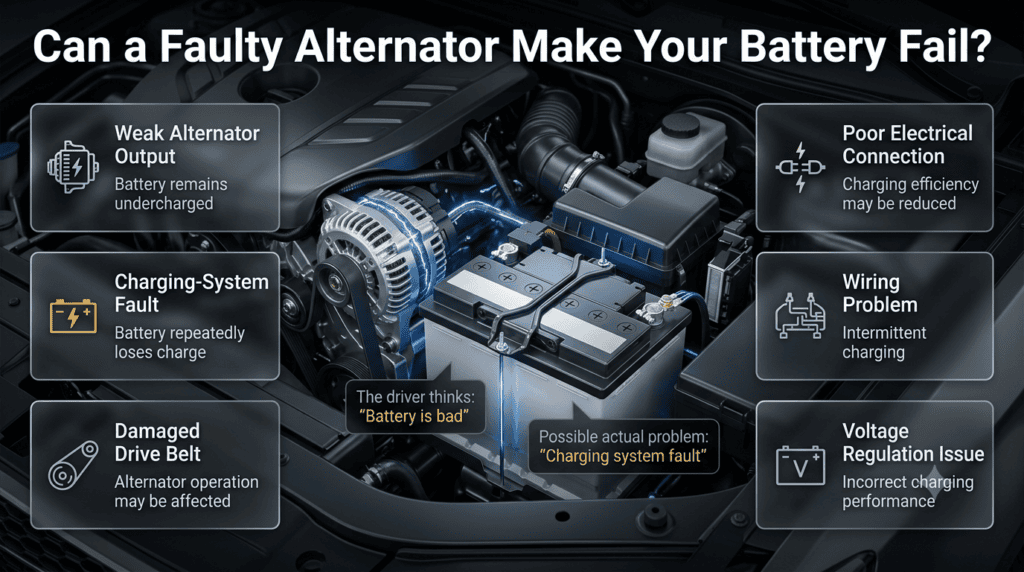
The driver thinks:
“My battery is bad because it keeps going flat.”
The actual problem could be:
“The charging system isn’t maintaining the battery correctly.”
Possible Charging-System Problems
| Problem | Possible Result |
|---|---|
| Weak alternator output | Battery remains undercharged |
| Charging-system fault | Battery repeatedly loses charge |
| Damaged drive belt | Alternator operation may be affected |
| Poor electrical connection | Charging efficiency may be reduced |
| Wiring problem | Intermittent charging |
| Voltage regulation issue | Incorrect charging performance |
Therefore, if a relatively new battery repeatedly becomes discharged, don’t immediately purchase another one.
A professional Engine Diagnostics inspection can help determine whether the battery, alternator, wiring, or another electrical component is responsible.
What Should You Check Before Replacing the Battery?
Before installing a replacement battery, a proper inspection should establish why the previous battery failed.
A technician should consider:
✔ Battery condition
✔ Battery age
✔ Starting performance
✔ Charging-system output
✔ Battery terminals
✔ Ground connections
✔ Battery cables
✔ Possible parasitic drain
✔ Correct battery specification
✔ Relevant dashboard warnings
This approach is much more useful than simply removing the old battery and installing another one.
If replacement is confirmed, the correct battery should be selected according to the vehicle manufacturer’s requirements rather than simply choosing a battery based on price or physical size.
Choosing the Right Battery for a Dubai Commuter
Not every battery is suitable for every vehicle.
Battery selection can depend on the vehicle’s engine, electrical architecture, manufacturer requirements, dimensions, capacity, starting requirements, and whether the vehicle uses a start-stop system.
For example, some vehicles require AGM technology rather than a conventional battery. Drivers can explore options such as an AGM battery replacement in Dubai when that technology is specified for their vehicle.
Depending on vehicle compatibility, other battery options may include Amaron Battery, Bosch Battery, or Tuflong Battery.
The key consideration should always be correct specification and compatibility with the vehicle, rather than choosing a brand simply because it is familiar.
Warning Signs Your Car Battery May Be Close to Failure
A car battery rarely goes from perfect condition to complete failure without any underlying deterioration. In many cases, the driver notices small changes but assumes they are temporary.
For an office commuter, these warning signs can be easy to overlook because the vehicle may still start every morning. However, a slower-than-normal crank or occasional electrical weakness can indicate that the battery no longer has the same reserve capacity it once had.
Common Warning Signs
| Warning Sign | What It May Indicate | Recommended Action |
|---|---|---|
| Slow engine cranking | Weak battery or starting-system issue | Test battery and starter system |
| Clicking when starting | Insufficient battery power or connection problem | Inspect battery and terminals |
| Dim dashboard lights | Low voltage or electrical issue | Check battery and charging system |
| Battery warning light | Possible charging-system problem | Arrange professional inspection |
| Frequent jumpstarts | Battery, alternator, or electrical drain | Diagnose the complete system |
| Car struggles after parking | Battery weakness or parasitic drain | Test battery and parked-current draw |
| New battery repeatedly goes flat | Underlying electrical issue | Check charging and electrical systems |
The important point is that a warning sign is not automatically a diagnosis.
For example, slow starting can be caused by a weak battery, poor battery connections, or even a problem within the starting system. Proper testing is needed before replacing parts.
Why Does My Car Start in the Morning but Fail After Work?
This is a common concern among daily commuters.
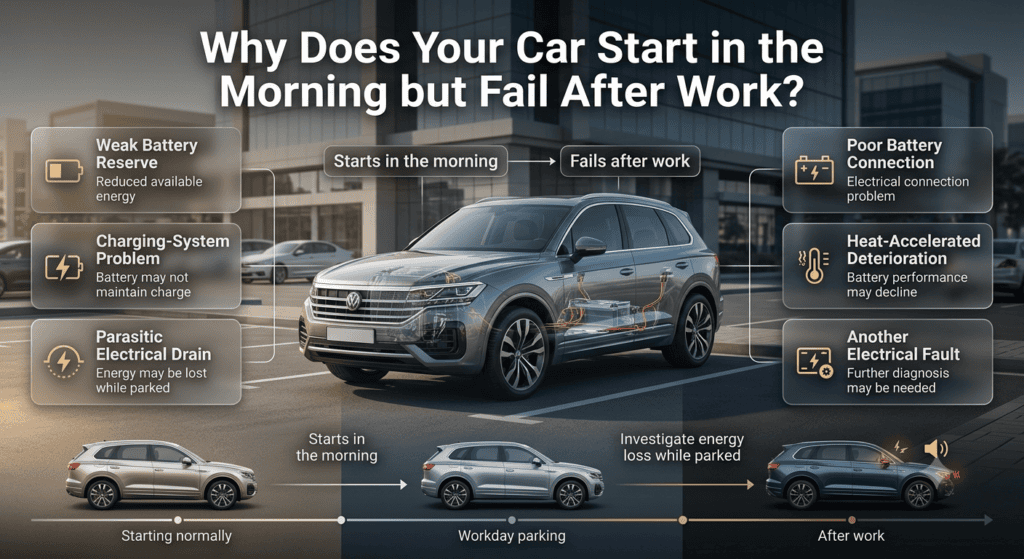
You may drive to the office without any problem, park the vehicle for several hours, and then discover that the engine will not start when you are ready to leave.
Several different problems can create this pattern.
Possible causes include:
- Weak battery reserve
- Charging-system problem
- Parasitic electrical drain
- Poor battery connection
- Battery deterioration accelerated by heat
- Another electrical fault
The timing of the failure can provide useful diagnostic information.
If the vehicle starts after a long journey but struggles after sitting overnight or during the workday, technicians should investigate whether electrical energy is being lost while the vehicle is parked.
Could a Parasitic Drain Be Discharging Your Battery?
Yes.
A parasitic drain occurs when an electrical component continues consuming power after the vehicle has been switched off and the relevant systems should have entered their normal low-power state.
Modern vehicles contain numerous electronic modules, so abnormal electrical consumption can sometimes be difficult to identify without proper diagnostic equipment.
Possible Sources of Excessive Electrical Drain
- Aftermarket accessories
- Dash cameras
- Audio equipment
- Interior lighting
- Trunk or glovebox lights
- Alarm systems
- USB accessories
- Faulty electronic modules
- Wiring problems
- Incorrect aftermarket installations
A vehicle with excessive electrical drain can behave normally during the daily commute and then develop a starting problem after several hours of parking.
A Useful Clue
If your car:
starts normally after driving but repeatedly struggles after being parked,
don’t immediately assume the battery itself is defective.
A professional electrical inspection can determine whether the battery is losing charge because of an abnormal parked-current draw.
Can a Loose Battery Terminal Cause a No-Start Condition?
Absolutely.
The battery may contain sufficient electrical energy, but that energy still needs a reliable path into the vehicle’s electrical system.
Loose, corroded, damaged, or contaminated terminals can interfere with electrical flow.
Battery Connection Problems Can Include:
- Loose positive terminal
- Loose negative terminal
- Corroded terminals
- Damaged battery cables
- Poor grounding
- Incorrectly installed connections
These problems can sometimes create intermittent symptoms.
The vehicle may start normally one day and then fail the next, making the battery appear unreliable.
Before replacing a battery, the technician should therefore inspect the physical installation and electrical connections.
Battery vs Alternator: How Professionals Separate the Two
Battery and alternator problems can produce similar symptoms, which is why guessing can become expensive.
The battery primarily provides electrical energy for starting and supports the vehicle’s electrical system when the engine is off. The alternator generates electrical power while the engine is running and helps replenish the battery.
Basic Comparison
| Symptom | Battery Problem | Alternator/Charging Problem |
|---|---|---|
| Slow starting | Common | Possible |
| Battery repeatedly goes flat | Possible | Common |
| Battery warning light | Less typical | More suggestive |
| New battery discharges quickly | Possible | Strong possibility |
| Electrical problems while driving | Possible | More concerning |
| Vehicle starts with jumpstart but fails again | Possible | Possible |
| Battery tests healthy but loses charge | Possible drain | Charging system should be checked |
This table is useful for understanding the difference, but it should not be treated as a home diagnosis.
A proper Vehicle Inspection can evaluate the complete starting and charging system.
What Happens During a Professional Battery Inspection?
A professional inspection should go beyond simply checking whether the vehicle starts.
A technician can examine the battery’s condition, electrical connections, charging performance, and other relevant components.
Typical Inspection Process
1. Visual inspection
The technician checks the battery case, terminals, cables, mounting, and visible signs of damage or deterioration.
2. Battery testing
The battery is tested to determine whether it can still provide the required starting performance.
3. Charging-system testing
The alternator and related charging components are checked to determine whether the battery is receiving appropriate charging support.
4. Connection inspection
Battery terminals, cables, and grounding points are examined for looseness, corrosion, or damage.
5. Electrical diagnosis
If the battery repeatedly loses charge, further testing may be necessary to identify abnormal electrical consumption.
6. Vehicle-specific checks
Modern vehicles may require additional diagnostic procedures depending on their electrical architecture.
This process helps avoid replacing a battery when the real fault is elsewhere.
What Should You Do If Your Battery Fails in an Office Parking Area?
A battery failure at the end of the working day can be particularly inconvenient.
The first priority should be safety. If the vehicle is in a location where it creates a traffic hazard, follow the appropriate local safety procedures and avoid repeatedly attempting to start it.
If the vehicle simply will not crank, professional Roadside Assistance can help determine the appropriate next step.
Practical Breakdown Checklist
✔ Keep the vehicle in a safe position.
✔ Switch off unnecessary electrical accessories.
✔ Avoid repeatedly attempting to crank the engine.
✔ Check the dashboard for warning indicators.
✔ Contact roadside assistance if the vehicle cannot restart.
✔ Have the battery and charging system tested.
✔ Do not assume that a successful jumpstart means the battery is permanently fixed.
A professional service such as Car Jumpstart can restore temporary mobility, but the underlying reason for the discharge should still be investigated.
Jumpstart vs Battery Replacement: Which One Is Appropriate?
A jumpstart and a battery replacement are not interchangeable services.
A jumpstart supplies enough external electrical power to help the vehicle start. It does not automatically restore a deteriorated battery or repair an alternator.
When a Jumpstart May Help
A jumpstart may be appropriate when:
- The battery has become temporarily discharged
- The vehicle was accidentally left with lights on
- The vehicle has been parked for an extended period
- Electrical consumption temporarily exceeded available battery charge
When Replacement May Be Necessary
Battery replacement may be appropriate when testing confirms:
- Significant battery deterioration
- Insufficient starting capacity
- Internal battery failure
- A battery that cannot reliably hold its charge
- An unsuitable or incorrectly specified battery
If a replacement is required, professional car battery replacement in Dubai can help ensure that the replacement matches the vehicle’s requirements.
Why a New Battery Can Fail Again
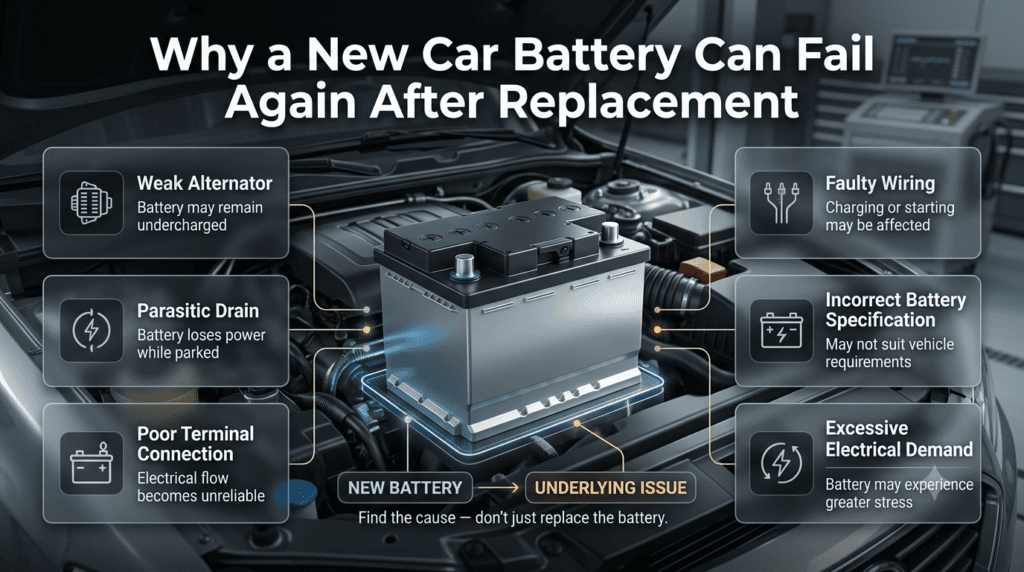
One of the most frustrating situations for a driver is installing a new battery and then experiencing another no-start condition soon afterward.
When this happens, the replacement battery may not be the problem.
Possible underlying causes include:
| Underlying Issue | How It Can Affect the New Battery |
|---|---|
| Weak alternator | Battery may remain undercharged |
| Parasitic drain | Battery loses power while parked |
| Poor terminal connection | Electrical flow becomes unreliable |
| Faulty wiring | Charging or starting may be affected |
| Incorrect battery specification | Battery may not suit vehicle requirements |
| Excessive electrical demand | Battery may experience greater stress |
This is why a professional Car Repair diagnosis should investigate the reason behind repeated battery failure rather than simply replacing components each time.
How Parking Conditions in Dubai Can Affect Battery Reliability
Office commuters often leave their vehicles parked for several hours during the hottest part of the day.
Extended exposure to high temperatures can contribute to battery deterioration, particularly when the battery is already aging.
The effect can become more noticeable when a vehicle is parked outdoors repeatedly throughout the working week.
Commuter Pattern
Morning: Vehicle starts normally.
Commute: Air conditioning and electrical systems operate continuously.
Workday: Vehicle remains parked for several hours.
Afternoon: Vehicle has experienced prolonged heat exposure.
Return journey: Battery may struggle to provide sufficient starting power.
This does not mean every hot parking period will cause battery failure. Instead, it can become an important contributing factor when combined with battery age, charging problems, or electrical drain.
Should You Check the Battery Before a Long Dubai Drive?
Yes.
A battery problem discovered before a journey is far easier to manage than a complete failure after you have already started driving.
This is particularly useful before:
- Long-distance trips
- Weekend travel
- Airport journeys
- Extended highway driving
- Road trips
- Periods of unusually high temperatures
If you have noticed slower starting, repeated jumpstarts, or electrical irregularities, arrange a battery and charging-system inspection before relying on the vehicle for an important journey.
How Much Does Battery Replacement Cost in Dubai?
Battery replacement pricing can vary considerably depending on the vehicle and battery specification.
Important cost factors include:
- Battery technology
- Battery capacity
- Vehicle requirements
- Brand
- Warranty
- Installation
- Battery size
- Start-stop compatibility
- AGM or conventional technology
Therefore, comparing prices without comparing specifications can be misleading.
Drivers researching the market can review a car battery price guide in Dubai to understand the factors that can influence replacement costs.
The cheapest battery is not necessarily the most appropriate choice if it does not meet the manufacturer’s specifications.
Battery Replacement Should Match the Vehicle, Not Just the Budget
When replacing a failed battery, drivers sometimes focus exclusively on price.
A better approach is to consider compatibility, specifications, expected operating conditions, warranty, and installation quality.
Depending on the vehicle, available battery options may include:
- Amaron Battery
- Bosch Battery
- Tuflong Battery
- AGM Battery
- Exide Battery
- Panasonic Battery
- FIAMM Battery
- AC Delco Battery
The correct option depends on the vehicle’s requirements, so battery selection should be based on specification rather than brand popularity alone.
Professional Recommendation for Daily Dubai Commuters
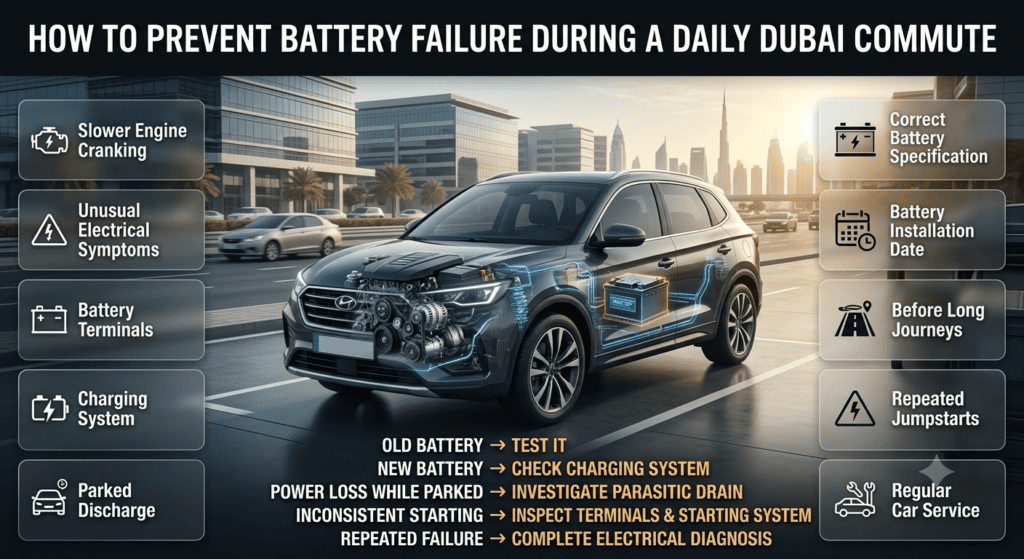
If your vehicle has already experienced a battery failure despite being driven every day, don’t treat the event as an isolated inconvenience.
Look for the pattern behind it.
If the battery is old, test it.
If the battery is relatively new, investigate the charging system.
If the vehicle loses power while parked, investigate parasitic drain.
If starting is inconsistent, inspect the battery terminals and starting system.
If the same problem continues after replacement, carry out a complete electrical diagnosis.
This approach can save time, reduce unnecessary component replacement, and improve long-term vehicle reliability.
How to Prevent Battery Failure During a Daily Office Commute
The best time to think about battery reliability is before the car refuses to start.
For drivers who use the same vehicle every weekday, battery problems can often be identified through changes in starting behavior and routine maintenance checks. Waiting until the battery completely fails can turn a manageable maintenance issue into an inconvenient roadside breakdown.
A practical prevention strategy should combine battery testing with inspection of the charging system and the vehicle’s wider electrical condition.
A Simple Preventive Approach
✔ Pay attention to slower engine cranking.
✔ Check the battery when unusual electrical symptoms appear.
✔ Inspect battery terminals during routine servicing.
✔ Test the charging system if the battery repeatedly loses charge.
✔ Investigate overnight or weekend discharge.
✔ Use the correct battery specification for the vehicle.
✔ Keep track of when the battery was installed.
✔ Arrange an inspection before important long-distance journeys.
✔ Don’t ignore repeated jumpstart requirements.
✔ Include electrical-system checks in regular Car Service appointments.
The objective isn’t to replace the battery unnecessarily. It is to identify deterioration early enough to avoid an unexpected failure.
How Often Should a Dubai Commuter Check the Car Battery?
There is no single inspection interval that applies to every vehicle because battery condition depends on age, vehicle design, driving pattern, climate, and electrical demand.
However, drivers who regularly commute through Dubai can benefit from checking battery condition during routine servicing and whenever starting behavior changes.
Situations That Justify an Earlier Inspection
| Situation | Why an Inspection Makes Sense |
|---|---|
| Vehicle starts more slowly | Possible loss of battery capacity |
| Battery is getting older | Failure risk can increase |
| Frequent short journeys | Battery may receive limited charging time |
| Repeated jumpstarts | Underlying problem may exist |
| Battery warning appears | Charging system needs attention |
| Vehicle sits unused frequently | Discharge can become more noticeable |
| New battery loses charge | Possible charging or electrical fault |
| Extreme heat exposure | Additional environmental stress |
A battery inspection does not necessarily mean replacement. Testing can help determine whether the battery is still suitable for continued use.
What Is the Best Maintenance Routine for an Office Commuter?
A daily driver benefits from a simple maintenance routine that focuses on early detection rather than emergency repair.
Weekly Awareness
You don’t need to perform complicated mechanical work every week. Instead, notice changes in how the vehicle behaves.
Pay attention to:
- Engine starting speed
- Dashboard warnings
- Headlight behavior
- Unusual electrical symptoms
- Repeated starting difficulties
During Routine Servicing
Ask the technician to consider:
- Battery condition
- Charging performance
- Battery terminals
- Electrical connections
- Vehicle-specific battery requirements
Before Long Trips
If your battery has already shown signs of weakness, don’t wait until the journey begins.
A pre-trip Vehicle Inspection can identify problems before they become roadside emergencies.
Why Repeated Jumpstarts Should Never Be Ignored
A jumpstart can be extremely useful when a vehicle will not start, but repeatedly depending on jumpstarts is a different situation.
If your car requires external assistance again and again, something needs to be investigated.
The battery may have lost its ability to retain charge, but other possibilities include:
- Alternator problems
- Parasitic drain
- Poor battery connections
- Electrical faults
- Incorrect battery specification
- Excessive discharge
The Wrong Approach
Battery dies → jumpstart → continue driving → battery dies again → jumpstart again
The Better Approach
Battery dies → temporary jumpstart → professional diagnosis → identify cause → repair or replace as required
This distinction can prevent a recurring breakdown cycle.
Does Driving Longer Recharge a Weak Battery?
Longer driving can give the charging system more time to replenish battery energy, but it should not be considered a guaranteed solution to a weak or failing battery.
If the battery is deteriorated internally, additional driving will not restore it to its original condition.
Likewise, if the alternator is not charging correctly, simply driving farther will not solve the underlying charging problem.
Therefore, a long drive should not be used as a substitute for diagnosis.
If a battery repeatedly loses charge, the correct response is to determine whether the problem is battery deterioration, insufficient charging, excessive electrical consumption, or another fault.
Can Air Conditioning Use Affect a Weak Battery?
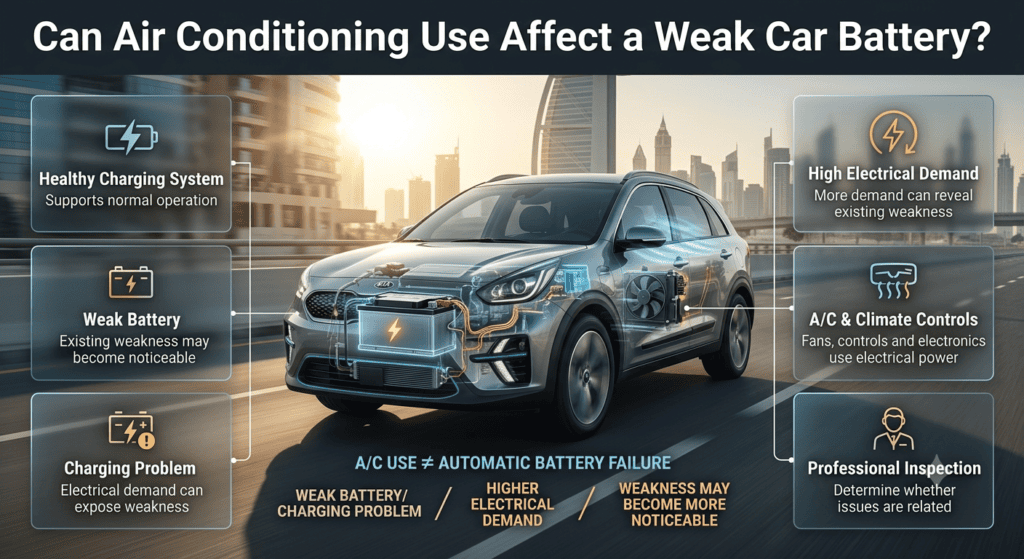
Dubai’s climate makes air conditioning essential for comfortable driving.
The vehicle’s electrical system supports numerous components associated with cooling and climate control, including fans, controls, electronics, and other systems.
A healthy charging system is designed to support normal operation.
The concern arises when the vehicle already has a weak battery or charging problem. In that situation, high electrical demand can make an existing weakness more noticeable.
This is why a battery problem should not automatically be blamed on the air conditioner itself.
If your vehicle is experiencing both battery problems and cooling issues, a professional inspection can determine whether the issues are related or simply occurring at the same time.
Why Battery Condition Should Be Considered During AC Servicing
Dubai drivers often schedule AC Repair or air-conditioning maintenance before or during the hotter months.
That service visit can also be a convenient opportunity to consider the vehicle’s electrical condition.
Modern climate-control systems depend on multiple electrical components, while cooling fans and related systems can place additional demand on the vehicle’s electrical architecture.
This doesn’t mean an AC service automatically includes battery diagnosis. Rather, if the vehicle already has starting or electrical symptoms, both concerns should be communicated to the technician.
Battery Maintenance Should Be Part of Overall Vehicle Maintenance
A battery does not operate independently from the rest of the vehicle.
Starting reliability depends on the interaction between:
Battery + Starter + Alternator + Wiring + Electrical Modules
A problem in one area can affect the others.
This is why a complete Vehicle Maintenance strategy should not focus only on oil changes and tires.
Depending on the vehicle’s age and condition, routine maintenance may also include:
- Battery inspection
- Engine diagnostics
- Brake inspection
- Tire checks
- Cooling-system inspection
- Oil and filter service
- Suspension inspection
- Charging-system testing
- Electrical-system diagnosis
For professional support, a qualified Auto Workshop can evaluate these systems according to the vehicle’s condition rather than applying the same maintenance approach to every car.
When Should You Replace a Car Battery?
Battery replacement should ideally be based on condition and testing, not simply a calendar date.
Some batteries may continue performing reliably for longer than expected, while others can deteriorate earlier due to operating conditions.
Consider Professional Testing When:
- Starting becomes noticeably slower
- The battery repeatedly becomes discharged
- The car requires jumpstarts
- Electrical symptoms appear
- The battery warning light appears
- The battery has been exposed to demanding conditions for an extended period
- A previous battery failure has occurred
A professional technician can determine whether the battery still has sufficient starting capability.
Replacing a healthy battery prematurely is unnecessary, while continuing to rely on a severely deteriorated battery can increase the risk of an inconvenient breakdown.
What Happens If You Keep Driving With a Weak Battery?
A weak battery can create increasing starting uncertainty.
The vehicle may continue functioning normally while driving because the alternator supplies electrical power when the engine is running. The problem may become obvious when the vehicle is switched off and needs to start again.
That can leave you stranded:
- At work
- In a shopping area
- At home
- At an airport
- During a roadside stop
- Before an important journey
For this reason, unusual starting behavior should be investigated rather than ignored.
Professional Battery Replacement Process
When testing confirms that replacement is necessary, the installation should be treated as more than simply removing one battery and installing another.
A professional replacement process may include:
1. Confirming the correct battery specification
The replacement should match the vehicle’s requirements.
2. Checking the old battery
The technician can evaluate whether deterioration is consistent with normal battery aging or whether another issue may have contributed.
3. Inspecting terminals and cables
Connections should be checked before the replacement is installed.
4. Installing the replacement correctly
The battery should be securely mounted with appropriate connections.
5. Checking the charging system
This is particularly important when the previous battery failed unexpectedly.
6. Checking vehicle-specific battery-management requirements
Some modern vehicles may require additional procedures after battery replacement.
7. Testing starting performance
The vehicle should be checked after installation to confirm proper operation.
This approach reduces the chance of replacing the battery while leaving an underlying electrical problem unresolved.
Modern Battery Technology Is Changing Vehicle Maintenance
Automotive batteries are becoming more closely integrated with modern vehicle electrical systems.
Traditional vehicles may use conventional lead-acid batteries, while vehicles equipped with advanced electrical systems and start-stop technology may require different battery technologies.
Common Technologies
| Battery Type | Typical Application Consideration |
|---|---|
| Conventional lead-acid | Common in many standard vehicles |
| EFB | Used in some vehicles with increased electrical demands |
| AGM | Often used where higher cycling performance is required |
| Advanced vehicle battery systems | Increasingly relevant in electronically complex vehicles |
The correct technology depends on the vehicle.
A driver should never switch battery types simply because one appears more powerful or expensive. The vehicle manufacturer’s requirements should determine the appropriate specification.
Why AGM Batteries Are Important for Some Modern Cars
AGM, or Absorbent Glass Mat, battery technology is designed for applications that can require increased cycling performance and electrical capability.
It is commonly associated with vehicles that have higher electrical demands or certain start-stop configurations.
However, AGM is not automatically better for every vehicle.
The important question is:
Does the vehicle require or support AGM technology?
If yes, installing the appropriate AGM battery can be an important part of maintaining the vehicle’s intended electrical performance.
Drivers whose vehicles require this technology can explore AGM battery replacement in Dubai as part of their replacement research.
Battery Brand vs Battery Specification: What Matters More?
Drivers often ask whether one battery brand is better than another.
Brand reputation can matter, but correct specification should come first.
A high-quality battery that does not match the vehicle’s requirements is not necessarily a better choice than a properly specified alternative.
When comparing options, consider:
- Correct dimensions
- Capacity
- Starting performance
- Battery technology
- Manufacturer specification
- Vehicle electrical requirements
- Warranty
- Installation quality
For example, depending on vehicle compatibility, drivers may consider Exide Battery, Panasonic Battery, FIAMM Battery, or AC Delco Battery.
The final selection should always be matched to the vehicle.
A Dubai Commuter’s Battery Failure Prevention Checklist
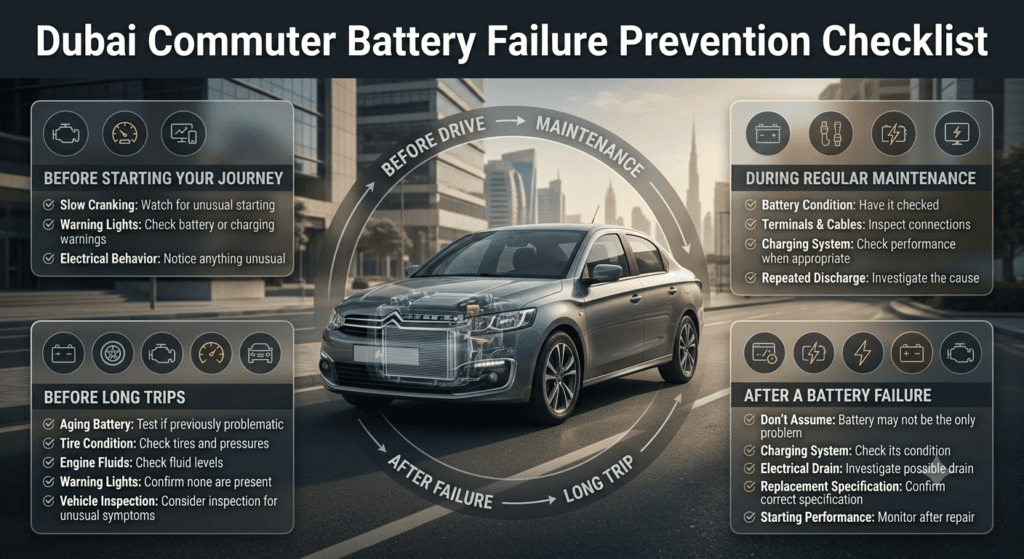
Use this practical checklist if your vehicle is driven to and from work most days.
Before Starting Your Journey
✔ Pay attention to slow or unusual cranking.
✔ Check for battery or charging warning lights.
✔ Notice unusual electrical behavior.
During Regular Maintenance
✔ Have battery condition checked.
✔ Inspect terminals and cables.
✔ Check charging-system performance when appropriate.
✔ Investigate repeated discharge.
Before Long Trips
✔ Test an aging or previously problematic battery.
✔ Check tire condition and pressures.
✔ Check engine fluids.
✔ Confirm that warning lights are not present.
✔ Consider a broader Vehicle Inspection if the vehicle has developed unusual symptoms.
After a Battery Failure
✔ Don’t assume the battery was the only problem.
✔ Check the charging system.
✔ Investigate possible electrical drain.
✔ Confirm the replacement specification.
✔ Monitor starting performance after repair.
Common Mistakes Dubai Drivers Make After Battery Failure
Mistake 1: Buying the Cheapest Battery Immediately
Price is important, but selecting a battery based only on cost can lead to an unsuitable specification.
Better approach: Compare compatibility, technology, warranty, and installation quality.
Mistake 2: Replacing the Battery Without Testing the Alternator
A charging-system fault can damage the reliability of a replacement battery.
Better approach: Include charging-system testing when investigating repeated battery failure.
Mistake 3: Assuming Daily Driving Means the Battery Is Fully Charged
Regular driving is not the same as guaranteed full charging.
Better approach: Consider journey length, electrical load, battery condition, and charging performance.
Mistake 4: Ignoring a Slow Start
A vehicle that still starts is not necessarily free of battery problems.
Better approach: Investigate noticeable changes in starting performance before the battery completely fails.
Mistake 5: Repeatedly Using Jumpstarts Without Diagnosis
A jumpstart solves the immediate starting problem, not necessarily the underlying cause.
Better approach: Diagnose recurring discharge.
Expert Insight: Think Beyond the Battery
When a commuter says, “My battery failed even though I drive every day,” the correct professional response should not simply be, “You need a new battery.”
The better diagnostic question is:
What changed in the vehicle’s starting, charging, or electrical system that allowed the battery to become unable to start the engine?
That question leads to a much more useful inspection.
The battery may be old. The alternator may be weak. A connection may be poor. An accessory may be consuming power while parked. Or the battery may simply have reached the end of its service life.
Identifying the actual cause is what turns a temporary fix into reliable Mechanical Repair and long-term vehicle maintenance.
Future Outlook: Predictive Battery Maintenance
As vehicle electronics become more advanced, battery monitoring is also becoming more sophisticated.
Modern vehicles can use battery sensors, electronic control modules, intelligent charging strategies, and diagnostic systems to monitor electrical conditions more precisely.
The long-term direction of automotive maintenance is moving toward predictive maintenance, where vehicle data can help identify potential problems before they become breakdowns.
For conventional petrol and diesel cars, this means battery health may increasingly be evaluated alongside other electronic and mechanical parameters rather than being treated as an isolated component.
For newer vehicles, especially those with extensive electronic systems, professional diagnostics are becoming increasingly important.
Professional Recommendation
For a Dubai office commuter, the best battery strategy is simple:
Don’t wait for complete failure to start thinking about battery health.
If your car starts slowly, needs repeated jumpstarts, loses charge while parked, or shows electrical warnings, arrange an inspection.
If testing confirms that the battery has reached the end of its service life, choose the correct replacement specification rather than simply purchasing the cheapest available option.
And if a new battery repeatedly fails, investigate the alternator, electrical connections, charging system, and parasitic drain before replacing another battery.
This approach provides better reliability and reduces the chance of repeating the same breakdown.
Why did my car battery fail even though I drive to work every day in Dubai?
Driving every day does not necessarily mean your battery is being fully recharged. A daily office commute can involve repeated engine starts, short-distance driving, heavy traffic, high air-conditioning use, and long periods of parking. If the battery is already aging or the charging system is not performing properly, the energy used during starting may not be adequately restored.
Dubai’s high temperatures can also accelerate battery deterioration. This means a battery that has been gradually losing capacity may continue working normally until one particularly demanding start exposes the problem.
Things worth checking:
Battery age and current condition
Length of your daily commute
Alternator and charging performance
Battery terminals and cable connections
Possible electrical drain while parked
Previous history of slow engine starting
If the battery has failed repeatedly despite regular driving, don’t assume that another battery is automatically the solution. A proper car battery replacement service in Dubai should ideally be accompanied by an inspection of the charging and electrical system.
How can I tell if my car battery is failing or the alternator is the problem?
Battery and alternator problems can produce very similar symptoms, which is why replacing the battery based only on symptoms can sometimes lead to another breakdown.
A weak battery commonly causes slow engine cranking, clicking when you attempt to start the vehicle, or difficulty starting after the car has been parked. An alternator problem, on the other hand, can prevent the battery from receiving sufficient charge while you are driving. In that situation, even a relatively new battery can eventually become discharged.
The timing of the problem can provide a useful clue. If the vehicle starts normally after receiving a jumpstart but repeatedly loses charge afterward, the charging system deserves attention.
A professional inspection should consider:
Battery condition and starting capacity
Alternator charging performance
Battery terminals and cables
Ground connections
Warning lights
Possible parasitic electrical drain
Overall starting-system performance
The important point is that battery testing and charging-system testing should be considered together when a vehicle repeatedly loses starting power.
Can Dubai heat cause a car battery to die suddenly?
Dubai’s extreme heat can contribute significantly to battery deterioration, particularly when a battery is already approaching the end of its useful service life. High temperatures can accelerate the aging of battery components, while temperatures inside the engine compartment can become particularly demanding.
The reason a driver may experience this as a “sudden” failure is that battery deterioration can remain hidden until the battery’s available reserve becomes too low. The vehicle may start normally for months and then suddenly struggle when conditions become more demanding.
Heat is not necessarily the only cause. Battery age, charging performance, electrical demand, and maintenance history all need to be considered.
For Dubai drivers, it is sensible to:
Pay attention to slower starting
Have an aging battery tested
Check charging-system performance when symptoms appear
Inspect battery connections
Avoid ignoring repeated jumpstart requirements
Have the battery checked before important long-distance journeys
A battery that is already weak can become much less dependable when exposed to demanding operating conditions, so early diagnosis is generally more useful than waiting for complete failure.
Why does my car battery keep dying after I replace it with a new one?
When a new battery repeatedly becomes discharged, the battery itself may not be the real problem. One of the first things to investigate is whether the alternator is charging correctly. If charging output is insufficient, the replacement battery can gradually lose its available charge even though the vehicle is being driven regularly.
Another possibility is a parasitic electrical drain. This happens when an electrical component continues consuming power while the vehicle is parked. After several hours or overnight, enough energy may be lost to create another starting problem.
Poor battery connections, wiring faults, aftermarket accessories, and an incorrect battery specification can also contribute.
If a replacement battery fails repeatedly, ask for these checks:
Battery condition
Alternator output
Charging-system operation
Battery terminals
Ground connections
Parasitic drain
Electrical accessories
Correct battery specification
Repeatedly replacing batteries without identifying the underlying cause can become an expensive cycle. A professional Vehicle Inspection is a much better approach when the same problem keeps returning.
Should I get a jumpstart or replace my battery if my car won’t start after work?
The correct choice depends on why the vehicle failed to start. A jumpstart can be useful when the battery has become temporarily discharged, such as after leaving an electrical accessory operating or when the vehicle has been parked for an extended period. However, a jumpstart does not repair a battery that has deteriorated internally, nor does it fix a faulty alternator or electrical drain.
If the vehicle starts successfully after a jumpstart but later develops the same problem, that is a strong reason to investigate the underlying electrical system rather than repeatedly relying on external starting assistance.
A sensible approach is:
Use professional roadside assistance when the vehicle cannot safely restart
Have the battery tested after the immediate problem is resolved
Check the charging system
Investigate repeated discharge
Replace the battery only when testing confirms it is no longer reliable
Verify that the replacement matches the vehicle’s requirements
For drivers who experience a breakdown during their commute, Roadside Assistance and a professional Car Battery Replacement service can address the immediate problem, while proper diagnosis helps prevent the same failure from happening again.
Final FAQ Takeaway
For a Dubai commuter, a failed battery should be treated as a diagnostic problem rather than simply a replacement problem. Heat, short commutes, heavy traffic, battery age, charging-system faults, and electrical drains can all contribute to starting failure.
The most reliable solution is to identify the underlying cause first, then choose the appropriate repair or replacement based on the vehicle’s actual condition.
Conclusion
A battery failed after daily office commute in Dubai situation is a reminder that regular driving alone does not guarantee a healthy battery. Daily stop-and-go traffic, repeated engine starts, high electrical demand, prolonged parking, battery age, and Dubai’s demanding climate can gradually reduce battery performance. In some cases, the battery is only the visible symptom while the actual cause is a weak alternator, poor connection, parasitic drain, or another electrical fault.
For commuters, the best approach is to investigate warning signs before complete failure. Slow engine cranking, repeated jumpstarts, battery warnings, or a vehicle that struggles after several hours of parking should not be ignored. A proper inspection can determine whether the vehicle needs Battery Replacement, charging-system repair, electrical diagnosis, or another form of Car Repair.
When replacement is necessary, selecting the correct battery specification is just as important as choosing a reputable battery brand. Whether the vehicle requires a conventional battery, AGM technology, or another specification, compatibility with the manufacturer’s requirements should come first.
Most importantly, don’t treat a battery breakdown as an isolated event. Combine regular Vehicle Maintenance, battery testing, Engine Diagnostics, and professional inspection to reduce the likelihood of another unexpected no-start situation. With the right preventive approach, Dubai office commuters can maintain better starting reliability and keep their vehicles dependable through demanding daily driving conditions.
For professional automotive support, EuroSwift Auto Services can be a useful point of contact when you need battery assistance, vehicle diagnostics, Roadside Assistance, or other automotive maintenance and repair services.
Leave a Reply