
Introduction
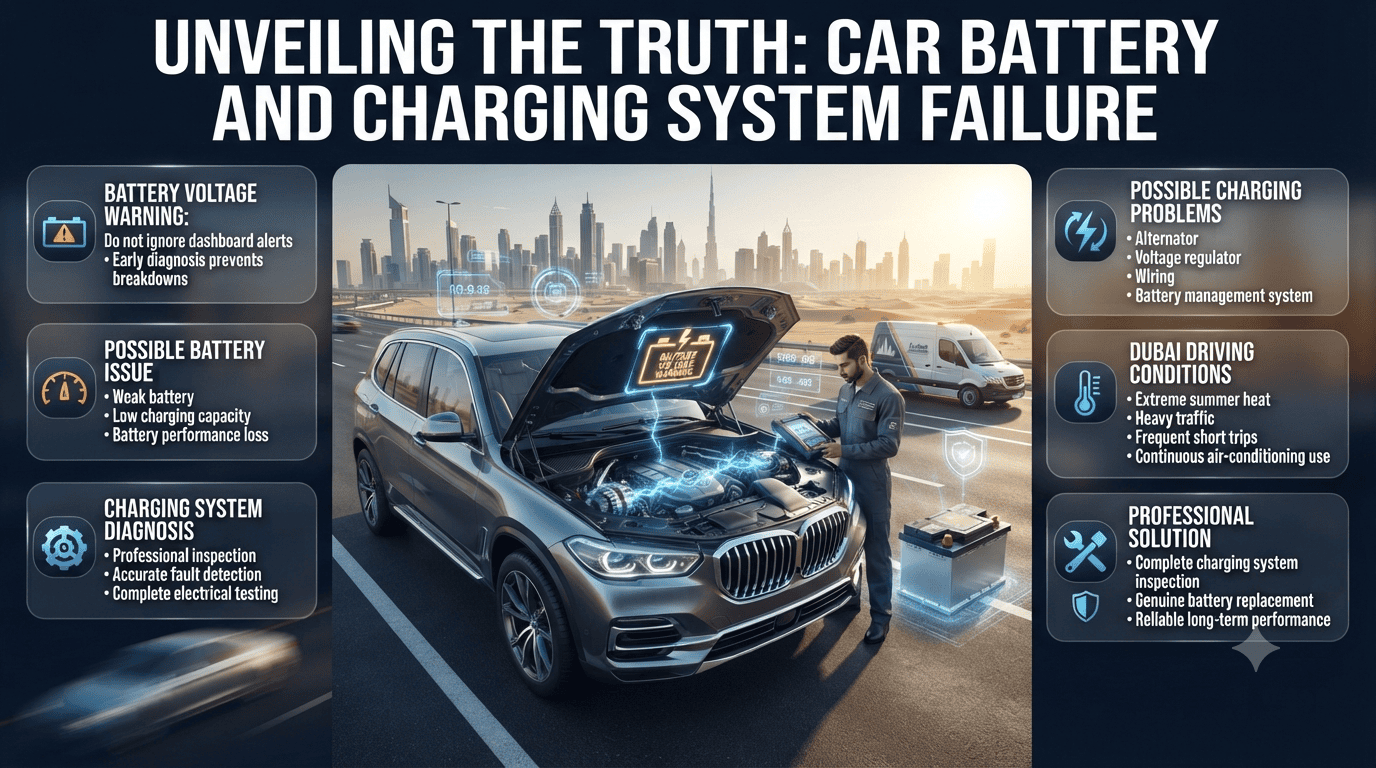
Fastest Premium & Genuine Battery Replacement After Battery Voltage Warning Dubai | Seeing a battery voltage warning on your dashboard can be alarming, especially if your vehicle appears to be running normally. Many drivers assume the warning simply means the battery has reached the end of its life, but in reality, it often points to a problem within the vehicle’s charging system. The issue could involve the battery, alternator, voltage regulator, wiring, or even an electronic battery management system. Ignoring this warning may result in a sudden breakdown, leaving you stranded at the most inconvenient time.
Dubai’s harsh climate makes battery-related issues even more common. Prolonged exposure to extreme temperatures, heavy traffic, frequent short trips, and continuous air-conditioning use all place additional stress on the charging system. This is why a professional diagnosis should always be the first step before replacing any battery.
At EuroSwift Auto Services, technicians perform a complete charging system inspection to determine whether the problem requires a Battery Replacement, alternator repair, or another electrical solution. Identifying the real cause early helps prevent unnecessary repairs, protects sensitive vehicle electronics, and keeps your car reliable on Dubai’s busy roads.
What Does a Battery Voltage Warning Mean?
A battery voltage warning indicates that the electrical charging system is no longer operating within the manufacturer’s recommended voltage range. Contrary to popular belief, this warning does not always mean the battery has failed. Instead, it tells you that the vehicle is detecting either insufficient or excessive charging voltage.
Modern vehicles constantly monitor battery performance through sensors connected to the Engine Control Module (ECM). If the system detects abnormal charging behaviour, it immediately activates the dashboard warning light to alert the driver before a complete electrical failure occurs.
Ignoring this warning can eventually affect engine performance, transmission electronics, safety systems, and even prevent the vehicle from starting altogether.
Common Reasons the Warning Appears
- Weak or aging battery
- Failing alternator
- Faulty voltage regulator
- Loose or corroded battery terminals
- Damaged charging cables
- Worn serpentine belt
- Battery sensor malfunction
- Excessive electrical load
- Internal battery cell failure
Professional diagnostics are essential because replacing the battery without identifying the root cause may only provide a temporary solution.
Understanding How Your Vehicle Charging System Works
Every modern vehicle depends on several components working together to maintain a stable electrical supply. If one component fails, the entire charging system can become unstable.
| Component | Function | If It Fails |
|---|---|---|
| Battery | Stores energy for engine starting | Vehicle may not start |
| Alternator | Recharges battery while driving | Battery gradually discharges |
| Voltage Regulator | Controls charging voltage | Overcharging or undercharging |
| Serpentine Belt | Drives the alternator | Charging system stops working |
| Battery Sensor | Monitors battery health | Incorrect charging information |
| Battery Cables | Deliver electrical current | Voltage drop and poor performance |
A proper Vehicle Inspection should evaluate each of these components instead of replacing parts based on guesswork.
Why You Should Never Ignore a Battery Voltage Warning
Many vehicles continue running for some time after the warning appears, giving drivers a false sense of security. However, once the battery charge becomes too low, the alternator can no longer support all electrical systems, leading to progressive failures.
Today’s vehicles rely heavily on electronic modules to control everything from engine timing to adaptive safety systems. Even a small voltage fluctuation can cause unexpected behaviour and expensive repairs if ignored.
Risks of Continuing to Drive
✔ Complete battery discharge
✔ Engine failing to restart
✔ Vehicle stalling unexpectedly
✔ Alternator damage
✔ ECU communication faults
✔ Sensor failures
✔ Dashboard warning lights multiplying
✔ Reduced fuel efficiency
✔ Roadside breakdown
✔ Increased repair costs
Scheduling a professional inspection at EuroSwift Auto Services as soon as the warning appears can prevent these issues from developing into major mechanical or electrical failures.
Common Causes of Battery Voltage Warnings in Dubai
Dubai’s environment creates unique challenges for vehicle batteries. High temperatures, traffic congestion, and demanding driving conditions all contribute to faster battery wear compared to many other regions.
1. Extreme Summer Heat
Heat is one of the biggest enemies of automotive batteries. While many people associate battery failures with cold weather, excessive heat actually causes faster internal chemical deterioration.
Continuous exposure to temperatures above 45°C accelerates electrolyte evaporation and damages the battery’s internal plates. Over time, this reduces the battery’s ability to hold a charge and increases the likelihood of a voltage warning.
Drivers who need a high-performance replacement often choose an AGM Battery because it is designed to handle greater electrical demand and offers improved durability for vehicles equipped with advanced electronic systems.
2. Heavy Stop-and-Go Traffic
Daily commuting through congested roads places additional strain on the charging system.
When the engine spends long periods idling, the alternator may not generate enough power to fully recharge the battery while electrical accessories continue consuming energy.
High-demand accessories include:
- Air conditioning
- Cooling fans
- Navigation systems
- Infotainment screens
- Phone chargers
- Dash cameras
- Heated or ventilated seats
Over time, this imbalance contributes to reduced battery performance.
3. Frequent Short Trips
Every engine start consumes a significant amount of electrical energy.
If your daily journeys last only a few minutes, the alternator may not have enough time to restore the battery to full capacity before the engine is switched off again.
Repeated shallow charging cycles shorten battery life and often trigger battery voltage warnings earlier than expected.
4. Battery Age
Even premium batteries lose capacity as they age.
In Dubai, many conventional batteries begin showing signs of deterioration after two to three years due to constant exposure to heat and heavy electrical demand.
Drivers looking for dependable long-term performance frequently consider trusted options such as an Amaron Battery or a Bosch Battery, depending on their vehicle manufacturer’s specifications and driving habits.
5. Poor Battery Maintenance
Simple maintenance issues are responsible for many charging problems.
Common examples include:
✔ Corroded battery terminals
✔ Loose cable connections
✔ Dirty terminal clamps
✔ Damaged battery casing
✔ Loose ground connections
✔ Worn charging cables
Routine inspections can identify these issues before they lead to complete battery failure.
Expert Insight
A battery voltage warning should never be treated as a signal to replace the battery immediately. Professional technicians first verify battery health, alternator output, charging voltage, cable integrity, and parasitic current draw before recommending repairs. This approach reduces unnecessary expenses and ensures the actual fault is corrected.
If testing confirms that the battery has reached the end of its service life, reviewing the Complete Guide to Car Battery Prices in Dubai can help you compare battery types, warranty options, and installation costs before making an informed decision.
Professional Battery Diagnostic Process Before Replacement
A battery voltage warning should always be investigated through a systematic diagnostic process rather than assuming the battery is faulty. Modern vehicles use sophisticated charging systems that require specialized equipment to identify the exact cause of the warning. Replacing a battery without testing the entire system may temporarily solve the symptom while the real fault remains unresolved.
At EuroSwift Auto Services, technicians follow a step-by-step diagnostic procedure to determine whether the issue originates from the battery, alternator, voltage regulator, electrical wiring, or battery management system.
Standard Diagnostic Procedure
✔ Visual inspection of the battery and terminals
✔ Battery resting voltage test
✔ Battery load capacity test
✔ Alternator charging output inspection
✔ Voltage regulator performance verification
✔ Starter motor current draw test
✔ Battery sensor evaluation
✔ OBD diagnostic scan for charging system fault codes
✔ Electrical cable continuity inspection
✔ Parasitic battery drain testing
Performing these tests ensures the correct repair is carried out the first time, reducing unnecessary replacement costs.
Battery vs Alternator vs Starter Motor
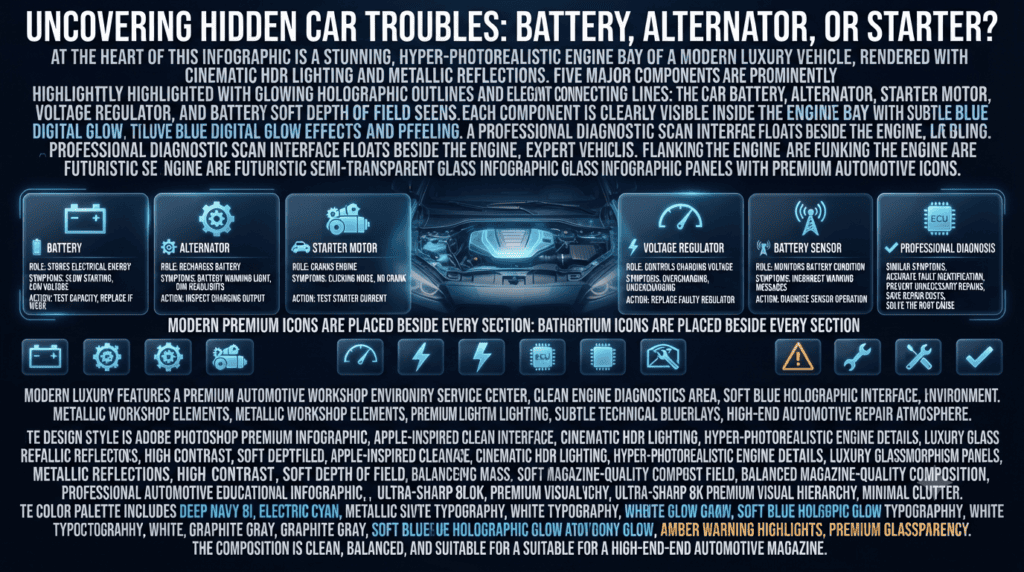
Many electrical problems produce similar symptoms, making professional diagnosis essential. While drivers often blame the battery, the actual issue may lie elsewhere within the charging or starting system.
| Component | Primary Role | Common Symptoms | Recommended Action |
|---|---|---|---|
| Battery | Stores electrical energy | Slow starting, low voltage | Test capacity and replace if weak |
| Alternator | Recharges battery | Battery warning light, dim lights | Inspect charging output |
| Starter Motor | Cranks the engine | Clicking noise or no crank | Test starter current draw |
| Voltage Regulator | Controls charging voltage | Overcharging or undercharging | Replace faulty regulator |
| Battery Sensor | Monitors battery condition | Incorrect warning messages | Diagnose sensor operation |
Replacing the wrong component not only increases repair costs but may also leave the original problem unresolved.
How Modern Vehicle Battery Diagnostics Work
Unlike older vehicles, today’s cars continuously monitor battery performance using intelligent charging systems. These systems calculate battery health based on voltage, current flow, battery temperature, and charging history.
When abnormal readings are detected, the Engine Control Module (ECM) stores diagnostic trouble codes that help technicians identify the exact source of the problem.
Professional Engine Diagnostics allow technicians to access these codes and analyze live charging data instead of relying on guesswork.
Modern Diagnostic Equipment Can Measure
- Battery State of Charge (SOC)
- Battery State of Health (SOH)
- Alternator output voltage
- Charging current
- Battery internal resistance
- Starter current consumption
- Voltage drop across cables
- Battery temperature
- Charging efficiency
These advanced tests provide a much clearer picture than a simple voltage reading.
Essential Battery Tests Performed Before Replacement
Replacing a battery without testing it can lead to unnecessary expenses. Each diagnostic test reveals different information about the charging system.
1. Resting Voltage Test
This test measures battery voltage after the vehicle has been parked.
| Battery Voltage | Battery Condition |
|---|---|
| 12.6V–12.8V | Fully charged |
| 12.4V | Partially charged |
| 12.2V | Low charge |
| Below 12.0V | Severely discharged |
A low reading does not always indicate battery failure, as charging system problems may also cause reduced voltage.
2. Battery Load Test
A load test evaluates the battery’s ability to deliver high current during engine startup.
If voltage drops excessively under load, the battery may no longer provide sufficient cranking power.
This test is particularly important for vehicles operating in Dubai’s high-temperature environment.
3. Alternator Charging Test
Once the engine starts, technicians verify whether the alternator supplies adequate charging voltage.
Typical charging voltage ranges between approximately 13.5V and 14.7V depending on vehicle design.
Readings outside this range require further investigation.
4. Parasitic Drain Test
Some vehicles continue consuming excessive electrical power even after the engine is switched off.
Common causes include:
- Faulty control modules
- Interior lights remaining active
- Dash cameras
- GPS trackers
- Aftermarket accessories
- Alarm systems
A parasitic drain test identifies components that slowly discharge the battery overnight.
Should You Repair the Charging System or Replace the Battery?
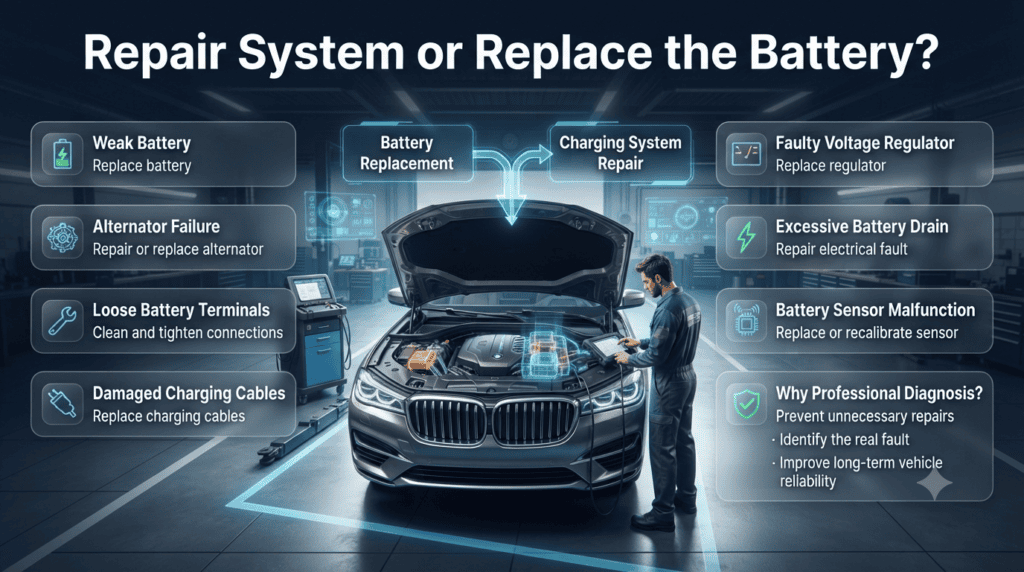
Not every battery voltage warning requires installing a new battery.
Professional diagnosis determines whether replacing the battery alone will solve the problem or whether another component requires repair.
| Problem Found | Recommended Solution |
|---|---|
| Weak battery | Battery Replacement |
| Alternator failure | Alternator repair or replacement |
| Loose battery terminals | Clean and tighten connections |
| Damaged charging cables | Replace cables |
| Faulty voltage regulator | Replace regulator |
| Excessive battery drain | Repair electrical fault |
| Battery sensor malfunction | Replace or recalibrate sensor |
Correct diagnosis prevents unnecessary repairs while improving long-term vehicle reliability.
Choosing the Right Battery for Your Vehicle
Selecting the correct battery involves much more than matching physical size. Every vehicle has specific electrical requirements based on engine size, onboard electronics, and charging system design.
Installing an incorrect battery can affect charging performance, reduce battery life, and trigger additional dashboard warnings.
Factors Considered During Battery Selection
✔ Cold Cranking Amps (CCA)
✔ Amp Hour Rating (Ah)
✔ Reserve Capacity
✔ Battery Dimensions
✔ Terminal Configuration
✔ Vehicle Manufacturer Specifications
✔ Start-Stop Compatibility
✔ Climate Suitability
Professional technicians always recommend a battery that meets or exceeds the manufacturer’s original specifications.
Comparing Popular Car Battery Brands
Drivers in Dubai have access to several high-quality battery manufacturers. The ideal choice depends on the vehicle type, electrical demand, and driving habits.
| Battery Brand | Best For | Key Benefits |
|---|---|---|
| Amaron Battery | Daily commuting | Long service life and strong heat resistance |
| Bosch Battery | European and luxury vehicles | Reliable starting power and advanced technology |
| Exide Battery | Family cars | Excellent value and dependable performance |
| Panasonic Battery | Japanese vehicles | Consistent charging efficiency |
| FIAMM Battery | Premium vehicles | Stable voltage delivery and durability |
| AC Delco Battery | American vehicles | High cranking performance |
| Tuflong Battery | Budget-conscious drivers | Reliable everyday performance |
The best battery is always the one that matches your vehicle’s specifications and operating conditions rather than simply choosing the highest-capacity option.
Mobile Battery Replacement in Dubai
When a battery voltage warning turns into a no-start condition, a mobile replacement service can save valuable time and eliminate the need for towing.
Professional mobile technicians arrive equipped with diagnostic tools, compatible replacement batteries, and installation equipment, allowing most vehicles to be serviced at the customer’s location.
A typical mobile service includes:
- Complete charging system diagnosis
- Battery health verification
- Safe battery removal
- Installation of the correct replacement battery
- Terminal cleaning
- Charging system re-test
- Battery registration (if required)
- Final performance verification
Choosing a trusted provider such as EuroSwift Auto Services ensures that the replacement process follows manufacturer-recommended procedures rather than simply swapping the battery.
Complete Battery Replacement Process After a Battery Voltage Warning
Once professional diagnostics confirm that the battery has reached the end of its service life, the next step is a safe and manufacturer-approved replacement procedure. Modern vehicles contain numerous electronic systems that can be affected by improper battery installation. Simply disconnecting the old battery and installing a new one is no longer considered best practice, especially for luxury and technologically advanced vehicles.
Professional technicians at EuroSwift Auto Services follow a structured replacement process to protect the vehicle’s electrical system, preserve ECU settings where applicable, and verify that the charging system operates correctly after installation.
Step-by-Step Battery Replacement Procedure
Replacing a car battery involves much more than fitting a new unit. Every step is designed to ensure safety, maintain electrical integrity, and maximize the lifespan of the replacement battery.
Step 1: Confirm the Fault
Before removing the battery, technicians verify:
- Battery State of Health (SOH)
- Battery State of Charge (SOC)
- Charging system voltage
- Alternator performance
- Battery age
- Diagnostic fault codes
This prevents replacing a battery when another charging system component is responsible.
Step 2: Protect the Vehicle Electronics
Modern vehicles often store critical settings in electronic control modules. To minimize the risk of data loss, technicians may use a memory saver during the replacement process.
This helps preserve:
✔ Radio presets
✔ Clock settings
✔ Power window calibration
✔ Seat memory
✔ Steering angle settings
✔ Infotainment preferences
✔ ECU adaptive learning values (where supported)
Step 3: Remove the Old Battery Safely
Battery removal is performed carefully to avoid damage to surrounding components.
The process generally includes:
- Switching off all electrical accessories
- Removing the negative terminal first
- Disconnecting the positive terminal
- Removing battery hold-down brackets
- Lifting the battery safely
- Inspecting the battery tray
The battery compartment is then cleaned before installing the replacement.
Step 4: Install the Correct Replacement Battery
Choosing the correct battery specification is just as important as replacing the old one.
Technicians verify:
- Battery size
- Capacity (Ah)
- Cold Cranking Amps (CCA)
- Terminal layout
- Manufacturer specifications
- Start-stop compatibility
Vehicles equipped with intelligent charging systems frequently require an AGM Battery because these batteries are designed to handle repeated charging cycles and higher electrical loads.
Step 5: Final Charging System Verification
After installation, additional testing confirms everything operates correctly.
Final checks include:
✔ Charging voltage
✔ Battery voltage
✔ Alternator output
✔ Starter performance
✔ Fault code scan
✔ Dashboard warning verification
✔ Electrical accessory operation
Only after these inspections is the vehicle considered ready for normal operation.
Battery Registration in Modern Vehicles
Many newer vehicles require battery registration after installing a replacement battery.
Battery registration informs the vehicle that a new battery has been installed. The Battery Management System (BMS) then adjusts charging strategies based on the characteristics of the new battery.
Failure to register the battery may result in:
- Incorrect charging
- Shortened battery life
- Dashboard warning lights
- Reduced charging efficiency
- Battery overcharging
- Battery undercharging
Battery registration is especially important for luxury vehicles equipped with intelligent charging systems.
Luxury Vehicles Require Specialized Battery Replacement
Premium vehicles have more complex electrical systems than standard passenger cars.
Manufacturers such as BMW, Mercedes-Benz, Audi, Porsche, Land Rover, Lexus, and Jaguar rely on sophisticated battery monitoring technology that requires professional installation procedures.
Special considerations include:
✔ Battery coding
✔ Battery registration
✔ ECU synchronization
✔ Intelligent charging calibration
✔ Fault code clearing
Attempting a DIY battery replacement on these vehicles may lead to unnecessary warning messages and charging problems.
Battery Replacement for Different Vehicle Types
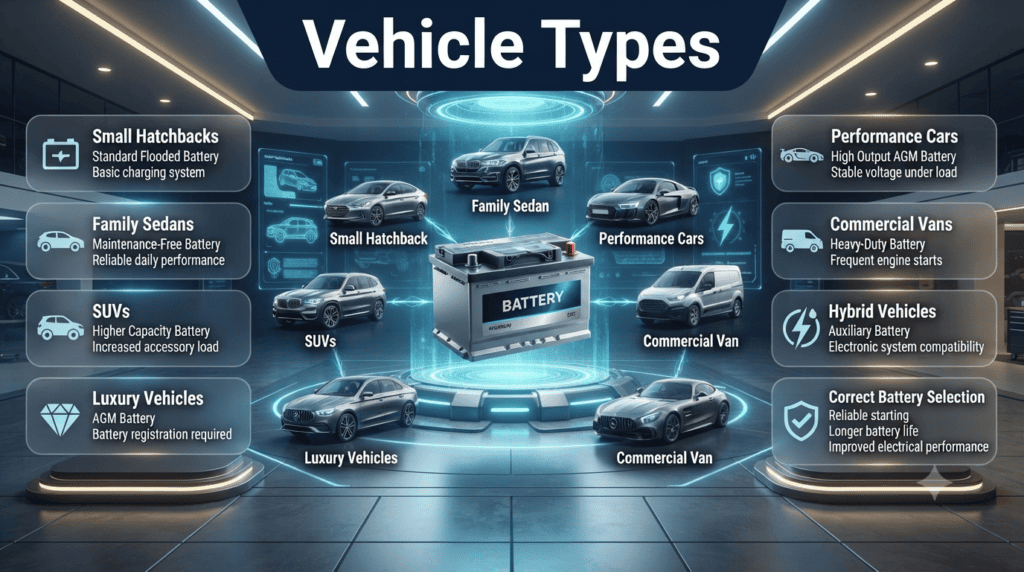
Different vehicles place different demands on the battery.
| Vehicle Type | Typical Battery Requirement | Special Considerations |
|---|---|---|
| Small Hatchbacks | Standard Flooded Battery | Basic charging system |
| Family Sedans | High-quality Maintenance-Free Battery | Reliable daily performance |
| SUVs | Higher Capacity Battery | Increased accessory load |
| Luxury Vehicles | AGM Battery | Battery registration required |
| Performance Cars | High Output AGM Battery | Stable voltage under load |
| Commercial Vans | Heavy-Duty Battery | Frequent engine starts |
| Hybrid Vehicles | Auxiliary Battery | Electronic system compatibility |
Selecting the appropriate battery ensures reliable starting and longer service life.
Choosing the Right Battery Brand
Battery quality directly affects long-term reliability.
Several trusted manufacturers are widely used for vehicles operating in Dubai’s demanding climate.
Popular Choices
- Bosch Battery — Excellent choice for European vehicles with advanced electrical systems.
- Amaron Battery — Known for durability and strong performance in high temperatures.
- Panasonic Battery — Frequently recommended for many Japanese vehicles.
- FIAMM Battery — Suitable for premium and high-performance applications.
- Exide Battery — Dependable option for everyday driving.
- AC Delco Battery — Commonly chosen for American vehicles.
- Tuflong Battery — A reliable solution for drivers seeking dependable performance at competitive value.
Rather than selecting a battery based solely on price, drivers should consider compatibility, warranty, expected lifespan, and manufacturer recommendations.
Common Mistakes Drivers Make After Battery Replacement
Installing a new battery does not automatically guarantee long-term reliability. Certain mistakes can significantly reduce the lifespan of the replacement battery.
Mistakes to Avoid
❌ Ignoring the original cause of the voltage warning
❌ Installing the wrong battery size
❌ Choosing insufficient Cold Cranking Amps (CCA)
❌ Skipping battery registration
❌ Leaving battery terminals loose
❌ Failing to clean corrosion
❌ Ignoring alternator problems
❌ Using low-quality replacement batteries
❌ Forgetting post-installation diagnostics
❌ Delaying replacement after repeated voltage warnings
Avoiding these mistakes helps maximize battery performance and reduces the likelihood of repeat failures.
Battery Maintenance Schedule After Replacement
Routine inspections help extend battery life, especially in Dubai’s extreme climate.
| Maintenance Item | Recommended Interval |
|---|---|
| Visual battery inspection | Every month |
| Terminal cleaning | Every 6 months |
| Charging system test | Every 12 months |
| Battery load test | Every 12 months |
| Battery health inspection | Before summer |
| Alternator output test | During annual service |
| Electrical system scan | If warning light appears |
Regular maintenance allows technicians to identify early signs of deterioration before they develop into costly repairs.
Troubleshooting Guide After Installing a New Battery
Occasionally, drivers may notice issues even after a battery replacement. In many cases, the battery itself is not the problem.
| Symptom | Possible Cause | Recommended Solution |
|---|---|---|
| Battery warning light remains on | Alternator fault | Inspect charging system |
| Slow engine cranking | Starter motor issue | Test starter current |
| Battery repeatedly discharges | Parasitic electrical drain | Electrical diagnostics |
| Flickering headlights | Voltage regulator problem | Charging system inspection |
| Dashboard warning lights | Battery registration required | Perform coding and registration |
| Vehicle starts then stalls | Charging system failure | Complete electrical diagnosis |
Addressing these symptoms promptly helps prevent further damage to the vehicle’s electrical system.
Can I continue driving if my car shows a battery voltage warning in Dubai?
A battery voltage warning is a sign that your vehicle’s charging system is not operating as it should. While the engine may continue running for a short period, driving for too long can be risky because the battery may stop receiving enough charge from the alternator. As the battery voltage drops, essential electrical systems—including power steering, ABS, engine management, and lighting—may begin to malfunction. In Dubai’s hot climate, where air conditioning and electrical accessories place additional demand on the charging system, the problem can worsen much faster than expected. Rather than waiting for a complete breakdown, it’s advisable to have the charging system inspected as soon as the warning appears. A professional diagnosis from EuroSwift Auto Services can determine whether the issue requires a Battery Replacement or another repair.
Key Points
✔ The warning may indicate a battery, alternator, or charging system issue.
✔ Continuing to drive increases the risk of an unexpected breakdown.
✔ Electrical safety systems can stop functioning if voltage drops too low.
✔ Early diagnosis is usually less expensive than emergency repairs.
Does a battery voltage warning always mean I need a new battery?
No. One of the biggest misconceptions is that a battery voltage warning automatically means the battery has failed. In reality, the warning simply indicates that the charging system has detected abnormal voltage. The root cause could be a weak battery, failing alternator, faulty voltage regulator, loose battery terminals, damaged wiring, or even an excessive parasitic drain. Replacing the battery without testing the entire charging system may temporarily hide the symptom while leaving the actual fault unresolved. A professional inspection should always include battery testing, alternator output measurement, and an electrical system scan before any replacement decision is made.
Key Points
✔ A weak battery is only one possible cause.
✔ Alternator and voltage regulator faults are also common.
✔ Professional testing prevents unnecessary battery replacement.
✔ Correct diagnosis saves both time and repair costs.
How long does a car battery usually last in Dubai’s extreme climate?
Battery lifespan in Dubai is generally shorter than in regions with milder weather because extreme heat accelerates internal battery wear. Most conventional car batteries provide reliable service for around 18 to 30 months, depending on driving habits, battery quality, and vehicle type. Frequent stop-and-go traffic, continuous air-conditioning use, and short daily trips can reduce battery life even further. Premium options such as an AGM Battery often offer improved durability for vehicles with advanced electronics or start-stop systems, but regular inspections remain essential regardless of battery type.
Key Points
✔ Dubai’s heat accelerates battery deterioration.
✔ Driving habits significantly affect battery lifespan.
✔ Annual battery testing helps detect early signs of failure.
✔ High-quality batteries generally provide more consistent performance.
Which battery brand is best after receiving a battery voltage warning?
There is no single battery brand that is ideal for every vehicle. The best replacement depends on your vehicle manufacturer’s specifications, electrical requirements, engine size, and driving conditions. Premium European vehicles often benefit from a Bosch Battery or FIAMM Battery, while many Japanese and family vehicles perform exceptionally well with an Amaron Battery or Panasonic Battery. The most important factor is selecting a battery that matches the vehicle’s required capacity, Cold Cranking Amps (CCA), and charging system specifications rather than choosing solely based on price or brand reputation.
Key Points
✔ Choose a battery that matches your vehicle specifications.
✔ Battery capacity and CCA are more important than brand alone.
✔ Premium batteries often provide better durability in Dubai’s climate.
✔ Professional installation ensures compatibility and optimal performance.
What should be checked immediately after replacing a car battery?
Installing a new battery is only part of the repair process. After replacement, technicians should verify that the charging system is functioning correctly to ensure the original problem has been resolved. This includes checking alternator output, battery charging voltage, cable connections, and diagnostic fault codes. On many modern vehicles, battery registration or coding is also required so the Battery Management System can recognize the new battery and adjust charging accordingly. Skipping these final checks can lead to repeated warning lights, reduced battery life, and continued charging problems even with a brand-new battery. Before selecting a replacement, reviewing the Complete Guide to Car Battery Prices in Dubai can also help you compare battery options, warranties, and service packages.
Key Points
✔ Verify alternator charging performance after installation.
✔ Ensure battery terminals are clean and securely connected.
✔ Perform battery registration if the vehicle requires it.
✔ Clear diagnostic fault codes and complete a final charging system test.
✔ Confirm the battery warning light does not return after installation.
Conclusion
A battery voltage warning should never be ignored, even if your vehicle still starts and appears to drive normally. In most cases, the warning is an early indication that the charging system is no longer operating efficiently. Whether the cause is a weak battery, a failing alternator, damaged wiring, or an electrical fault, identifying the problem early can prevent unexpected breakdowns, costly repairs, and unnecessary inconvenience—especially in Dubai’s extreme climate, where high temperatures place additional stress on automotive batteries.
The key to a reliable repair is accurate diagnosis rather than immediate replacement. A professional inspection evaluates the entire charging system, including battery health, alternator output, voltage regulation, and electrical connections, ensuring the actual cause of the warning is resolved. If a replacement is required, selecting the correct battery type and having it installed properly will improve vehicle performance, protect sensitive electronic systems, and extend battery life.
Whether you drive a compact sedan, luxury vehicle, SUV, or commercial fleet, trusting experienced professionals makes a significant difference. EuroSwift Auto Services provides expert diagnostics, fast Battery Replacement, and reliable roadside support to help drivers stay safe and avoid unexpected failures. By combining preventive Vehicle Maintenance, regular charging system inspections, and high-quality replacement batteries, you can ensure dependable starting performance, greater electrical reliability, and confidence on every journey throughout Dubai.
Leave a Reply