
Introduction
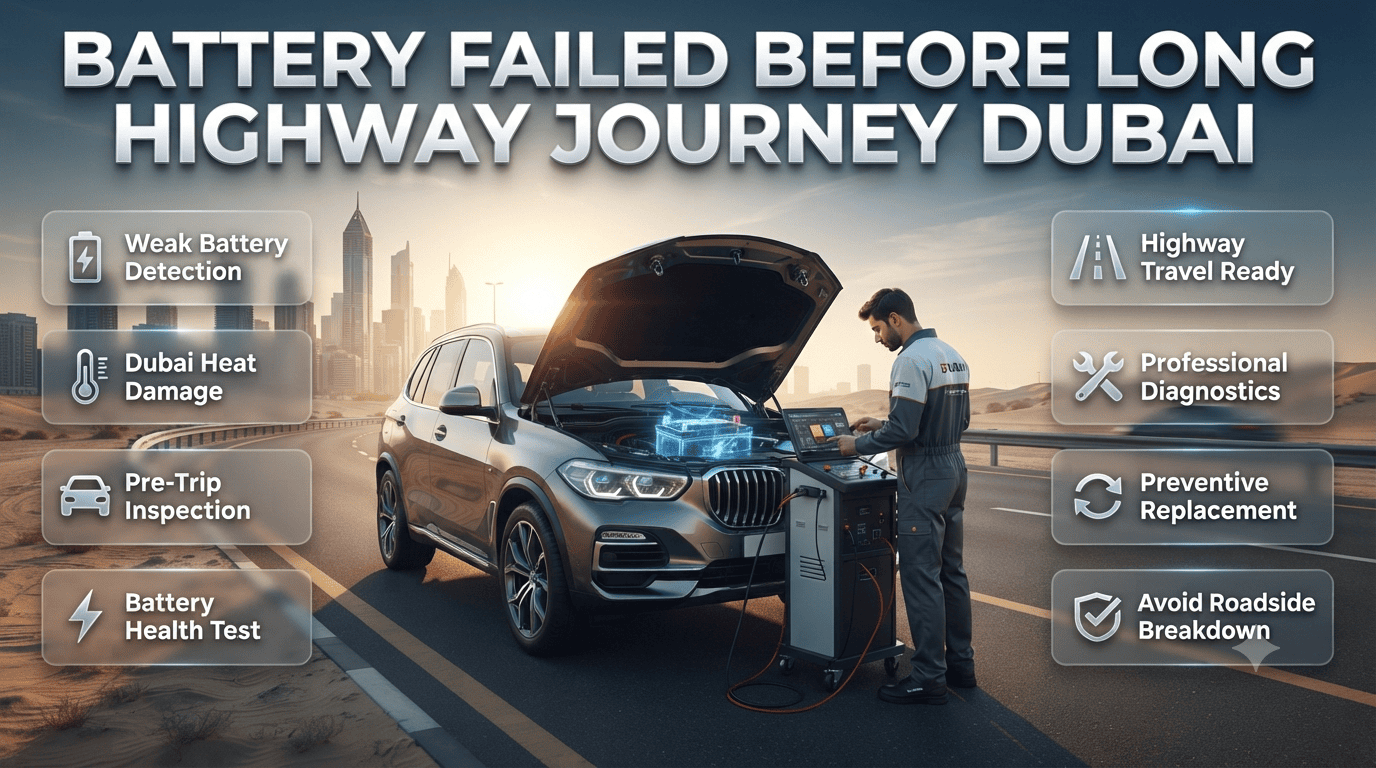
Fastest Premium & Genuine Battery Failed Before Long Highway Journey Dubai | Few situations are more frustrating than discovering your car battery has failed just before a long highway journey in Dubai. Whether you’re planning a business trip to Abu Dhabi, a family drive to Fujairah, or a weekend escape to Ras Al Khaimah, a battery that suddenly refuses to start can disrupt your plans, create unnecessary stress, and even leave you stranded before your trip begins.
Many drivers assume that highway driving is easy on the battery because the alternator recharges it while the engine is running. In reality, a battery often fails before the journey starts because it has already been weakened by Dubai’s extreme temperatures, daily stop-and-go traffic, frequent short trips, or age-related deterioration. The longer the battery has been operating under these conditions, the greater the chance it will reach the end of its service life when you least expect it.
Professional technicians recommend performing a complete Vehicle Inspection before any long-distance drive rather than relying solely on whether the engine starts normally. Modern diagnostic equipment can identify declining battery performance before complete failure occurs, helping drivers avoid unexpected roadside emergencies.
If your vehicle struggles to start before departure, arranging a professional Battery Replacement through EuroSwift Auto Services is often the safest solution. A preventive replacement is usually far less expensive and stressful than dealing with a breakdown during a highway journey.
Why Car Batteries Commonly Fail Before Long Highway Trips in Dubai
Many people believe batteries fail while driving, but automotive technicians often see the opposite. The battery usually reaches its weakest point before a planned journey because of months or even years of gradual deterioration.
Several environmental and mechanical factors combine to reduce battery performance long before complete failure becomes obvious.
Extreme Dubai Heat Accelerates Battery Wear
Dubai’s climate is one of the biggest reasons batteries have a shorter lifespan than in cooler regions.
Continuous exposure to temperatures above 45°C speeds up chemical reactions inside the battery. While this initially seems beneficial, prolonged heat causes electrolyte evaporation, plate corrosion, and internal damage that permanently reduces battery capacity.
Even batteries that appear to function normally can lose a significant portion of their reserve power after repeated summers.
Daily Urban Driving Prevents Full Charging
Many vehicles spend most of their time making short trips between offices, schools, shopping centres, and residential communities.
During these journeys:
- The starter motor consumes significant power.
- The alternator has limited time to recharge the battery.
- Air conditioning operates continuously.
- Electronic accessories remain active.
Over weeks and months, the battery may never regain a complete charge.
Growing Electrical Demand in Modern Vehicles
Today’s vehicles depend on dozens of electronic systems that continue consuming electricity even after the engine is switched off.
Examples include:
- Smart key detection
- Security systems
- GPS modules
- Dash cameras
- Parking sensors
- Infotainment memory
- ECU standby functions
These systems create a small but continuous electrical load known as parasitic drain. While normal, this drain becomes problematic when an aging battery has limited reserve capacity.
Age-Related Battery Degradation
Every automotive battery has a finite lifespan.
In Dubai’s climate, most conventional lead-acid batteries remain reliable for approximately 18–30 months, depending on vehicle usage, charging habits, and maintenance.
As internal components age, the battery gradually loses its ability to:
- Deliver high cranking power
- Hold a full charge
- Recover after repeated starts
- Perform consistently during hot weather
Eventually, even a battery that worked yesterday may fail without warning.
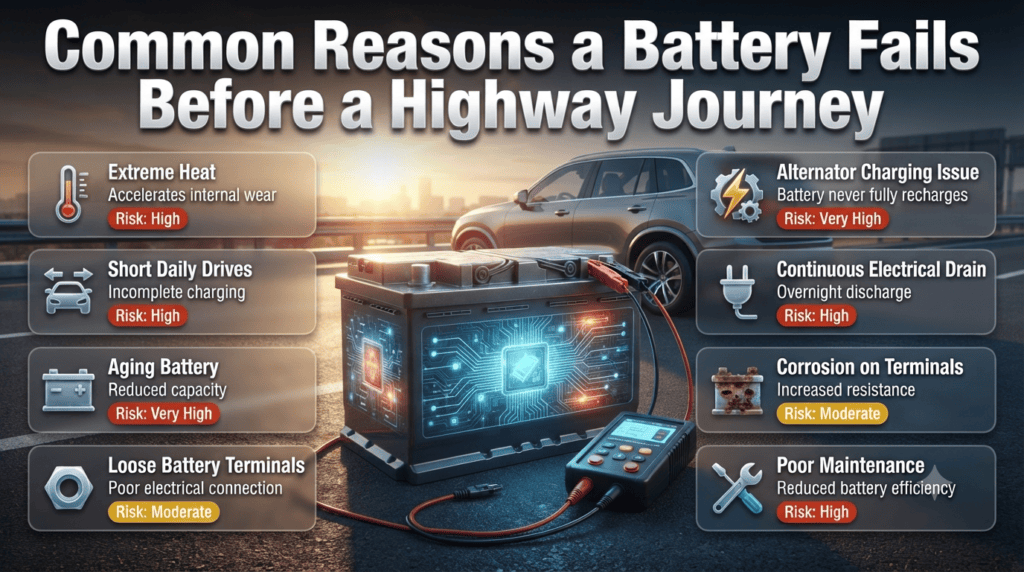
Table: Common Reasons a Battery Fails Before a Highway Journey
| Cause | Effect on Battery | Risk Before Long Trip |
|---|---|---|
| Extreme heat | Accelerates internal wear | High |
| Short daily drives | Incomplete charging | High |
| Aging battery | Reduced capacity | Very High |
| Loose battery terminals | Poor electrical connection | Moderate |
| Alternator charging issue | Battery never fully recharges | Very High |
| Continuous electrical drain | Overnight discharge | High |
| Corrosion on terminals | Increased resistance | Moderate |
| Poor maintenance | Reduced battery efficiency | High |
Warning Signs Your Battery May Fail Before a Long Drive
Most batteries do not fail without providing warning signs. The challenge is that many drivers overlook these early symptoms until the vehicle refuses to start.
Recognizing these indicators before beginning a highway journey can prevent an inconvenient breakdown.
Slow Engine Cranking
One of the earliest and most reliable warning signs is a slower-than-normal engine crank.
Instead of starting immediately, the starter motor may rotate sluggishly before the engine fires.
This usually indicates declining battery voltage or reduced cold cranking capability.
Dashboard Battery Warning Light
Although the battery warning light may indicate charging system issues rather than battery failure alone, it should never be ignored.
Professional Engine Diagnostics can determine whether the problem involves:
- Battery condition
- Alternator output
- Voltage regulator
- Wiring faults
Ignoring this warning increases the likelihood of complete battery failure before your journey.
Flickering Interior or Exterior Lights
Weak batteries often struggle to maintain stable voltage.
Drivers may notice:
- Headlights dimming while starting
- Interior lights flickering
- Dashboard brightness fluctuating
- Infotainment system restarting unexpectedly
These symptoms often appear several weeks before complete failure.
Multiple Jump Starts
Needing repeated Car Jumpstart assistance is one of the clearest indicators that the battery is nearing the end of its service life.
While a jump start temporarily restores operation, it does not repair internal battery deterioration.
Repeated jump starts should always be followed by professional testing.
Electrical Features Behaving Erratically
Modern vehicles rely on stable battery voltage.
Low voltage may cause:
- Power windows moving slowly
- Touchscreen delays
- Random warning messages
- Parking sensor errors
- Keyless entry inconsistencies
- Automatic stop-start malfunction
These problems often disappear temporarily after charging but usually return if the battery itself is failing.
Checklist: Signs You Should Delay Your Highway Journey
✔ Slow engine cranking
✔ Battery older than two years
✔ Battery warning light illuminated
✔ Recent jump start required
✔ Dim headlights during startup
✔ Corroded battery terminals
✔ Swollen battery casing
✔ Sulfur or rotten egg smell
✔ Vehicle parked unused for several days
✔ Electrical systems behaving unpredictably
If several of these warning signs are present, arranging a professional inspection before travelling is strongly recommended.
Why Dubai’s Highway Conditions Demand a Healthy Battery
Many drivers assume that once they reach the highway, the alternator will solve any battery issue. While the alternator supplies electrical power during driving, it cannot compensate for a battery that has already suffered significant internal damage.
A weak battery may struggle to support electrical systems during:
- Fuel stops
- Rest area breaks
- Engine restarts
- Emergency situations
- Heavy nighttime electrical loads
- Extended idling with air conditioning
If the battery fails at one of these stops, you may require Roadside Assistance far from your original departure point.
Long-distance travel also places greater demands on supporting systems such as the alternator, voltage regulator, and engine management electronics. A battery operating at reduced capacity increases stress on these components, making pre-trip testing a sensible precaution rather than an unnecessary expense.
Professional Pre-Trip Battery Inspection Process
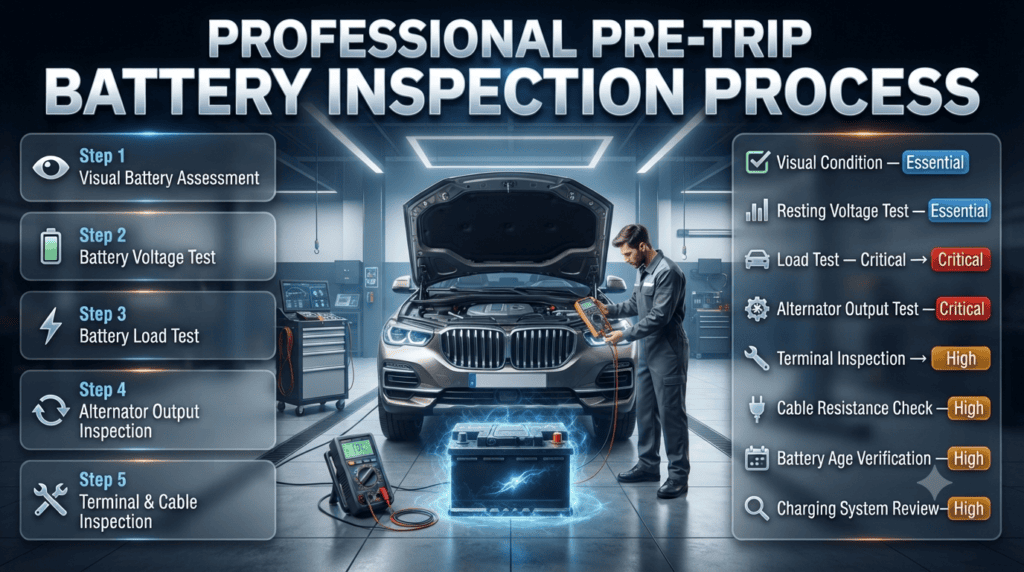
A visual inspection alone cannot accurately determine whether a battery is ready for a long highway journey. Professional workshops combine electronic testing with a complete charging system evaluation to identify hidden problems before they lead to a breakdown.
Step 1: Visual Battery Assessment
The technician begins by checking the battery for signs of physical deterioration, including swelling, cracks, electrolyte leakage, damaged terminals, loose mounting brackets, and corrosion around the connections. Any of these issues can affect reliability during a long trip.
Step 2: Battery Voltage Test
Using a calibrated digital multimeter, the battery’s resting voltage is measured. This provides an initial indication of its state of charge and whether it has sufficient reserve power before the engine is started.
Step 3: Battery Load Test
A battery load tester simulates the high electrical demand created during engine starting. Unlike a simple voltage check, this test reveals whether the battery can maintain adequate voltage under real-world conditions. Batteries that fail this test are at a much higher risk of leaving drivers stranded.
Step 4: Alternator Output Inspection
Technicians then verify that the alternator is charging within the manufacturer’s specified voltage range. An undercharging or overcharging alternator can shorten battery life and prevent a replacement battery from performing correctly.
Step 5: Terminal and Cable Inspection
Battery cables, ground points, and terminal connections are inspected for corrosion, looseness, and excessive resistance. Even a healthy battery can struggle to deliver power if these connections are compromised.
Table: Professional Battery Inspection Checklist
| Inspection Item | Purpose | Importance Before Highway Travel |
|---|---|---|
| Visual condition | Detect physical damage | Essential |
| Resting voltage test | Measure state of charge | Essential |
| Load test | Evaluate starting performance | Critical |
| Alternator output test | Confirm charging efficiency | Critical |
| Terminal inspection | Ensure reliable electrical flow | High |
| Cable resistance check | Identify hidden voltage loss | High |
| Battery age verification | Estimate remaining service life | High |
| Charging system review | Detect related electrical faults | High |
Expert Insight
A battery often fails at the first engine start of the day, not while cruising on the highway. This is because starting the engine requires the highest electrical output from the battery. If it cannot deliver sufficient cranking power before departure, the journey may never begin. Scheduling a professional battery health check before a long-distance trip is one of the most effective ways to reduce the risk of unexpected breakdowns, especially during Dubai’s demanding climate.
Highway Risks of Driving with a Weak Battery in Dubai
Many drivers believe that once the engine is running, the battery no longer matters. While the alternator powers most electrical systems during driving, the battery continues to stabilize voltage and support the vehicle whenever electrical demand changes. A weakened battery can therefore create unexpected problems even during a long highway trip.
On Dubai’s highways, where vehicles often travel at high speeds for extended periods, an electrical failure can quickly become a safety concern. Preventive Vehicle Maintenance before departure is far safer than dealing with an emergency on Sheikh Zayed Road or the Dubai–Abu Dhabi highway.
Risks You May Face During a Long Journey
Engine Fails to Restart After a Stop
Many highway journeys involve fuel stations, restaurants, or rest areas. If the battery is already weak, the vehicle may start normally from home but fail after one of these stops.
This is one of the most common emergency callouts handled by Roadside Assistance teams throughout Dubai.
If testing shows the battery has reached the end of its lifespan, replacing it through EuroSwift Auto Services before travelling is usually the safest option.
Increased Stress on the Charging System
A failing battery forces the alternator to work harder than intended.
Instead of maintaining a healthy battery, the alternator continuously attempts to recharge an aging unit that can no longer hold sufficient capacity.
Over time this extra workload may contribute to:
- Increased alternator wear
- Higher operating temperatures
- Reduced charging efficiency
- Greater strain on voltage regulators
Ignoring a weak battery can therefore increase future repair costs.
Electrical System Instability
Modern vehicles rely on stable electrical voltage.
A deteriorating battery may cause:
- Dashboard warning lights
- Electronic steering alerts
- Infotainment resets
- Safety sensor interruptions
- Camera malfunctions
- Parking assist errors
Luxury vehicles equipped with advanced driver-assistance systems are especially sensitive to unstable battery voltage.
Table: Highway Risks Caused by Weak Batteries
| Battery Condition | Possible Highway Consequence | Risk Level |
|---|---|---|
| Low cranking power | Vehicle won’t restart after fuel stop | Very High |
| Internal battery damage | Complete battery failure | Very High |
| Charging system overload | Alternator stress | High |
| Corroded terminals | Intermittent electrical faults | Moderate |
| Low battery voltage | ECU warning messages | High |
| Battery nearing end of life | Unexpected roadside breakdown | Very High |
How Professionals Diagnose Battery Problems Before a Long Trip
Replacing a battery without testing can sometimes waste money if another component is actually causing the issue. Professional technicians perform a complete charging-system diagnosis before recommending a replacement.
Battery Health Analysis
Modern battery analyzers measure much more than voltage.
They evaluate:
- Remaining battery capacity
- Cold Cranking Amps (CCA)
- Internal resistance
- State of health
- State of charge
This provides a much clearer picture of battery condition than a simple multimeter reading.
Alternator Charging Test
A healthy battery cannot compensate for a failing alternator.
Technicians verify:
✔ Charging voltage
✔ Charging current
✔ Belt condition
✔ Voltage stability
✔ Charging performance under electrical load
If the alternator is undercharging, replacing the battery alone will not solve the problem.
Parasitic Drain Testing
Some vehicles continue losing battery power after parking.
Technicians inspect for excessive current draw from components such as:
- Dash cameras
- GPS trackers
- Faulty control modules
- Interior lighting
- Aftermarket accessories
- Alarm systems
Identifying these hidden drains prevents repeated battery failures.
Starter Motor Inspection
Many battery complaints actually originate from an aging starter motor.
If the starter draws excessive current, even a healthy battery may struggle to crank the engine.
Professional Engine Diagnostics include starter current analysis to distinguish between battery failure and mechanical starting problems.
Complete Charging System Inspection
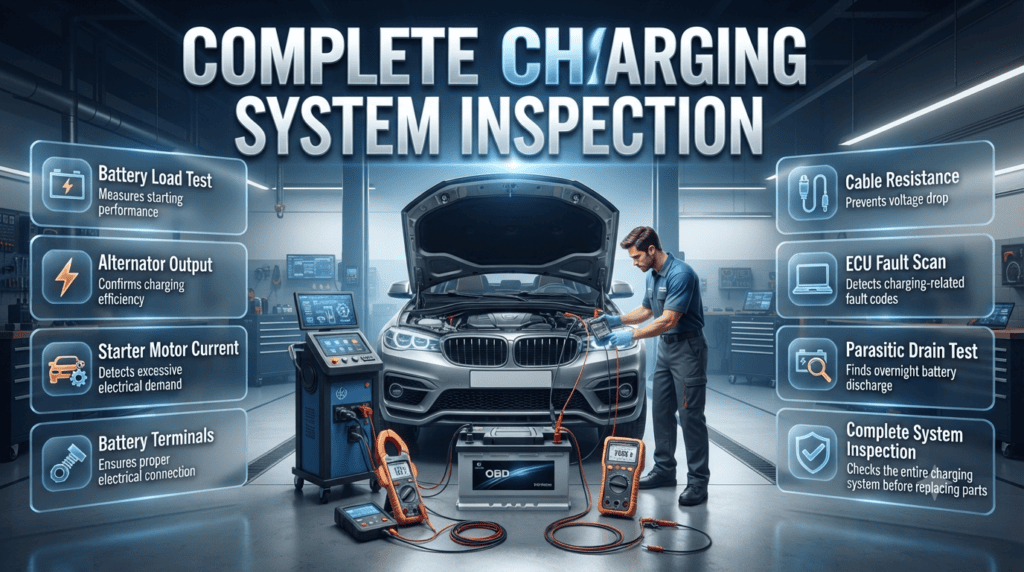
Rather than replacing parts unnecessarily, experienced workshops inspect the entire electrical system.
Professional Inspection Checklist
| Inspection | Why It Matters |
|---|---|
| Battery load test | Measures starting performance |
| Alternator output | Confirms charging efficiency |
| Starter motor current | Detects excessive electrical demand |
| Battery terminals | Ensures proper electrical connection |
| Cable resistance | Prevents voltage drop |
| ECU fault scan | Detects charging-related fault codes |
| Parasitic drain test | Finds overnight battery discharge |
Repair vs Battery Replacement – Which Is the Better Option?
Drivers often ask whether a weak battery can simply be repaired.
In reality, the answer depends on what has actually failed.
When Repair May Be Enough
Sometimes the battery itself remains healthy while another issue prevents proper operation.
Examples include:
- Loose battery terminals
- Corrosion buildup
- Damaged ground cables
- Alternator charging faults
- Loose drive belt
- Electrical connection problems
Correcting these faults may restore reliable battery performance without replacing the battery.
When Replacement Is the Smarter Decision
Replacement is usually recommended when testing confirms permanent internal deterioration.
Typical indicators include:
✔ Battery older than two years in Dubai
✔ Failed load test
✔ Swollen battery case
✔ Internal cell failure
✔ Electrolyte leakage
✔ Low CCA reading
✔ Repeated jump starts
Attempting to extend the life of a severely worn battery often results in another unexpected breakdown.
Table: Repair or Replace?
| Condition | Repair | Replace |
|---|---|---|
| Corroded terminals | ✔ | |
| Loose battery clamp | ✔ | |
| Alternator fault | ✔ | |
| Low charging voltage | ✔ | |
| Internal battery damage | ✔ | |
| Failed load test | ✔ | |
| Swollen battery | ✔ | |
| Battery older than 30 months | ✔ |
Choosing the Right Replacement Battery for Dubai Conditions
Not every battery performs equally well in Dubai’s demanding climate. Selecting the correct battery depends on your vehicle’s electrical requirements, driving habits, and manufacturer specifications.
Professional technicians recommend matching battery capacity, Cold Cranking Amps (CCA), reserve capacity, and technology type rather than choosing solely on price.
For drivers who want dependable performance in high temperatures, Amaron Battery options are known for strong heat resistance and long service life.
Many European vehicles are factory-equipped with or compatible with Bosch Battery models, which offer consistent starting power and advanced manufacturing quality.
Drivers seeking reliable everyday performance often consider Exide Battery products, which are available in multiple capacities suitable for passenger cars and SUVs.
Japanese vehicles commonly benefit from Panasonic Battery solutions designed for dependable performance and efficient charging characteristics.
Luxury vehicles equipped with start-stop technology generally require an AGM Battery, which offers improved vibration resistance, faster recharge capability, and greater durability under heavy electrical loads.
Commercial fleets and high-demand applications may also use FIAMM Battery, AC Delco Battery, or Tuflong Battery depending on manufacturer recommendations and operating conditions.
Comparison Table: Popular Battery Options for Dubai Drivers
| Battery Type | Best For | Key Advantages |
|---|---|---|
| Amaron | Daily commuters | Excellent heat resistance |
| Bosch | European vehicles | Premium build quality |
| Exide | Passenger cars & SUVs | Balanced value and reliability |
| Panasonic | Japanese vehicles | Stable charging performance |
| AGM | Luxury & Start-Stop cars | High electrical capacity |
| FIAMM | Premium applications | Strong durability |
| AC Delco | American vehicles | OEM compatibility |
| Tuflong | Mixed vehicle fleet | Reliable everyday performance |
Factors That Influence Battery Replacement Cost
Battery replacement costs vary depending on more than just the battery brand. Vehicle size, battery technology, installation complexity, and electronic programming requirements all affect the final price.
For example, many luxury vehicles require battery registration or ECU coding after installation, while conventional vehicles can often be fitted more quickly.
If you want to understand current pricing across different battery brands and vehicle categories, the Complete Guide to Car Battery Prices in Dubai provides a detailed overview of typical costs and replacement considerations.
Why did my car battery fail just before a long highway journey in Dubai?
Many drivers are surprised when their battery fails before a road trip, even though the vehicle seemed to work perfectly during daily use. In most cases, the battery has been gradually weakening over several months due to Dubai’s extreme heat, frequent short-distance driving, and the continuous electrical load from modern vehicle systems. The battery often reaches its limit when the engine requires maximum power for the next start.
A long highway journey doesn’t usually cause the battery to fail—it simply exposes an existing problem that was already developing.
Professional testing before departure can identify declining battery performance before it leaves you stranded.
Common reasons include:
Extreme summer temperatures reducing battery lifespan
Battery older than 18–30 months
Frequent short trips preventing full charging
Loose or corroded battery terminals
Alternator charging problems
Continuous parasitic electrical drain
Internal battery cell failure
Previous deep battery discharge
Situation
Likelihood of Battery Failure
Battery under 1 year old
Low
Battery 2–3 years old
Moderate to High
Battery over 3 years old
Very High
Weak alternator + old battery
Extremely High
Is it safe to drive on the highway with a weak battery?
A vehicle with a weak battery may still start and appear to drive normally, but that doesn’t mean it’s safe for a long-distance journey. If you stop for fuel, food, or a rest break, the engine may not restart. Additionally, unstable battery voltage can affect modern electronic systems, including sensors and safety features.
Driving with a weak battery also forces the alternator to work harder, which may increase wear on the charging system over time.
Before travelling, it’s always safer to have the battery tested rather than assuming it will last the entire journey.
Possible risks include:
Vehicle failing to restart after stopping
Unexpected roadside breakdown
Electrical warning lights
Reduced charging efficiency
Alternator overload
Inconsistent electronic performance
How can I tell if my battery needs replacing before a road trip?
Most batteries provide warning signs before they fail completely. Paying attention to these symptoms can help you avoid an unexpected breakdown.
If your engine cranks more slowly than usual, you’ve needed a recent jump start, or the battery is more than two years old, it’s a good idea to arrange a professional battery inspection.
Other warning signs include dim headlights, dashboard battery warnings, corrosion around the terminals, and electronic accessories behaving unpredictably.
Watch for these symptoms:
Slow engine cranking
Clicking sound during startup
Battery warning light
Swollen battery casing
Corroded terminals
Frequent jump starts
Electrical glitches
Rotten egg smell from the battery
How long does a car battery usually last in Dubai?
Battery lifespan depends on driving habits, maintenance, and environmental conditions. Because of Dubai’s high temperatures, batteries generally have a shorter service life than in cooler countries.
Most conventional batteries remain reliable for approximately 18 to 30 months, although premium AGM batteries may last longer when properly maintained.
Regular inspections, alternator testing, and keeping the battery fully charged can help maximize its lifespan.
Battery Type
Typical Lifespan in Dubai
Conventional Lead-Acid
18–30 months
Enhanced Flooded Battery (EFB)
2–3 years
AGM Battery
3–5 years (depending on usage)
Should I replace my battery before a long highway journey if it’s more than two years old?
Not every battery older than two years needs immediate replacement, but it should definitely be tested before a long trip. Heat, heavy electrical usage, and daily driving conditions may reduce its remaining capacity even if it still starts the engine.
A professional load test and charging-system inspection can determine whether the battery is still reliable or nearing the end of its service life.
Replacing an aging battery before a long journey is often more cost-effective than arranging emergency roadside assistance after it fails.
Professional inspections usually include:
Battery load testing
Voltage testing
Alternator output inspection
Starter motor evaluation
Terminal inspection
Charging system analysis
Conclusion
A battery failure before a long highway journey in Dubai is more than just an inconvenience—it can quickly turn a well-planned trip into an unexpected roadside emergency. Dubai’s extreme heat, heavy traffic, frequent short-distance driving, and the increasing electrical demands of modern vehicles all contribute to faster battery wear. Identifying warning signs early and scheduling a professional battery inspection before travelling can significantly reduce the risk of breakdowns and costly repairs.
If your battery is showing signs of weakness, such as slow engine cranking, repeated jump starts, dim lights, or inconsistent electrical performance, don’t wait until your journey begins. A complete diagnostic check can determine whether the issue is the battery, alternator, starter motor, or another component within the charging system. Replacing a failing battery before it leaves you stranded is always the safer and more cost-effective choice.
At EuroSwift Auto Services, experienced technicians provide professional battery testing, mobile battery replacement, charging system diagnostics, and emergency roadside assistance across Dubai. Whether your vehicle requires an Amaron Battery, Bosch Battery, Exide Battery, Panasonic Battery, FIAMM Battery, AC Delco Battery, Tuflong Battery, or a high-performance AGM Battery, choosing the correct battery for your vehicle helps ensure reliable performance in Dubai’s demanding climate. If you’re unsure about replacement costs, you can also explore the Complete Guide to Car Battery Prices in Dubai to compare battery options and make an informed decision.
By combining regular Vehicle Maintenance, timely Battery Replacement, professional Engine Diagnostics, and preventive inspections before every long trip, you can enjoy safer highway travel, improve your vehicle’s reliability, and avoid unexpected interruptions on the road. A proactive approach today helps protect your vehicle, your time, and your peace of mind for every journey ahead.
Leave a Reply