
Introduction
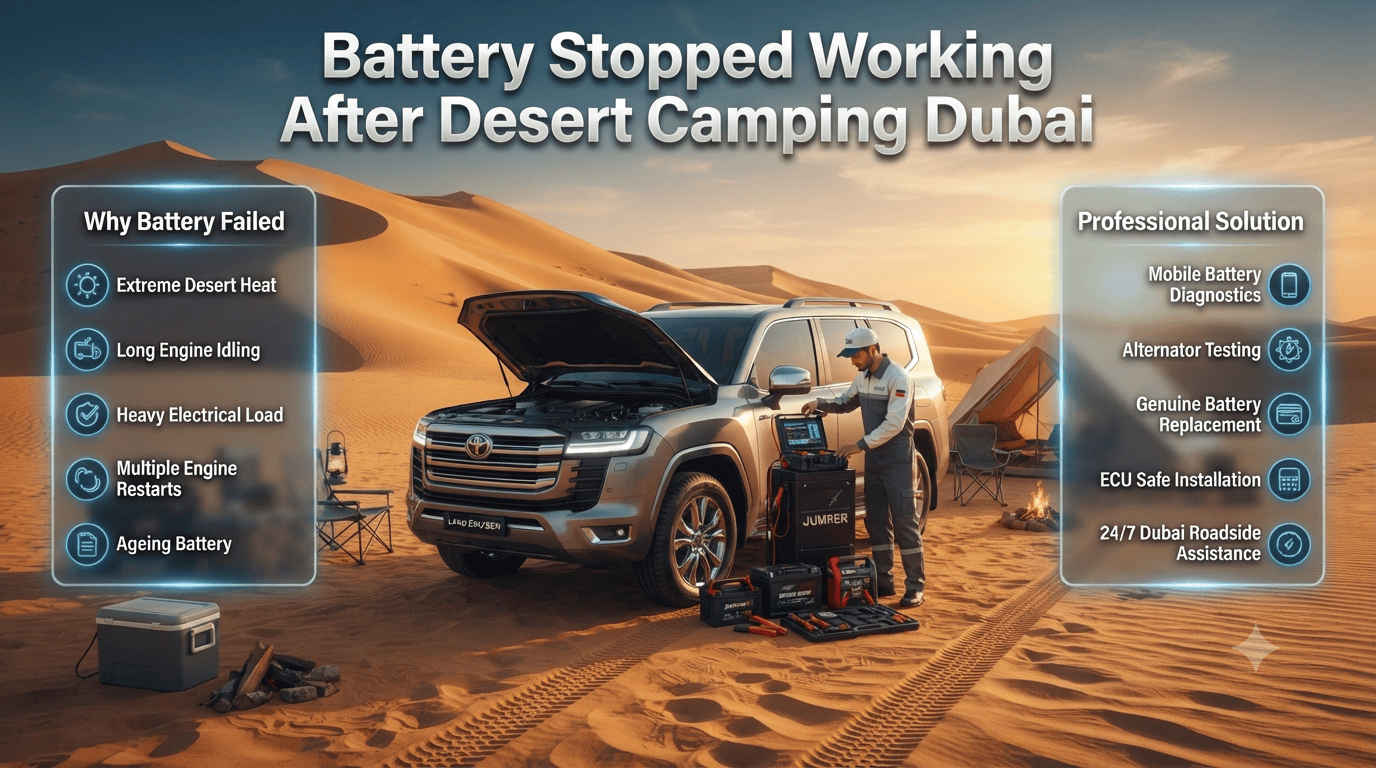
Battery Stopped Working After Desert Camping Dubai | Desert camping is one of Dubai’s most popular outdoor adventures, attracting thousands of residents and tourists every year. Whether you drive a family SUV, luxury 4×4, pickup truck, or premium off-road vehicle, spending hours in remote desert locations places unique stress on your vehicle’s electrical system. One of the most common problems drivers experience after returning from the desert is discovering that the battery has suddenly stopped working, leaving the vehicle unable to start.
Unlike normal city driving, desert environments expose your battery to prolonged engine idling, high ambient temperatures, heavy electrical loads, repeated engine restarts, and challenging terrain. These conditions can rapidly weaken an ageing battery or reveal hidden electrical faults that were previously unnoticed.
When your battery fails after desert camping, acting quickly can prevent additional damage to sensitive electronic systems such as the alternator, starter motor, ECU, and charging circuit. Professional testing is essential to determine whether the battery simply needs charging, whether another electrical component is responsible, or whether immediate Battery Replacement is the safest solution.
At EuroSwift Auto Services, experienced technicians provide mobile diagnostics, emergency roadside assistance, professional battery installation, alternator testing, and genuine replacement batteries throughout Dubai. Their mobile service helps drivers stranded after camping trips without the need for expensive towing.
Why Desert Camping Is Hard on Car Batteries
Most people assume soft sand only affects tyres and engines. In reality, your battery works considerably harder during desert driving than during everyday commuting.
Every electrical system inside the vehicle relies on the battery to provide stable voltage. During off-road driving, additional accessories and repeated engine demands increase electrical consumption while Dubai’s extreme temperatures accelerate battery wear.
Common factors include:
- Continuous air conditioning operation
- Multiple engine restarts after dune stops
- Winch usage
- Portable air compressor operation
- Recovery lighting
- GPS navigation devices
- Mobile charging equipment
- Refrigerators and camping coolers
- Auxiliary lighting systems
- Long periods of engine idling
Each of these accessories draws power from the battery or charging system. If the battery is already nearing the end of its lifespan, desert conditions often become the final trigger for failure.
Electrical Load Increases Significantly During Camping
Many camping enthusiasts install additional accessories without considering their cumulative electrical demand.
Examples include:
- LED light bars
- Portable refrigerators
- Air pumps
- Drone charging stations
- Coffee machines
- Sound systems
- Camping lights
- Power inverters
- Portable fans
Although each accessory may consume only a small amount individually, using several simultaneously places continuous demand on the charging system.
Professional Vehicle Inspection before long desert trips helps identify batteries that may not withstand extended electrical loads.
High Temperatures Reduce Battery Performance
Dubai’s summer temperatures regularly exceed 45°C.
Battery chemistry performs best within moderate temperature ranges. Excessive heat causes:
- Faster electrolyte evaporation
- Plate corrosion
- Internal resistance increase
- Reduced reserve capacity
- Lower cold-cranking efficiency
- Shortened overall battery lifespan
Heat damage accumulates gradually. Many batteries appear normal until the first demanding trip into the desert, where the additional load causes complete failure.
Sand and Vibration Accelerate Internal Battery Wear
Driving over dunes creates constant vibration that is far more severe than normal road driving.
Repeated impacts may contribute to:
- Internal plate damage
- Loose battery terminals
- Broken mounting brackets
- Cable movement
- Increased electrical resistance
- Terminal corrosion
Professional battery inspections include checking battery security, terminal torque, cable integrity, and mounting hardware after frequent off-road use.
How Desert Driving Affects the Entire Charging System
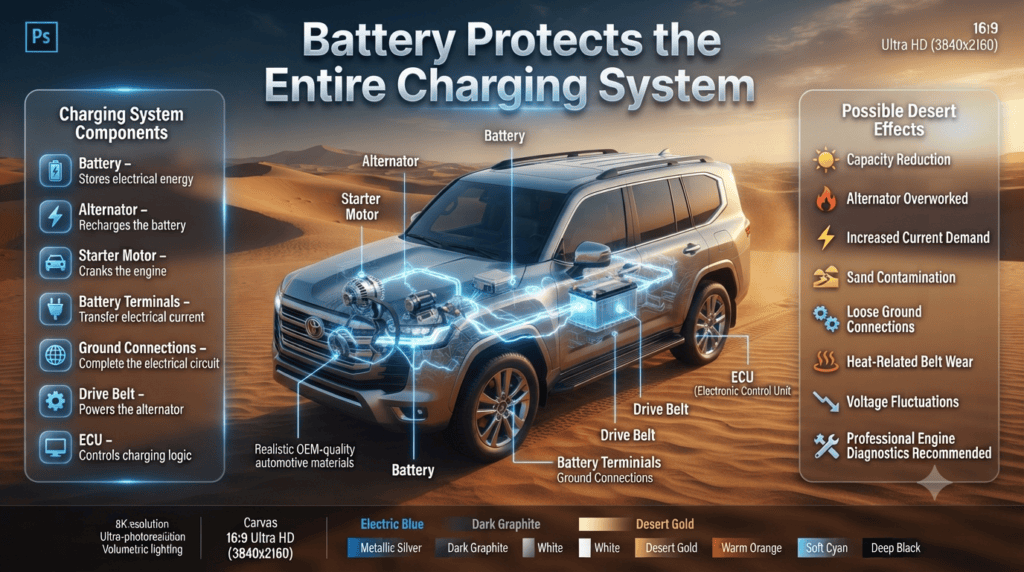
A battery rarely fails in isolation. The charging system consists of multiple interconnected components working together.
These include:
| Vehicle Component | Function | Possible Desert Effect |
|---|---|---|
| Battery | Stores electrical energy | Capacity reduction |
| Alternator | Recharges battery | Overworked under heavy loads |
| Starter Motor | Cranks engine | Increased current demand |
| Battery Terminals | Transfer electrical current | Sand contamination and corrosion |
| Ground Connections | Complete electrical circuit | Loose due to vibration |
| Drive Belt | Powers alternator | Heat-related wear |
| ECU | Controls charging logic | Sensitive to voltage fluctuations |
Because these components depend on one another, professional diagnostics are recommended before replacing any battery.
Technicians performing Engine Diagnostics can identify whether the battery itself has failed or if another component is preventing proper charging.
Common Reasons a Battery Stops Working After Desert Camping
Several factors often combine rather than a single issue causing failure.
1. Battery Was Already Near the End of Its Service Life
Most vehicle batteries in Dubai typically last between 18 and 30 months, depending on driving habits, climate, and maintenance. An older battery may continue working during daily city use but fail after the additional strain of a desert trip.
Professional load testing before off-road travel is one of the most effective ways to identify a weak battery before it leaves you stranded.
2. Extended Engine Idling
Many campers leave the engine running to operate the air conditioning while stationary.
Although the alternator charges the battery during idling, charging efficiency is significantly lower than during highway driving. If electrical consumption exceeds alternator output, the battery gradually discharges.
3. Repeated Engine Restarts
Stopping frequently for:
- Photography
- Dune recovery
- Tyre pressure adjustments
- Navigation
- Breaks
means the starter motor repeatedly draws high current from the battery.
An ageing battery struggles to recover between starts, increasing the likelihood of failure by the end of the trip.
4. Overnight Battery Drain at the Campsite
Leaving electrical accessories connected while the engine is off is another common cause of breakdowns.
Examples include:
- Camping lights
- Portable refrigerators
- Mobile chargers
- Dash cameras
- Power banks
- Inverters
- Audio systems
Even modest overnight power consumption can leave insufficient charge to start the engine the following morning.
5. Alternator Charging Problems
Drivers often assume a dead battery is the root cause, but a faulty alternator may be responsible.
Signs include:
- Battery warning light
- Dim headlights
- Flickering dashboard
- Slow engine cranking
- Electrical system faults
A professional alternator output test should always accompany any Battery Replacement to prevent recurring failures.
Early Warning Signs Before Complete Battery Failure
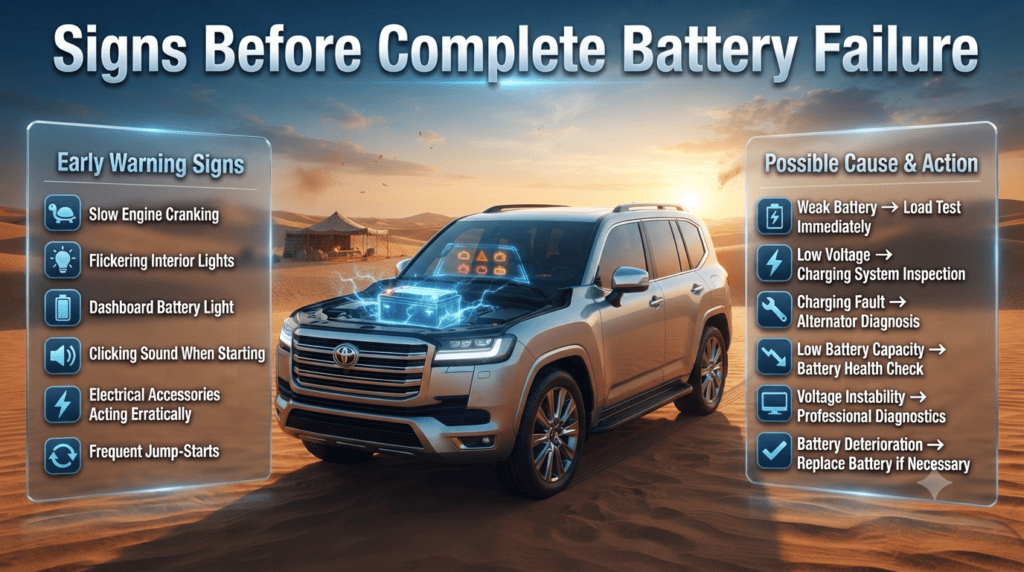
Many drivers overlook subtle warning signs in the days leading up to a breakdown.
Recognising these symptoms early can prevent inconvenient roadside emergencies.
| Warning Sign | Possible Cause | Recommended Action |
|---|---|---|
| Slow engine cranking | Weak battery | Load test immediately |
| Flickering interior lights | Low voltage | Charging system inspection |
| Dashboard battery light | Charging fault | Alternator diagnosis |
| Clicking sound when starting | Low battery capacity | Battery health check |
| Electrical accessories behaving erratically | Voltage instability | Professional diagnostics |
| Frequent jump-start requirements | Battery deterioration | Replace battery if necessary |
Ignoring these warning signs often results in complete battery failure during or after demanding desert journeys.
Professional Battery Inspection After Desert Camping
Following any extended off-road trip, a comprehensive inspection can reveal issues before they develop into costly repairs.
A professional inspection typically includes:
✔ Battery voltage testing
✔ Battery load testing
✔ Alternator charging output
✔ Starter motor current draw
✔ Battery terminal cleaning
✔ Ground cable inspection
✔ Parasitic drain testing
✔ Charging system diagnostics
✔ ECU fault code scan
✔ Battery mounting inspection
✔ Electrical cable condition assessment
These inspections help determine whether a simple recharge is sufficient or whether a new battery is required.
For vehicles requiring replacement, EuroSwift Auto Services stocks genuine options including Amaron Battery, Bosch Battery, Exide Battery, Panasonic Battery, FIAMM Battery, AC Delco Battery, Tuflong Battery, and high-performance AGM Battery solutions suitable for luxury vehicles and demanding off-road use.
Expert Insight
Professional recovery technicians frequently report that batteries failing after desert camping are rarely caused by a single issue. More often, an ageing battery, extreme Dubai heat, prolonged accessory usage, and demanding off-road driving combine to overwhelm the charging system. Performing a preventative battery health check before every desert trip—and replacing an ageing battery with a genuine, climate-suitable model—can significantly reduce the risk of being stranded in remote locations. If replacement is required, reviewing the Complete Guide to Car Battery Prices in Dubai 2026 helps drivers choose the correct battery based on their vehicle, budget, and performance requirements.
Emergency Steps to Take When Your Battery Stops Working in the Dubai Desert
Discovering that your vehicle will not start after a desert camping trip can be stressful, particularly if you are far from the nearest paved road or mobile service station. Acting methodically is important. Randomly attempting multiple jump starts or repeatedly cranking the engine can worsen the situation and even damage the starter motor.
The safest approach is to diagnose the problem before attempting any repair.
Step 1: Stay Calm and Assess Your Surroundings
Your immediate priority should always be safety rather than repairing the vehicle.
If you are still inside the desert:
- Park on stable ground whenever possible.
- Switch on hazard lights if battery power allows.
- Inform your group or another driver of your location.
- Avoid walking long distances alone.
- Keep drinking water available, particularly during summer.
- Share your GPS location with roadside assistance.
Modern smartphones and vehicle GPS systems make it much easier for Roadside Assistance teams to locate stranded vehicles quickly.
Step 2: Check Whether the Battery Is Truly Dead
Not every no-start situation means the battery has failed.
Perform these quick observations.
| Vehicle Behaviour | Possible Cause | Recommended Action |
|---|---|---|
| No dashboard lights | Completely discharged battery | Voltage test required |
| Dashboard lights work but engine will not crank | Weak battery or starter motor | Professional diagnosis |
| Rapid clicking sound | Low battery voltage | Jump start may help |
| One loud click | Starter motor issue | Electrical inspection |
| Engine cranks slowly | Battery nearing failure | Battery load test |
| Engine starts then immediately stops | Charging system fault | Alternator inspection |
These simple checks can provide valuable information before professional assistance arrives.
Common Desert Camping Situations That Drain a Battery
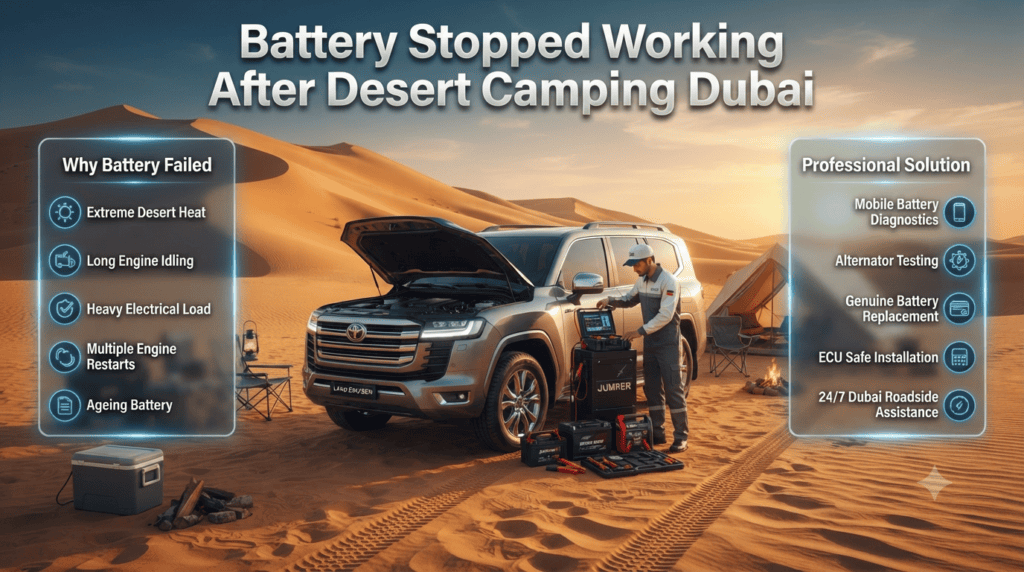
Every camping trip is different, but technicians regularly encounter similar scenarios.
Overnight Camping With Accessories Running
Many campers continue using electrical equipment after switching off the engine.
Typical accessories include:
- LED camping lights
- Portable refrigerators
- Air pumps
- USB charging hubs
- Bluetooth speakers
- Drone charging equipment
- Camera batteries
- Portable fans
Although these devices seem harmless individually, together they can consume enough power overnight to prevent the engine from starting the next morning.
Frequent Tyre Pressure Adjustments
Desert drivers often reduce tyre pressure before entering soft sand and inflate tyres again before returning to the road.
Portable compressors require considerable electrical power.
Repeated compressor use while the engine is switched off increases battery discharge, especially on batteries that are already ageing.
Continuous Winch Operation
Vehicles fitted with recovery winches place exceptional demand on the electrical system.
Recovery operations may require:
- High-current winching
- Floodlights
- Hazard lighting
- Engine idling
- Repeated repositioning
Professional off-road drivers generally ensure the engine remains running during winch use to reduce battery discharge.
Why Jump Starting Is Not Always the Right Solution
Many drivers assume a jump start will permanently solve the problem.
In reality, a successful jump start only restores enough power to restart the engine. It does not repair the underlying fault.
A jump start may only provide temporary relief if the battery has:
- Internal plate damage
- Sulphation
- Cell failure
- Excessive age
- Low reserve capacity
Without identifying the root cause, the vehicle may fail again later the same day.
Professional Car Jumpstart services therefore include battery testing rather than simply connecting booster cables.
Professional Mobile Battery Diagnostics in Dubai
Modern roadside technicians no longer rely on guesswork.
Today’s diagnostic equipment provides rapid analysis of the vehicle’s electrical system.
A comprehensive inspection generally includes:
Battery Voltage Test
Measures current battery voltage both before and after starting.
Battery Load Test
Determines whether the battery can maintain voltage under heavy demand.
Charging System Analysis
Checks whether the alternator is producing sufficient charging voltage while the engine is running.
Starter Motor Inspection
Measures starter current draw to identify excessive electrical resistance.
Terminal and Cable Inspection
Technicians inspect for:
- Loose terminals
- Corrosion
- Heat damage
- Broken cables
- Sand contamination
Electronic System Scan
Luxury vehicles often require an ECU scan after battery problems to identify stored fault codes and charging system irregularities.
Mobile Battery Replacement Process
If testing confirms that replacement is necessary, professional mobile technicians follow a structured installation procedure rather than simply swapping batteries.
| Service Stage | Professional Procedure |
|---|---|
| Vehicle Identification | Confirm battery specification using VIN and manufacturer requirements |
| Safety Inspection | Check cables, terminals and mounting hardware |
| Battery Removal | Disconnect safely while protecting vehicle electronics |
| Terminal Cleaning | Remove corrosion and improve electrical conductivity |
| Genuine Battery Installation | Install correct battery capacity and CCA rating |
| Battery Registration (if required) | Register battery on compatible luxury vehicles |
| Charging System Test | Confirm alternator output |
| Final Verification | Test starting performance and charging stability |
Following these procedures helps ensure reliable operation and protects sensitive vehicle electronics.
Choosing the Correct Battery After Desert Use
Not every battery is suitable for every vehicle.
Professional technicians consider several important factors before recommending a replacement.
Vehicle Type
Different requirements exist for:
- Hatchbacks
- Sedans
- SUVs
- Pickup trucks
- Luxury vehicles
- High-performance cars
- Hybrid vehicles
Electrical Equipment
Vehicles with features such as:
- Start-stop technology
- Adaptive suspension
- Premium infotainment
- Electric tailgates
- Multiple climate control systems
usually require higher-capacity or AGM batteries.
Desert Driving Frequency
Drivers who regularly visit desert locations often benefit from batteries offering:
- Higher reserve capacity
- Improved vibration resistance
- Better heat tolerance
- Stronger deep-cycle performance
This is particularly important for vehicles carrying camping accessories or aftermarket electrical equipment.
Repair or Replace? Making the Right Decision
Sometimes a battery can be recharged successfully. In other cases, replacement is the only dependable option.
| Battery Condition | Recharge | Replace |
|---|---|---|
| Accidentally discharged overnight | ✔ Usually suitable | ✖ Normally unnecessary |
| Battery under 12 months old | ✔ Often recoverable | ✖ Rarely required |
| Battery over 24 months old | ▲ Temporary only | ✔ Recommended |
| Swollen battery casing | ✖ Unsafe | ✔ Immediate replacement |
| Internal cell failure | ✖ Impossible | ✔ Required |
| Severe terminal corrosion with battery damage | ✖ Limited benefit | ✔ Recommended |
Professional testing prevents unnecessary battery replacement while ensuring unsafe batteries are removed promptly.
Common Mistakes Drivers Make After Battery Failure
Small mistakes can turn a simple battery issue into a more expensive electrical repair.
Avoid these common errors:
✔ Repeatedly attempting to crank the engine
✔ Connecting jumper cables in the wrong order
✔ Installing the wrong battery size
✔ Ignoring the battery warning light
✔ Disconnecting luxury vehicle batteries without proper procedures
✔ Continuing to drive with a faulty alternator
✔ Purchasing the cheapest battery without considering heat resistance
✔ Failing to inspect the charging system after replacing the battery
Professional Recommendation
If your battery stops working after desert camping, avoid assuming that the battery alone is responsible. A complete inspection of the charging system—including the alternator, starter motor, battery terminals, and electronic control systems—provides a far more accurate diagnosis. Mobile specialists from EuroSwift Auto Services perform on-site testing before recommending a replacement, ensuring drivers receive the correct solution rather than an unnecessary battery change.
For vehicles that require a replacement, choosing a genuine battery suited to Dubai’s climate is essential. Options such as Amaron Battery, Bosch Battery, Panasonic Battery, Exide Battery, FIAMM Battery, AC Delco Battery, Tuflong Battery, and AGM Battery are designed to meet the demands of high temperatures, heavy electrical loads, and frequent off-road driving.
Battery Lifespan After Regular Desert Camping in Dubai
Battery lifespan depends on far more than age alone. Frequent desert driving exposes the battery to conditions that accelerate wear, including extreme heat, heavy electrical loads, continuous vibration, and repeated engine restarts. Even a high-quality battery may reach the end of its service life sooner if it is regularly used for off-road adventures without routine inspections.
Drivers who camp in the desert several times a year should schedule a Vehicle Maintenance check before and after major trips to identify declining battery performance before it leads to a roadside breakdown.
Average Battery Life Under Different Driving Conditions
| Driving Pattern | Estimated Battery Life | Inspection Frequency |
|---|---|---|
| Daily city driving | 24–36 months | Every 6 months |
| Mixed highway and city driving | 24–30 months | Every 6 months |
| Frequent desert camping | 18–24 months | Every 3–4 months |
| Commercial off-road use | 15–24 months | Every 3 months |
| Luxury SUVs with heavy electrical loads | 18–30 months | Every 4 months |
Regular inspections are more valuable than relying solely on battery age, as performance can vary based on driving habits and climate.
Preventive Maintenance Before Every Desert Camping Trip
Preparing your vehicle before entering the desert significantly reduces the risk of battery failure in remote areas. A simple inspection takes far less time than arranging vehicle recovery.
Essential Pre-Trip Battery Checklist
✔ Check battery voltage using a professional tester
✔ Inspect battery terminals for corrosion
✔ Ensure battery mounting brackets are secure
✔ Test alternator charging output
✔ Inspect drive belt condition
✔ Verify all electrical accessories operate correctly
✔ Confirm tyre inflator works properly
✔ Carry quality jumper cables or a portable jump starter
✔ Check vehicle lighting before travelling at night
✔ Verify recovery equipment is functioning correctly
Drivers who regularly visit the desert should include these checks as part of their routine Car Service schedule.
Preventive Maintenance After Returning From the Desert
Many drivers focus only on preparing for the trip but overlook the inspection afterwards.
A post-trip inspection can identify hidden problems caused by vibration, sand, and prolonged electrical demand.
Recommended inspections include:
- Battery load testing
- Charging system evaluation
- Terminal cleaning
- Cable inspection
- Ground connection testing
- Alternator output verification
- Starter motor inspection
- ECU diagnostic scan
- Battery mounting inspection
- General electrical system inspection
Completing these checks helps identify developing issues before they become expensive repairs.
Modern Battery Technologies for Off-Road Vehicles
Battery technology has advanced significantly in recent years, providing improved durability for demanding driving conditions.
AGM Batteries
Absorbent Glass Mat (AGM) batteries are increasingly popular among luxury vehicles and off-road enthusiasts.
Advantages include:
- Improved vibration resistance
- Faster charging capability
- Better performance under heavy electrical loads
- Lower maintenance requirements
- Enhanced durability in high-temperature environments
Vehicles equipped with start-stop systems or numerous electronic features often benefit from AGM battery technology.
Enhanced Flooded Batteries (EFB)
EFB batteries provide a practical upgrade over conventional flooded batteries.
They offer:
- Improved cycling performance
- Longer operational life
- Better resistance to repeated discharge
- Suitable performance for moderate off-road use
Conventional Lead-Acid Batteries
Traditional batteries remain suitable for many vehicles when properly maintained.
However, they generally offer:
- Lower vibration resistance
- Reduced lifespan in extreme heat
- Less reserve capacity
- Greater maintenance requirements
Selecting the correct battery depends on vehicle specifications, electrical demand, and driving conditions rather than price alone.
Common Electrical Problems Found After Desert Camping
Battery failure is not always an isolated issue. Technicians frequently identify additional faults during inspections.
| Problem | Possible Cause | Professional Solution |
|---|---|---|
| Loose battery terminals | Off-road vibration | Retighten and clean terminals |
| Battery not charging | Alternator fault | Charging system diagnosis |
| Battery repeatedly discharges | Parasitic electrical drain | Circuit testing |
| Vehicle starts intermittently | Internal battery deterioration | Battery replacement |
| Dashboard warning lights | Voltage instability | ECU diagnostics |
| Slow engine cranking | Ageing battery or starter motor | Load testing and inspection |
Resolving the underlying cause prevents repeat breakdowns after installing a new battery.
Professional Battery Replacement Process at EuroSwift Auto Services
Professional battery replacement involves far more than removing one battery and fitting another.
A structured installation process protects both the battery and the vehicle’s sensitive electronic systems.
Initial Diagnosis
Technicians verify whether replacement is genuinely required through voltage testing, load testing, and charging system analysis.
Battery Matching
The correct battery is selected based on:
- Manufacturer specifications
- Cold Cranking Amps (CCA)
- Reserve Capacity (RC)
- Battery dimensions
- Terminal configuration
- Vehicle electronics
Safe Battery Installation
Professional installation includes:
- Safe battery removal
- Memory protection where required
- Terminal cleaning
- Correct torque settings
- Secure battery mounting
Electronic System Verification
Modern vehicles may require:
- ECU reset
- Battery registration
- Charging system calibration
- Diagnostic fault code clearance
This process helps maintain optimum vehicle performance following replacement.
Future Trends in Automotive Battery Technology
Battery technology continues to evolve rapidly, improving reliability for vehicles operating in demanding climates such as Dubai.
Emerging developments include:
Smart Battery Monitoring
Modern vehicles increasingly use intelligent battery sensors that continuously monitor:
- Voltage
- Temperature
- Charging efficiency
- Battery ageing
- Power consumption
These systems can warn drivers before complete battery failure occurs.
Improved Heat-Resistant Materials
Manufacturers continue developing batteries capable of withstanding prolonged exposure to extreme temperatures without significant performance loss.
Advanced Vehicle Diagnostics
Cloud-connected diagnostic systems allow technicians to analyse charging system performance more accurately, reducing unnecessary battery replacements.
Predictive Maintenance
Artificial intelligence and vehicle telematics are expected to improve maintenance scheduling by identifying battery deterioration before drivers notice any symptoms.
Industry Best Practice
Professional automotive workshops increasingly recommend preventative battery testing before every major off-road journey rather than waiting for symptoms to appear. This proactive approach reduces roadside breakdowns, extends battery life, and improves overall vehicle reliability. Combining regular Battery Replacement, Engine Diagnostics, Vehicle Inspection, and Roadside Assistance services ensures drivers remain prepared for Dubai’s demanding desert environment.
Desert Camping Battery Maintenance Checklist
| Maintenance Task | Recommended Interval |
|---|---|
| Battery voltage inspection | Before every camping trip |
| Battery load test | Every 6 months |
| Alternator output test | Every 6 months |
| Terminal cleaning | Every 6 months or after heavy off-road use |
| Battery mounting inspection | After every desert trip |
| Electrical system inspection | Annually |
| Replace ageing battery | Before performance declines |
| Comprehensive vehicle inspection | Before long desert expeditions |
Following a structured maintenance schedule helps minimise unexpected battery failures while extending the lifespan of the vehicle’s charging system.
Why did my car battery stop working after desert camping in Dubai even though it was working perfectly before the trip?
Desert camping places far greater stress on your vehicle’s battery than everyday city driving. During an off-road trip, the battery supports repeated engine starts, prolonged air conditioning use, tyre inflators, camping lights, portable refrigerators, phone charging, and other electrical accessories. At the same time, Dubai’s extreme heat accelerates battery wear by increasing internal chemical reactions and reducing the battery’s ability to hold a full charge. If the battery was already ageing or slightly weakened, the additional demands of the desert can quickly expose the problem, causing it to fail when you try to start the vehicle after the trip.
Rather than assuming the battery is the only issue, it’s advisable to have the complete charging system—including the alternator, starter motor, battery terminals, and electrical connections—professionally inspected. This ensures the real cause of the breakdown is identified before replacing any parts.
Key Points
✔ Desert heat significantly shortens battery lifespan.
✔ Continuous electrical accessory use increases battery discharge.
✔ Off-road vibrations can loosen battery connections.
✔ A weak battery often fails after heavy off-road use.
✔ A professional diagnostic test confirms whether replacement is actually required.
Can I jump-start my vehicle after desert camping, or should I replace the battery immediately?
A jump start can be an effective temporary solution if the battery has been accidentally discharged, such as after leaving camping lights or other accessories on overnight. However, if the battery is old, internally damaged, swollen, or unable to maintain sufficient voltage, a jump start will only restart the engine temporarily. In these situations, the vehicle may stop again later, leaving you stranded once more.
The safest approach is to use a jump start only to get the vehicle running and then immediately have the battery and charging system professionally tested. This helps determine whether the battery simply needs recharging or has reached the end of its service life. Replacing a healthy battery unnecessarily can be costly, while ignoring a failing one can result in repeated breakdowns.
Key Points
✔ Jump starting is a temporary solution, not a permanent repair.
✔ Batteries with internal damage usually require replacement.
✔ Alternator testing should always accompany a battery inspection.
✔ Avoid repeated jump starts on an ageing battery.
✔ Professional diagnostics prevent unnecessary battery replacement.
How can I prevent my car battery from failing during future desert camping trips in Dubai?
Preventing battery failure starts with preparation before leaving for the desert. A professional battery health check can identify declining performance before it becomes a problem in remote areas. You should also inspect battery terminals, confirm the alternator is charging correctly, ensure the battery is securely mounted, and avoid running electrical accessories for long periods while the engine is switched off.
During camping, minimise unnecessary power consumption by switching off lights, portable refrigerators, and charging equipment when they are not needed. Carrying quality jumper cables or a portable jump starter also provides an additional level of safety if the unexpected happens.
Key Points
✔ Test the battery before every major desert trip.
✔ Reduce electrical accessory use when the engine is off.
✔ Keep battery terminals clean and tightly secured.
✔ Carry emergency jump-start equipment.
✔ Schedule routine charging system inspections throughout the year.
Which type of battery is best for vehicles that regularly go desert camping in Dubai?
The ideal battery depends on your vehicle, driving habits, and electrical requirements. Drivers who frequently travel off-road or own luxury SUVs with multiple electronic systems generally benefit from high-quality AGM (Absorbent Glass Mat) batteries because they provide excellent vibration resistance, improved durability, and stronger performance under heavy electrical loads. Standard lead-acid batteries remain suitable for many vehicles, but they may not tolerate extreme heat and demanding off-road conditions as effectively.
Choosing a battery should never be based solely on price. Factors such as battery capacity, Cold Cranking Amps (CCA), reserve capacity, manufacturer specifications, and compatibility with your vehicle’s charging system are far more important for long-term reliability.
Key Points
✔ AGM batteries are ideal for demanding off-road conditions.
✔ Match the battery to your vehicle manufacturer’s specifications.
✔ Heat resistance is essential in Dubai’s climate.
✔ Battery capacity should suit your electrical equipment.
✔ Professional installation helps maximise battery life.
When should I call professional roadside assistance instead of trying to fix the battery myself?
If your vehicle is stranded in the desert, repeatedly attempting to start the engine or experimenting with electrical repairs can make the situation worse. Professional roadside assistance should be contacted whenever the battery shows signs of complete failure, the vehicle will not crank after a jump start, dashboard warning lights remain illuminated, or you suspect an alternator or electrical system problem.
Qualified technicians arrive with specialised diagnostic equipment capable of testing the battery, alternator, starter motor, and charging system on-site. They can determine whether a safe jump start, battery replacement, or further mechanical repair is required, reducing the risk of unnecessary part replacement and helping you return to the road more quickly.
Key Points
✔ Call for assistance if the vehicle still won’t start after a jump start.
✔ Do not continue cranking the engine repeatedly.
✔ Electrical warning lights should never be ignored.
✔ Professional diagnostics identify the real cause of the failure.
✔ Mobile battery replacement is often faster and safer than towing the vehicle.
Conclusion
A car battery that stops working after desert camping in Dubai is rarely the result of a single problem. Extreme temperatures, prolonged electrical accessory use, repeated engine starts, off-road vibrations, and the natural ageing of the battery can all combine to place significant strain on your vehicle’s charging system. Identifying the underlying cause early through professional diagnostics is the most effective way to avoid unexpected breakdowns and costly repairs.
Routine Vehicle Maintenance, timely Battery Replacement, and periodic Engine Diagnostics play a vital role in keeping your vehicle reliable, particularly if you frequently explore Dubai’s deserts. Before every off-road trip, checking the battery’s health, alternator output, terminal condition, and overall electrical system can greatly reduce the risk of becoming stranded in a remote location.
When battery issues do occur, relying on experienced technicians ensures the correct solution—whether it’s a safe Car Jumpstart, a complete charging system inspection, or the installation of a genuine replacement battery matched to your vehicle’s specifications. Professional mobile services also minimise downtime by providing on-site testing and replacement without the inconvenience of towing.
As modern vehicles become increasingly dependent on advanced electronics, battery care is no longer just routine maintenance—it is an essential part of vehicle safety and reliability. By following a proactive maintenance schedule, using high-quality batteries designed for Dubai’s demanding climate, and seeking professional assistance when warning signs appear, drivers can enjoy every desert adventure with greater confidence, improved performance, and long-term peace of mind.
Leave a Reply