
Introduction
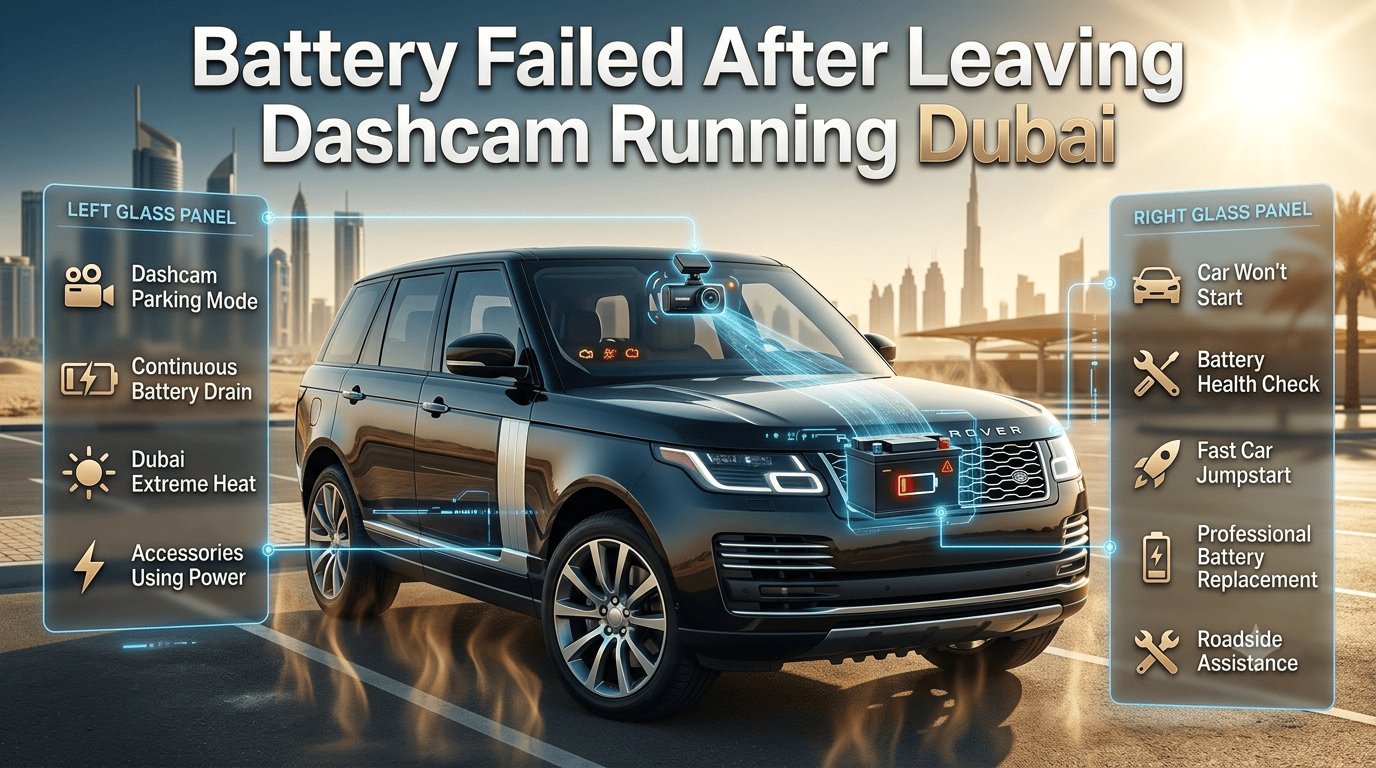
A dashcam is one of the smartest upgrades for drivers in Dubai. Whether you’re recording daily commutes, protecting your vehicle while parked, or collecting evidence after an accident, a dashcam offers valuable peace of mind. However, many drivers don’t realize that leaving a dashcam running for extended periods—especially in parking mode—can slowly drain the vehicle’s battery. Combined with Dubai’s intense heat, even a healthy battery can fail unexpectedly.
If your battery failed after leaving dashcam running Dubai, you’re not alone. This issue is increasingly common among drivers using modern vehicles equipped with dashcams, GPS trackers, parking surveillance systems, and other electronic accessories. Heat accelerates battery degradation, while continuous power consumption reduces the remaining charge, often leaving the engine unable to start.
When the battery becomes completely discharged, a professional Battery Replacement service can quickly diagnose the problem, perform a full battery health assessment, and install the correct replacement if needed. In many situations, a rapid Car Jumpstart is enough to get you moving again, while Roadside Assistance ensures you are not stranded in parking lots, residential communities, or along busy Dubai roads.
This guide explains how dashcams affect vehicle batteries, why Dubai’s climate makes the problem worse, how technicians diagnose battery drain, and what preventive measures help keep your vehicle reliable throughout the year.
Why Dashcams Can Drain a Car Battery
A dashcam consumes relatively little power while recording, but when it remains active for hours—or even days—after the engine is switched off, the total energy consumption gradually becomes significant.
Most battery drain complaints occur when parking mode is enabled. Instead of shutting down with the ignition, the camera continues monitoring movement, impacts, or suspicious activity around the vehicle.
Common situations where this happens include:
- Overnight residential parking
- Airport long-term parking
- Office parking during work hours
- Shopping mall parking
- Hotel valet parking
- Weekend vehicle storage
- Vacation travel
While each hour of operation draws only a small amount of electricity, continuous recording can eventually reduce battery voltage below the level required to start the engine.
How Parking Mode Works
Most premium dashcams include several parking surveillance modes, each consuming different amounts of power.
| Parking Mode | Power Usage | Battery Impact |
|---|---|---|
| Continuous Recording | High | Highest battery drain |
| Motion Detection | Moderate | Moderate battery drain |
| Impact Detection | Low | Lower battery drain |
| Time-Lapse Recording | Moderate | Balanced power usage |
| Buffered Parking Mode | Moderate | Depends on recording activity |
Without a low-voltage cut-off module or battery protection device, the dashcam may continue operating until the vehicle battery reaches a critically low voltage.
Why Dubai’s Heat Makes Battery Drain Worse
Dubai’s extreme temperatures place enormous stress on every automotive battery. Heat speeds up internal chemical reactions, increases electrolyte evaporation, and gradually reduces the battery’s ability to store electrical energy.
When a battery has already lost part of its original capacity due to prolonged exposure to temperatures exceeding 45°C, even a relatively small electrical load from a dashcam can be enough to prevent the engine from starting.
High temperatures commonly cause:
✔ Reduced battery reserve capacity
✔ Increased internal resistance
✔ Faster sulfation
✔ Plate deterioration
✔ Higher self-discharge rate
✔ Shorter overall battery lifespan
Drivers using high-performance or luxury vehicles often benefit from installing a quality AGM Battery, which is designed to handle greater electrical demands and performs more reliably under Dubai’s harsh climate.
How Long Can a Dashcam Run Before Draining a Battery?
There is no single answer because battery runtime depends on several important variables.
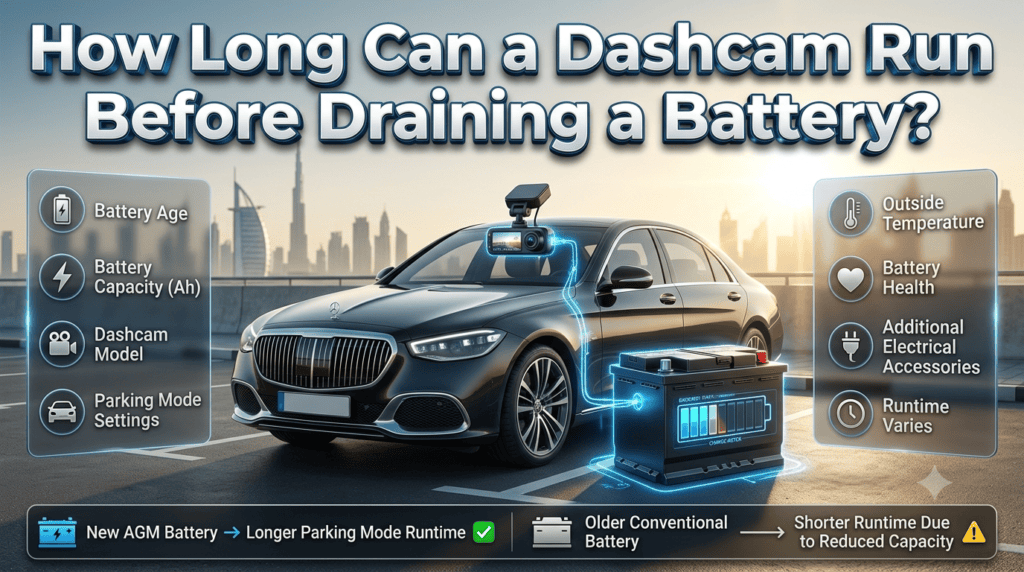
These include:
- Battery age
- Battery capacity (Ah)
- Dashcam model
- Parking mode settings
- Outside temperature
- Battery health
- Additional electrical accessories
A brand-new AGM battery can usually support parking mode much longer than an older conventional battery that has already lost a significant percentage of its capacity.
Estimated Dashcam Battery Runtime
| Battery Condition | Approximate Parking Time |
|---|---|
| Brand-new AGM Battery | 24–48 Hours |
| Healthy Standard Battery | 12–24 Hours |
| Two-Year-Old Battery | 6–15 Hours |
| Weak or Failing Battery | Less Than 6 Hours |
These estimates vary depending on camera power consumption, battery size, and vehicle electronics.
If your battery is approaching the end of its service life, reviewing the latest Car Battery Price Guide in Dubai can help you compare suitable replacement options before an unexpected breakdown occurs.
Common Symptoms After Leaving a Dashcam Running
Drivers often assume the starter motor or alternator has failed, when the real problem is simply a deeply discharged battery.
Typical warning signs include:
- Slow engine cranking
- Clicking sound while starting
- Dashboard warning lights flickering
- Complete loss of electrical power
- Infotainment system restarting
- Remote key responding slowly
- Battery-saving mode activating
- Auto start-stop system becoming unavailable
Luxury vehicles equipped with intelligent battery management systems may display battery-related warnings long before complete failure occurs.
Other Accessories That Increase Battery Drain
A dashcam is often only one part of the vehicle’s standby electrical load.
Modern vehicles contain numerous electronic modules that continue consuming power after the ignition has been switched off.
Additional accessories include:
- GPS tracking devices
- Wi-Fi hotspots
- USB charging adapters
- Phone charging cables
- OBD diagnostic devices
- Parking sensors
- Aftermarket alarm systems
- Interior LED lighting
- Audio amplifiers
- Smart security systems
When several accessories operate together, the combined standby current can significantly shorten battery life.
Combined Electrical Load Comparison
| Accessory Combination | Battery Load |
|---|---|
| Dashcam Only | Low |
| GPS Tracker Only | Low |
| Dashcam + GPS Tracker | Moderate |
| Dashcam + Wi-Fi Hotspot | Moderate to High |
| Dashcam + Audio Amplifier | High |
| Multiple Aftermarket Electronics | Very High |
A professional Vehicle Inspection can identify whether your vehicle has excessive parasitic current draw caused by aftermarket accessories or faulty electrical components.
Why Older Batteries Fail Much Faster
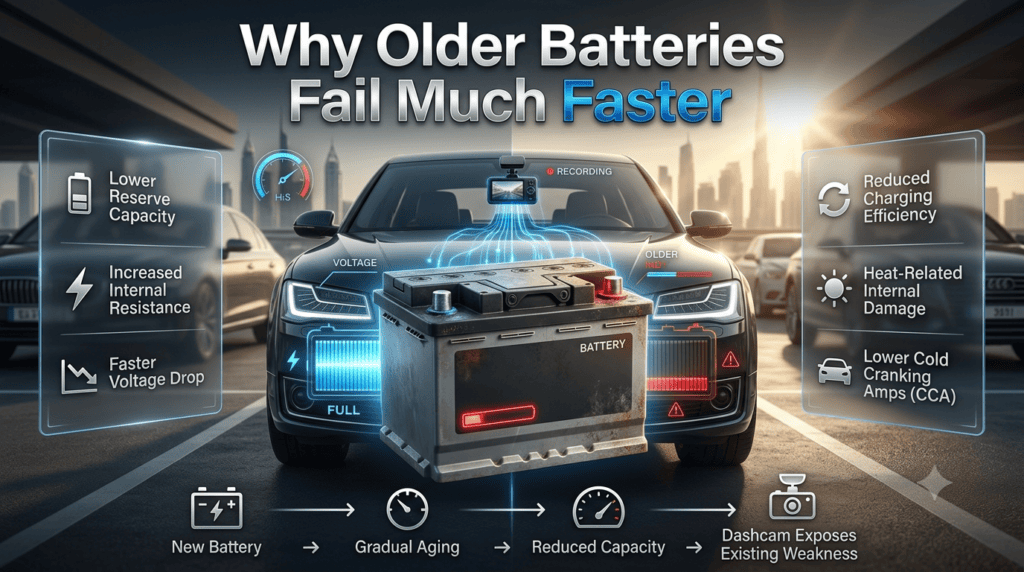
Battery age is one of the biggest reasons vehicles fail to start after a dashcam has been left running.
As batteries age, they naturally lose their ability to store and deliver electrical energy efficiently.
Common age-related changes include:
- Lower reserve capacity
- Increased internal resistance
- Faster voltage drop
- Reduced charging efficiency
- Heat-related internal damage
- Lower Cold Cranking Amps (CCA)
A battery that originally delivered excellent performance may retain only a fraction of its usable capacity after two or three years in Dubai’s demanding climate. In these cases, continuous dashcam recording simply exposes a weakness that already existed.
Expert Insight
Many vehicle owners believe the dashcam itself caused the battery failure. In reality, the camera often exposes an aging or weakened battery rather than creating the problem. A healthy battery with proper voltage protection should tolerate normal parking-mode operation without difficulty.
At EuroSwift Auto Services, technicians perform battery load testing, charging system analysis, and parasitic drain inspections before recommending replacement. If testing confirms the battery has reached the end of its lifespan, premium options such as Bosch Battery or Amaron Battery are commonly recommended for dependable performance in Dubai’s extreme temperatures.
Professional Battery Diagnostic Process
Before replacing a battery, experienced technicians follow a structured diagnostic procedure to identify the actual cause of the problem.
The inspection typically includes:
- Measuring resting battery voltage
- Performing a battery load test
- Checking alternator charging output
- Inspecting battery terminals for corrosion
- Testing for parasitic current draw
- Examining dashcam wiring quality
- Verifying low-voltage cut-off settings
- Scanning the battery management system
- Confirming battery age and service history
- Recommending repair or replacement based on test results
This professional approach ensures the issue is accurately diagnosed instead of replacing parts unnecessarily.
Battery Diagnostic Checklist
| Inspection Item | Purpose |
|---|---|
| Battery Voltage Test | Measures available battery charge |
| Battery Load Test | Confirms battery health |
| Alternator Output Test | Verifies charging performance |
| Parasitic Drain Test | Detects hidden electrical loads |
| Terminal Inspection | Identifies corrosion and loose connections |
| Dashcam Wiring Inspection | Ensures safe installation |
| Battery Registration (If Required) | Matches vehicle battery management system |
| Charging System Scan | Checks intelligent charging operation |
How Professionals Diagnose Dashcam-Related Battery Drain
A vehicle that refuses to start after leaving a dashcam running does not always require a new battery. Experienced technicians first determine whether the battery is discharged, damaged, or simply unable to hold a charge because of age or excessive parasitic draw.
At EuroSwift Auto Services, technicians follow a systematic diagnostic process instead of immediately recommending a replacement. This approach saves customers unnecessary expenses while ensuring the real cause of the problem is identified.
Professional Diagnostic Equipment
Modern battery inspections commonly include:
- Digital battery analyzer
- Battery load tester
- Digital multimeter
- Clamp ammeter
- Alternator charging tester
- ECU diagnostic scanner
- Thermal inspection tools
- Parasitic current testing equipment
Each tool helps isolate a different electrical issue, allowing technicians to determine whether the battery, charging system, dashcam wiring, or another component is responsible.
Understanding Parasitic Battery Drain
Every modern vehicle consumes a small amount of electricity after the engine is switched off. Systems such as the alarm, keyless entry, clock, and ECU memory remain active even while the vehicle is parked.
Problems arise when the total standby current becomes excessive.
A poorly installed dashcam, faulty hardwire kit, or additional aftermarket electronics can increase the parasitic draw beyond the manufacturer’s recommended limits, causing the battery to discharge much faster than expected.
Normal vs Excessive Battery Drain
| Electrical Condition | Typical Current Draw | Effect on Battery |
|---|---|---|
| Vehicle Sleep Mode | 20–50 mA | Normal |
| Dashcam with Voltage Cut-off | 40–80 mA | Usually Safe |
| Dashcam Without Cut-off | 80–150 mA | Faster Battery Drain |
| Multiple Accessories Active | 150–300+ mA | High Risk of Battery Failure |
| Electrical Fault | Variable | Requires Immediate Diagnosis |
Signs Your Battery Has Been Permanently Damaged
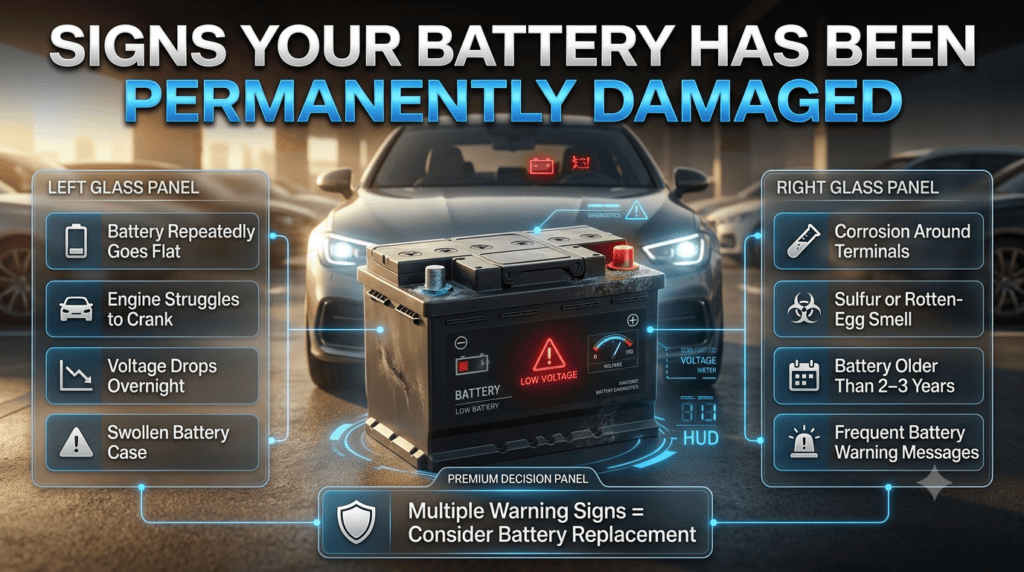
Sometimes a simple recharge restores the battery. In other cases, deep discharge causes irreversible damage.
Watch for these warning signs:
✔ Battery repeatedly goes flat
✔ Engine struggles to crank after charging
✔ Voltage drops quickly overnight
✔ Battery case appears swollen
✔ Visible corrosion around terminals
✔ Sulfur or rotten-egg smell
✔ Battery older than two to three years
✔ Frequent battery warning messages
If several of these symptoms appear together, replacement is usually the safer and more reliable solution.
Recharge or Replace? How Professionals Decide
Not every discharged battery needs replacement.
Technicians evaluate several factors before making a recommendation.
| Inspection Result | Recommended Solution |
|---|---|
| Battery healthy but discharged | Recharge and retest |
| Low voltage with good capacity | Slow recharge |
| Poor load-test results | Replace battery |
| Internal cell failure | Immediate replacement |
| Battery cannot hold charge | Replace battery |
| Alternator charging fault | Repair charging system first |
Replacing the battery without diagnosing the charging system can lead to repeated failures.
Choosing the Right Battery for Dashcam Users
Drivers who regularly use parking mode should select a battery designed to handle frequent charge and discharge cycles.
Premium batteries generally provide:
- Greater reserve capacity
- Better resistance to heat
- Improved recharge efficiency
- Longer service life
- Stable voltage during accessory operation
For vehicles with advanced electronics or start-stop systems, an AGM Battery is often the preferred option because it is engineered for higher electrical demands.
Popular Battery Options for Dubai Drivers
Different vehicles require different battery specifications.
Common premium choices include:
- Amaron Battery – Excellent heat resistance and long service life.
- Bosch Battery – Reliable performance for European and luxury vehicles.
- Exide Battery – Strong value with dependable daily performance.
- Panasonic Battery – Consistent output in demanding weather.
- FIAMM Battery – Suitable for many premium European models.
- AC Delco Battery – Popular for American vehicles and SUVs.
- Tuflong Battery – Cost-effective option for everyday driving.
The correct choice depends on your vehicle manufacturer’s specifications, battery size, Cold Cranking Amps (CCA), and electrical system requirements.
Common Installation Mistakes That Cause Battery Drain
Many battery drain problems are caused by improper dashcam installation rather than the camera itself.
Avoid these common mistakes:
- Connecting directly to a constant power source without voltage protection
- Using low-quality hardwire kits
- Incorrect fuse tap installation
- Poor grounding connections
- Exposed wiring
- Ignoring battery voltage cut-off settings
- Installing accessories beyond battery capacity
- Mixing incompatible electrical components
Professional installation greatly reduces the likelihood of future electrical issues.
Expert Recommendation: Install a Low-Voltage Cut-Off Module
One of the most effective ways to protect your battery is by using a hardwire kit with an integrated low-voltage protection feature.
When battery voltage reaches a preset threshold, the module automatically disconnects power to the dashcam.
Benefits include:
✔ Prevents complete battery discharge
✔ Protects battery lifespan
✔ Maintains sufficient starting power
✔ Reduces emergency breakdowns
✔ Supports safer long-term parking
This small investment often prevents expensive roadside emergencies.
How Dubai Driving Habits Affect Battery Health
Daily driving patterns also influence battery performance.
Vehicles driven only for short distances may never fully recharge the battery after starting.
High electrical demand from:
- Air conditioning
- Infotainment systems
- Dashcams
- Phone chargers
- Navigation systems
- Interior electronics
combined with frequent short trips leaves the battery undercharged for extended periods.
Driving Habits vs Battery Health
| Driving Habit | Battery Impact |
|---|---|
| Daily long-distance driving | Excellent charging |
| Mostly short trips | Gradual battery discharge |
| Long airport parking | Increased battery drain risk |
| Weekend-only driving | Moderate battery aging |
| Extended holiday parking | High discharge risk |
| Heavy accessory usage | Reduced battery reserve |
Professional Recommendation
If your vehicle is frequently parked for long periods while the dashcam remains active, schedule a periodic Vehicle Inspection to check battery health, charging performance, and standby current draw. Early testing often identifies weakening batteries before they leave you stranded.
Drivers who notice slower engine cranking or repeated battery warnings should arrange a professional Battery Replacement assessment rather than waiting for a complete failure.
What To Do If Your Battery Dies After Leaving the Dashcam Running
Discovering that your vehicle will not start can be frustrating, especially if you’re parked at an airport, shopping mall, office building, or residential community. Acting correctly can prevent additional damage and help technicians diagnose the real issue more efficiently.
Follow these immediate steps:
✔ Switch off all unnecessary electrical accessories.
✔ Avoid repeated attempts to crank the engine.
✔ Check whether interior lights and dashboard indicators are functioning.
✔ Inspect the battery terminals for loose or corroded connections.
✔ If available, measure the battery voltage using a digital multimeter.
✔ Contact a professional Roadside Battery Replacement and Car Jumpstart Service instead of repeatedly jump-starting a failing battery.
Attempting multiple engine starts can further discharge the battery and place unnecessary strain on the starter motor.
Safe Jump-Starting Procedure
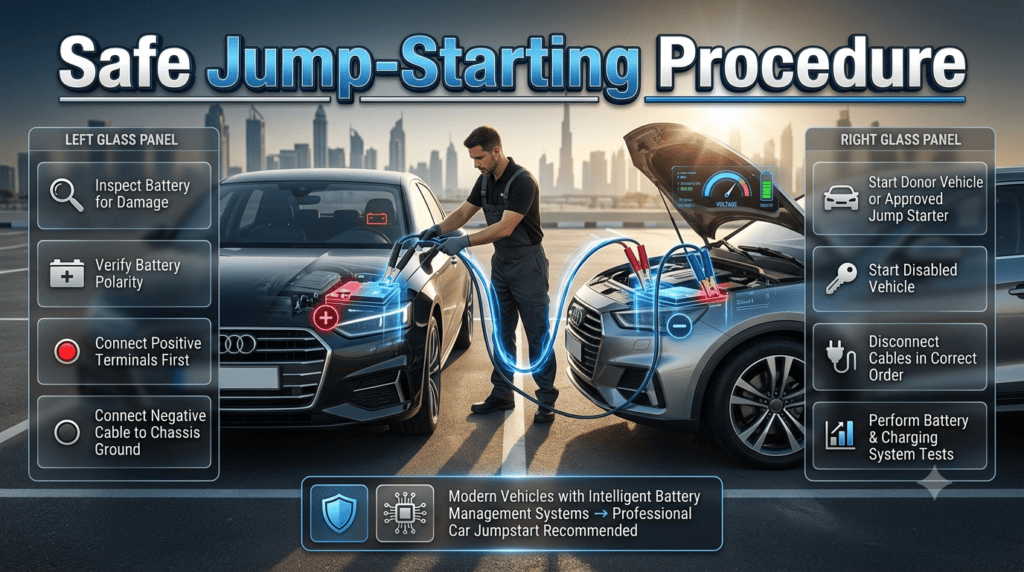
A jump-start is often the fastest solution when the battery has simply been discharged. However, incorrect procedures may damage sensitive vehicle electronics.
Professional technicians typically follow these steps:
- Inspect the battery for swelling, leakage, or physical damage.
- Verify battery polarity before connecting cables.
- Connect positive terminals first.
- Connect the negative cable to a suitable chassis ground.
- Start the donor vehicle or approved jump starter.
- Start the disabled vehicle.
- Disconnect cables in the correct order.
- Perform charging system and battery health tests immediately afterward.
For modern vehicles equipped with intelligent battery management systems, professional Car Jumpstart procedures are always recommended.
DIY vs Professional Jump Start
| Method | DIY Jump Start | Professional Service |
|---|---|---|
| Battery Safety Inspection | Limited | ✔ Complete |
| Correct Equipment | May Vary | ✔ Professional Grade |
| Alternator Testing | ✖ | ✔ Included |
| Battery Load Test | ✖ | ✔ Included |
| Electrical System Scan | ✖ | ✔ Available |
| Immediate Battery Replacement | ✖ | ✔ On-Site |
A professional visit often identifies the root cause rather than temporarily solving the symptom.
Preventing Battery Drain While Using a Dashcam
Most dashcam-related battery failures can be prevented through proper installation and routine battery maintenance.
Best practices include:
- Install a hardwire kit with low-voltage protection.
- Use parking mode only when necessary.
- Update dashcam firmware regularly.
- Turn off unnecessary accessories before leaving the vehicle.
- Inspect battery terminals every few months.
- Replace aging batteries before they become unreliable.
- Have the charging system tested during routine Car Service appointments.
- Avoid leaving the vehicle parked for extended periods without driving.
Small maintenance habits significantly reduce the likelihood of unexpected battery failures.
Seasonal Battery Care in Dubai
Dubai’s climate creates different challenges throughout the year.
Summer
High temperatures accelerate battery aging and increase electrolyte evaporation.
Winter
Although winters are mild, batteries weakened during summer often begin showing symptoms such as slow cranking or voltage drops.
Before Long Trips
Always test:
- Battery voltage
- Alternator output
- Charging efficiency
- Dashcam wiring
- Parking mode settings
Preventive maintenance before travel reduces the risk of breakdowns far from home.
Seasonal Maintenance Checklist
| Season | Recommended Maintenance |
|---|---|
| Summer | Battery inspection every 6 months |
| Winter | Load testing and charging check |
| Before Vacation | Disable unnecessary accessories |
| After Long Parking | Test battery voltage before driving |
| Annual Service | Complete electrical system inspection |
Vehicles Most Affected by Dashcam Battery Drain
Some vehicles experience battery drain more quickly because of their advanced electronics and higher standby power requirements.
Examples include:
- Luxury sedans
- Premium SUVs
- Hybrid vehicles
- Start-stop equipped vehicles
- High-performance sports cars
- Vehicles with factory security systems
- Cars with multiple aftermarket accessories
These vehicles often benefit from premium batteries with higher reserve capacity.
For many luxury and European models, technicians recommend an AGM Battery because it better handles repeated charging and discharging cycles.
When Battery Replacement Becomes the Better Option
Even if a discharged battery can be recharged, replacement may be the smarter long-term decision under certain conditions.
Replacement is generally recommended when:
✔ Battery fails the load test.
✔ Internal battery cells are damaged.
✔ Battery voltage drops repeatedly.
✔ Battery age exceeds manufacturer recommendations.
✔ Visible swelling or leakage is present.
✔ Multiple jump-starts have been required within a short period.
Using an aging battery often increases the likelihood of future roadside breakdowns.
Battery Repair vs Replacement
| Condition | Recharge | Replace |
|---|---|---|
| Temporary discharge | ✔ | ✖ |
| Healthy battery after testing | ✔ | ✖ |
| Weak load-test result | ✖ | ✔ |
| Internal cell failure | ✖ | ✔ |
| Swollen battery | ✖ | ✔ |
| Battery cannot retain charge | ✖ | ✔ |
When replacement is necessary, selecting the correct battery specification is just as important as replacing it promptly.
Understanding Battery Costs in Dubai
Battery prices vary depending on:
- Vehicle make and model
- Battery capacity
- Battery technology
- Cold Cranking Amps (CCA)
- Warranty period
- Brand reputation
- Installation requirements
Instead of choosing solely based on price, drivers should compare warranty coverage, compatibility, and long-term reliability.
For current options across premium and standard brands, consult the Complete Guide to Car Battery Prices in Dubai before making a purchase.
Future Technology Helping Prevent Battery Drain
Automotive technology continues to reduce the risk of battery-related breakdowns.
Modern developments include:
- AI-powered battery monitoring
- Smart Battery Management Systems (BMS)
- Intelligent charging algorithms
- Bluetooth battery health monitoring
- Solar battery maintainers
- Dashcams with integrated battery protection
- Low-power image sensors
- Mobile battery health diagnostics
These innovations allow drivers to monitor battery condition before a failure occurs, making preventive maintenance more effective than ever.
Industry Best Practice
Professional workshops no longer rely solely on battery voltage when diagnosing failures. Modern diagnostics combine load testing, charging system analysis, parasitic drain measurements, and ECU scanning to identify the exact cause of battery problems. At EuroSwift Auto Services, this comprehensive approach helps ensure drivers receive the correct solution—whether that’s a simple recharge, a Car Jumpstart, or a complete Battery Replacement—without replacing parts unnecessarily.
Why does my dashcam drain my car battery so fast specifically in Dubai?
The root cause is a brutal combination of continuous power draw and extreme thermal stress. Car batteries rely on liquid electrolytes to hold a charge. Dubai’s intense summer heat causes this liquid to evaporate rapidly, structurally weakening the battery and lowering its overall capacity. When you leave a dashcam running in Parking Mode, it pulls a constant electrical current (parasitic draw) from an already weakened battery. Because the battery’s capacity is severely compromised by the heat, it takes significantly less time for the camera to drop the battery’s voltage below the threshold required to crank the engine.
Heat multi-plier: High temperatures increase internal resistance, making the battery drain faster under any load.
Sulphation acceleration: Constant deep discharging caused by the dashcam speeds up chemical sulphation, permanently ruining the battery cells.
Shortened lifespan: A car battery that typically lasts 3 to 5 years globally usually only survives 1 to 2 years in the UAE.
Can I use a normal hardwire kit to protect my battery in the UAE summer?
Standard hardwire kits feature a Low Voltage Cut-Off (LVCO) switch, usually set to stop drawing power when the car battery hits 11.8V or 12.0V. In cooler climates, this leaves enough juice to start the car. However, in Dubai’s extreme heat, a battery sitting at 12.0V often lacks the cranking amps necessary to turn over a hot engine. Relying on a basic hardwire kit during a Dubai summer will still frequently result in a clicked starter and a dead engine. You must use an advanced kit that allows you to configure the cut-off to a higher threshold, such as 12.4V.
Voltage deception: Heat lowers the cranking efficiency, meaning you need a higher resting voltage to start the car.
Adjustable settings: Ensure your hardwiring kit is set to its maximum voltage threshold (12.2V–12.4V) between May and October.
Timer overrides: Set the hardwire kit to cut power after 2 to 4 hours maximum, rather than letting it run indefinitely overnight.
What is the safest way to run a dashcam 24/7 in Dubai without killing the car battery?
The gold standard solution for the Middle East market is dedicated Dashcam Battery Packs using Lithium Iron Phosphate (\(LiFePO_{4}\)) chemistry. These specialized packs hardwire to your car’s ignition, charging only while you drive (taking about 40–50 minutes to fully charge). When you turn off the engine, the dashcam draws power exclusively from this dedicated battery pack, leaving your main car battery completely untouched and isolated. Furthermore, \(LiFePO_{4}\) batteries are engineered to safely withstand extreme cabin temperatures up to 70°C to 80°C without risk of swelling or combustion.
Zero car battery drain: The main starting battery is 100% isolated when the engine is switched off.
Thermal stability: \(LiFePO_{4}\) technology is vastly safer than standard lithium-ion power banks, which can explode in UAE heat.
Cost vs value: While expensive upfront (approx. 800 to 1,500 AED), it saves you from replacing your main car battery every few months.
Should I use “Motion Detection” or “Time-Lapse” parking mode in the UAE?
From an energy-conservation standpoint, you should strictly use Time-Lapse Parking Mode or Impact-Only Detection. Standard Motion Detection keeps the camera’s image sensor constantly active, processing pixels to look for movement. In busy Dubai parking lots or malls, nearby foot traffic and moving cars mean the camera will record almost continuously, maximizing power consumption. Time-Lapse mode reduces the frame rate to 1 frame per second, drastically lowering the processor’s power consumption and reducing the heat generated by the dashcam itself.
Lower power draw: Time-lapse reduces the electrical load on your power source by up to 40%.
Reduced camera heat: Less processing power means the dashcam runs cooler, preventing internal hardware failure.
Optimized storage: Saves memory card space while still ensuring you capture structural timeline evidence if hit.
My battery died from the dashcam; do I need a new battery or just a jumpstart?
It depends entirely on the age of your battery and how long it remained flat. If your battery is less than a year old and was drained just once, a professional jumpstart followed by a 45-minute drive (or a bench charge) will likely revive it. However, if the battery is over 18 months old, Dubai’s ambient heat has likely already degraded the plates. Allowing a dashcam to drain it to completely flat (below 10.5V) causes irreversible damage to the cells. In most UAE scenarios, a battery drained completely by a dashcam during summer will never hold a reliable charge again and requires immediate replacement.
Get a health check: Visit a local battery center to test the Cold Cranking Amps (CCA) and voltage health post-jumpstart.
Alternator strain: Forcing your car’s alternator to completely recharge a dead battery in extreme heat can overheat and damage the alternator.
Warranty warnings: Note that many UAE battery retailers will void your warranty if they detect the failure was caused by deep parasitic drain from aftermarket accessories.
Conclusion
A battery failed after leaving dashcam running Dubai is a common issue, particularly during the city’s long, hot summers when high temperatures and continuous electrical loads place extra stress on automotive batteries. While a dashcam itself typically consumes only a small amount of power, extended parking mode, an aging battery, or additional aftermarket accessories can combine to create enough battery drain to leave your vehicle unable to start.
The best way to avoid unexpected breakdowns is through preventive maintenance. Regular battery health checks, professional electrical inspections, proper dashcam installation with a low-voltage cut-off module, and timely battery replacement all help ensure reliable vehicle performance. If your battery repeatedly loses charge, don’t rely on frequent jump-starts alone. A complete diagnostic can determine whether the issue lies with the battery, alternator, charging system, or excessive parasitic drain.
At EuroSwift Auto Services, experienced technicians provide comprehensive Battery Replacement, Car Jumpstart, Roadside Assistance, Vehicle Inspection, and electrical diagnostics for all major vehicle brands. Whether your vehicle requires a premium AGM Battery, Bosch Battery, Amaron Battery, Exide Battery, or another trusted brand, choosing the correct battery for your vehicle and driving conditions is essential for long-term reliability.
Investing in routine Vehicle Maintenance today can prevent costly roadside emergencies tomorrow. As modern vehicles continue to rely on more electronic systems and accessories, proactive battery care and professional servicing remain the most effective way to keep your car dependable on Dubai’s roads throughout the year.
Leave a Reply