
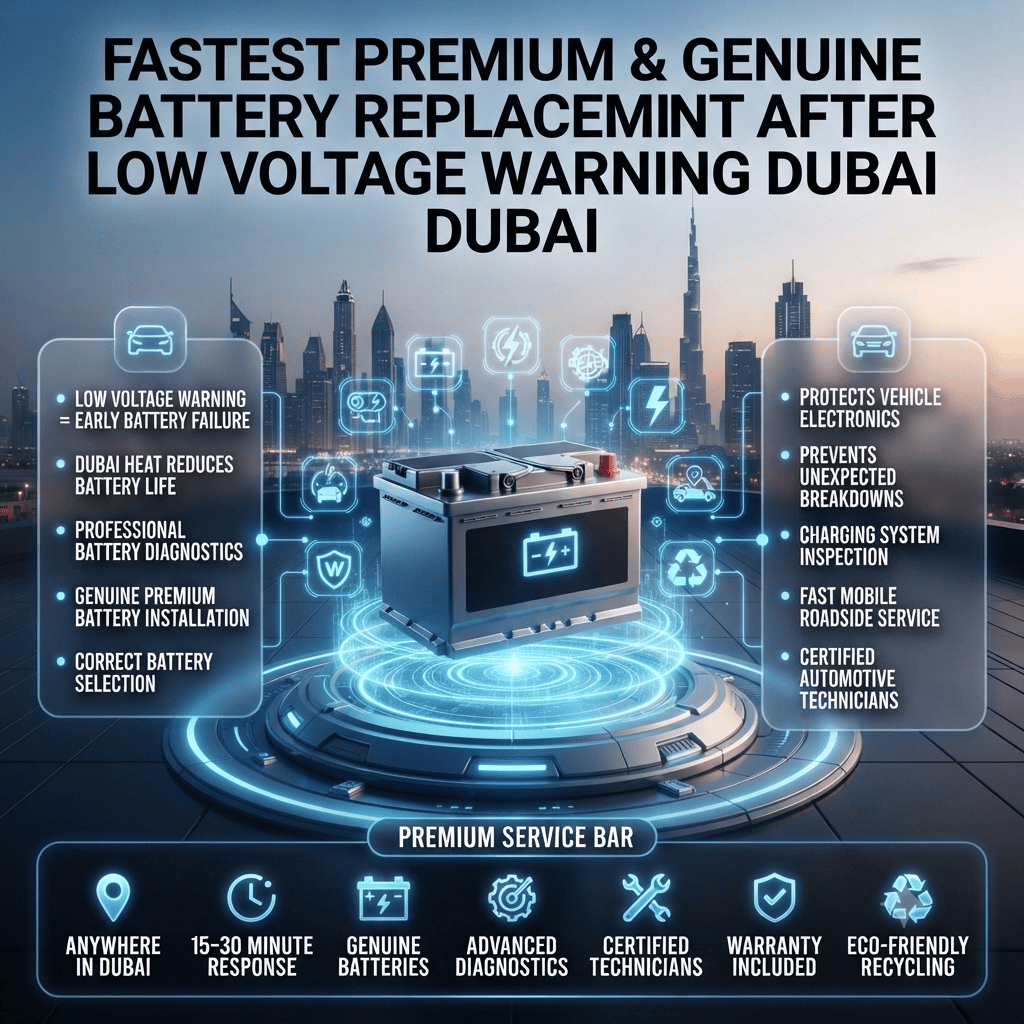
A low voltage warning is one of the earliest signs that your vehicle’s battery is no longer supplying the electrical power required for reliable operation. In Dubai, where prolonged exposure to extreme temperatures places constant stress on automotive electrical systems, ignoring this warning can quickly lead to a completely discharged battery and an unexpected breakdown. Choosing the fastest premium & genuine battery replacement after low voltage warning Dubai helps restore vehicle performance, protects sensitive electronics, and reduces the risk of roadside emergencies.
Modern vehicles rely on stable battery voltage to power advanced onboard systems, including engine management, intelligent safety features, infotainment, navigation, electronic parking brakes, adaptive lighting, driver assistance systems, and climate control. When battery voltage drops below the manufacturer’s recommended level, these systems may begin displaying warning messages, operate inconsistently, or stop functioning altogether.
Professional battery replacement services in Dubai use advanced diagnostic equipment to confirm whether the warning is caused by a deteriorated battery, charging system fault, alternator issue, or excessive electrical drain. Once the battery is confirmed as the primary cause, technicians install a premium replacement that matches the manufacturer’s specifications and verify that the entire charging system operates correctly before returning the vehicle to service.
Drivers who require immediate assistance can also request mobile roadside support through EuroSwift Auto Services, allowing certified technicians to perform professional diagnostics and battery replacement directly at the vehicle’s location.
Why Low Voltage Warnings Are Common in Dubai
Dubai’s climate presents unique challenges for automotive batteries. Although many drivers associate battery failures with cold weather, excessive heat is equally damaging. High ambient temperatures accelerate chemical reactions inside the battery, increase water loss from the electrolyte, and gradually reduce the battery’s overall lifespan.
Several local driving conditions contribute to frequent low voltage warnings:
- Continuous exposure to temperatures exceeding 45°C
- Heavy stop-and-go traffic across Dubai
- Long periods of vehicle idling
- Short-distance urban driving
- High electrical demand from air conditioning systems
- Extended vehicle parking during holidays
- Smart key systems remaining active while parked
- Increased use of electronic safety systems
- Dash cameras operating continuously
- Battery aging caused by prolonged heat exposure
Because of these factors, batteries in Dubai often require replacement earlier than those operating in cooler climates.https://euroswiftautoservices.ae/
Understanding a Low Voltage Warning
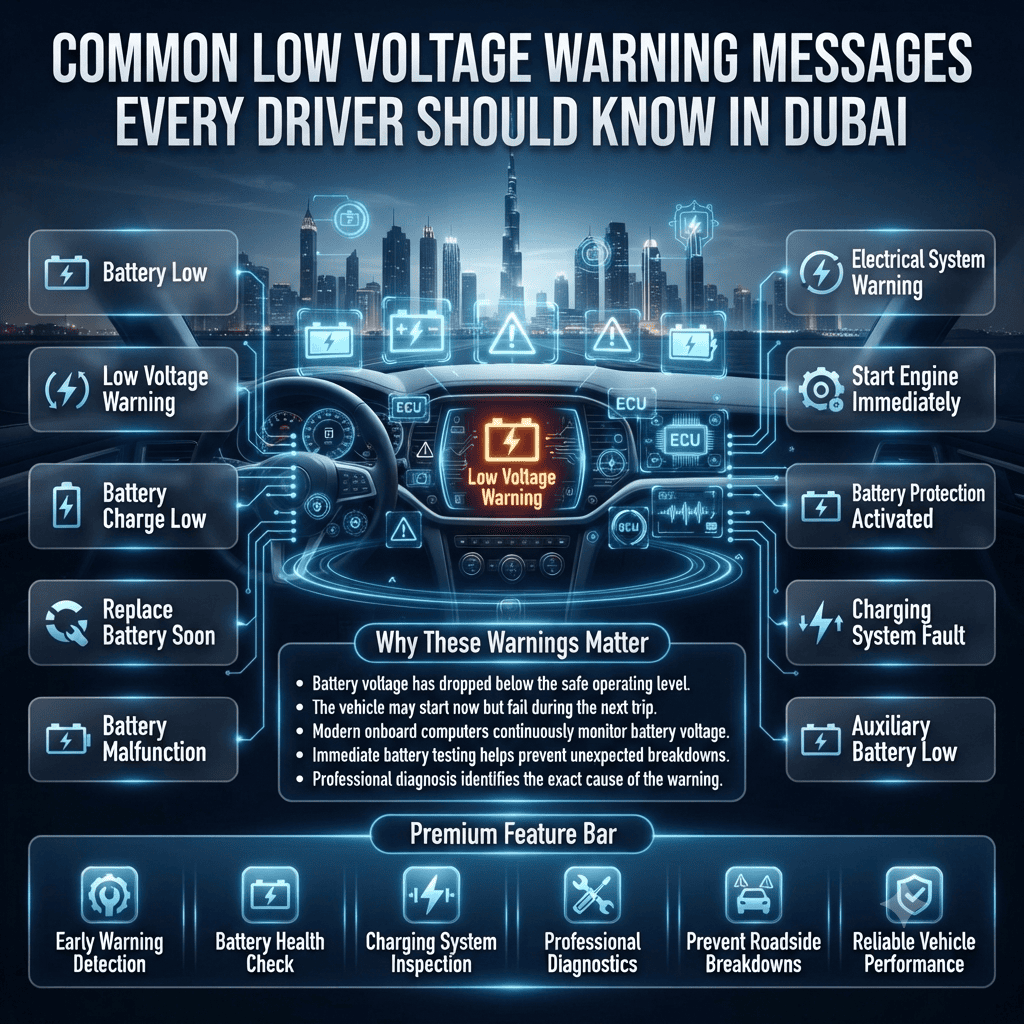
A low voltage warning indicates that the battery voltage has fallen below the level required for reliable vehicle operation. This warning should never be ignored because the battery may still start the engine today but fail completely during the next journey.
Common warning messages include:
- Battery Low
- Low Voltage Warning
- Battery Charge Low
- Replace Battery Soon
- Battery Malfunction
- Electrical System Warning
- Start Engine Immediately
- Battery Protection Activated
- Charging System Fault
- Auxiliary Battery Low
These warnings are generated by the vehicle’s onboard computer after monitoring voltage levels over time.
Common Causes of Low Voltage Warning in Dubai
Several factors can trigger a low voltage warning. Professional diagnosis identifies the exact cause before replacing the battery.
Natural Battery Aging
Every automotive battery has a limited service life. In Dubai’s climate, many batteries begin losing capacity after two to three years due to accelerated internal chemical degradation.
Heat Damage
Persistent exposure to high temperatures causes electrolyte evaporation and internal plate deterioration. Even premium batteries gradually lose efficiency under extreme heat conditions.
Charging System Problems
A malfunctioning alternator may fail to recharge the battery while driving. As the battery continues supplying electrical power without adequate charging, voltage gradually decreases.
Electrical Drain
Modern vehicles contain dozens of electronic modules that consume small amounts of electricity even when parked. Excessive parasitic drain caused by faulty components can discharge the battery overnight.
Short Trips
Frequent short journeys prevent the alternator from fully recharging the battery after engine start-up.
Vehicle Storage
Cars parked for several weeks without being started naturally experience battery discharge.
Corroded Battery Terminals
Corrosion increases electrical resistance and interferes with charging efficiency.
Loose Battery Connections
Poor terminal contact causes voltage fluctuations that trigger dashboard warning messages.
Dubai’s Automotive Service Ecosystem for Battery Replacement
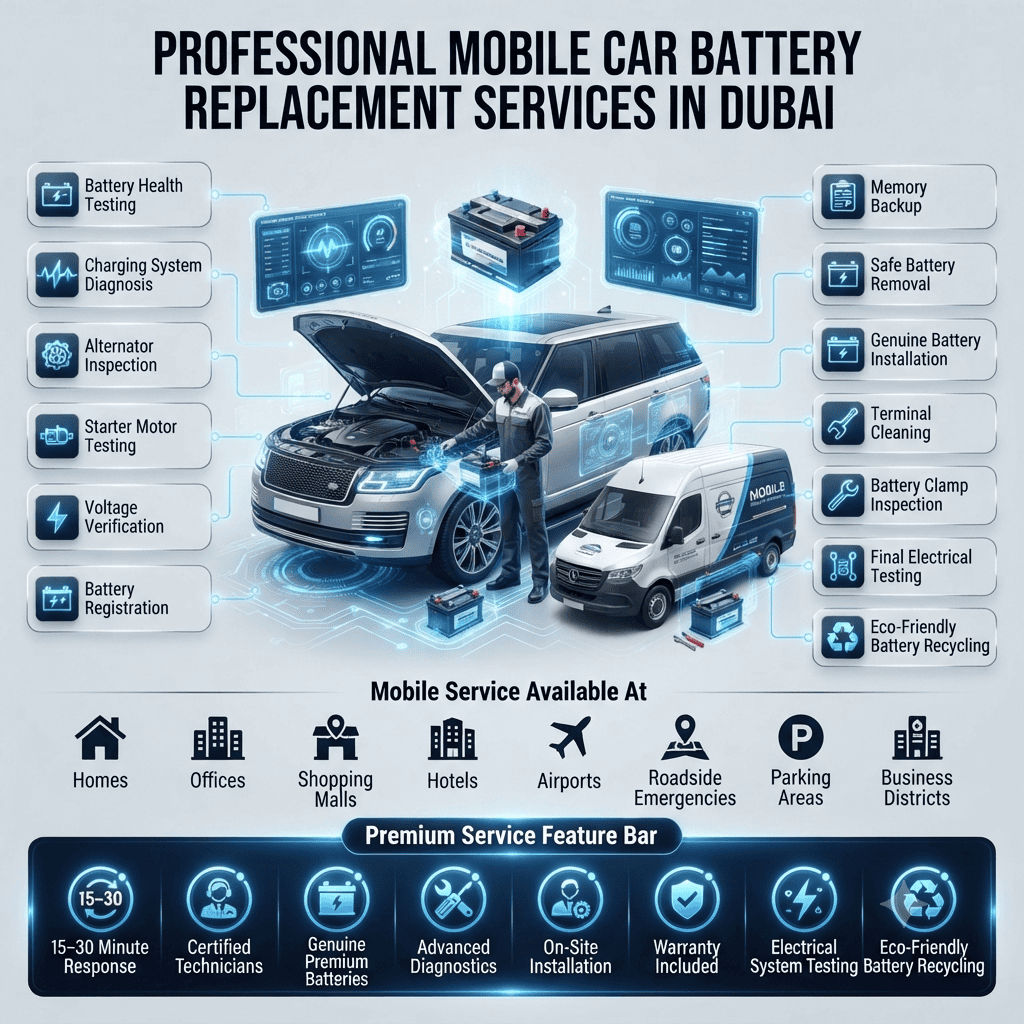
Dubai has developed a highly efficient automotive service network capable of responding quickly to battery-related emergencies. Mobile technicians equipped with diagnostic tools and genuine replacement batteries can reach customers at homes, offices, shopping malls, airports, hotels, and roadside locations.
Professional battery replacement services generally include:
- Battery health testing
- Charging system diagnosis
- Alternator inspection
- Starter motor testing
- Voltage verification
- Battery registration when required
- Memory backup for electronic systems
- Safe battery removal
- Genuine battery installation
- Terminal cleaning
- Battery clamp inspection
- Final electrical testing
- Responsible recycling of the old battery
Many providers now offer response times of approximately 15–30 minutes across major areas of Dubai, depending on traffic conditions.
Premium Battery Brands Available in Dubai
Selecting a premium battery significantly improves reliability, especially under UAE driving conditions. Professional technicians recommend batteries that match the manufacturer’s electrical specifications rather than simply choosing the least expensive option.
Drivers looking for long-lasting performance often choose Amaron batteries for excellent heat resistance.
Many German vehicles are equipped with or compatible with premium Bosch batteries designed for advanced electrical systems.
Japanese vehicles frequently benefit from reliable Tuflong battery replacements known for durability and consistent starting power.
Luxury vehicles equipped with Start-Stop technology often require advanced AGM batteries capable of handling higher electrical loads.
Drivers seeking dependable OEM-quality performance also choose Exide batteries for a wide range of passenger vehicles.
Many Toyota, Nissan, Honda, and Lexus owners prefer Panasonic batteries because of their long service life and consistent reliability.
European vehicle owners often select FIAMM batteries engineered for demanding electrical systems.
American vehicles and many SUVs are commonly fitted with durable AC Delco batteries that deliver dependable starting performance.
Battery Types Used After a Low Voltage Warning
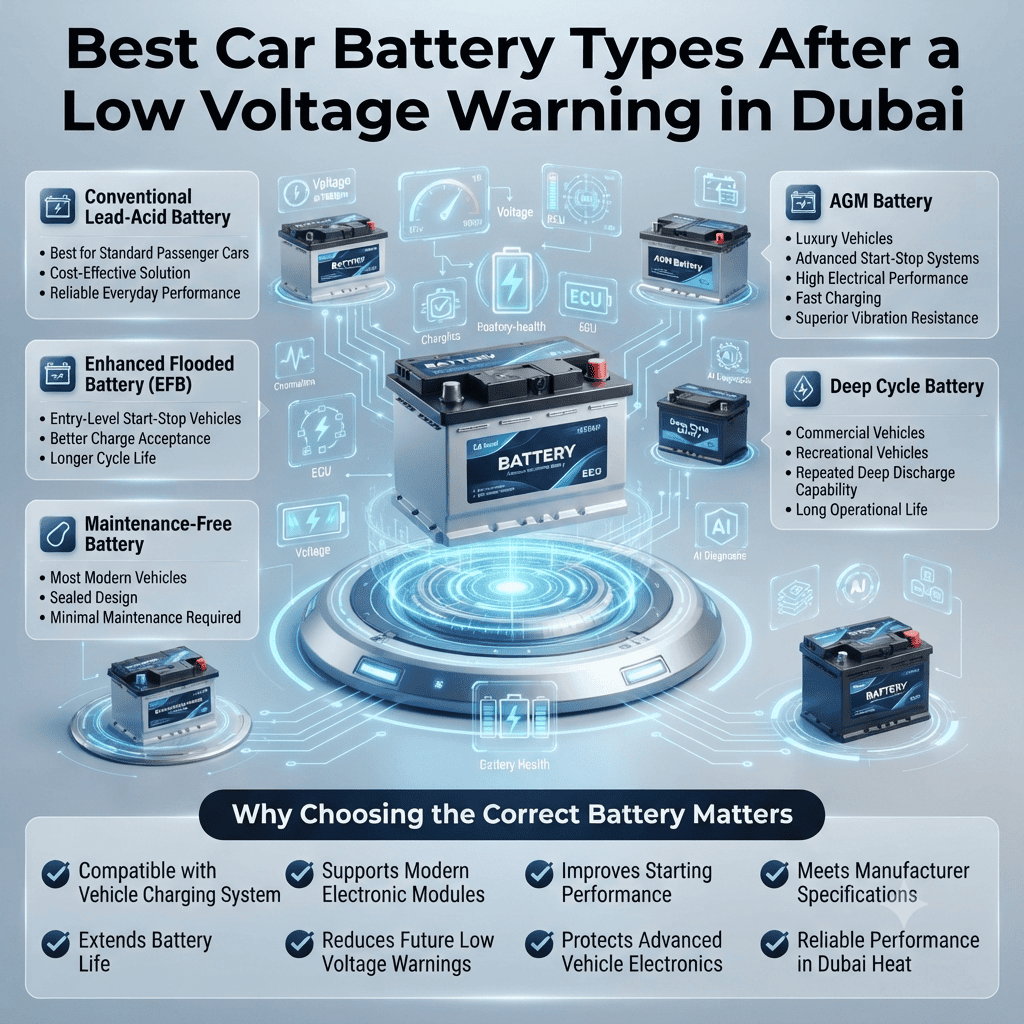
Choosing the correct battery type is essential for restoring reliable vehicle performance after a low voltage warning. Different vehicles require different battery technologies based on their electrical demands, engine configuration, and onboard systems.
| Battery Type | Best Suited For | Main Benefits |
|---|---|---|
| Conventional Lead-Acid | Standard passenger vehicles | Cost-effective and reliable for everyday driving |
| Enhanced Flooded Battery (EFB) | Entry-level Start-Stop vehicles | Improved charge acceptance and longer cycle life |
| Absorbent Glass Mat (AGM) | Luxury vehicles and advanced Start-Stop systems | Excellent vibration resistance, rapid charging, and high electrical performance |
| Deep Cycle Battery | Commercial and recreational vehicles | Designed for repeated deep discharge cycles |
| Maintenance-Free Battery | Most modern passenger vehicles | Sealed construction with minimal servicing requirements |
Selecting the correct battery ensures proper compatibility with the vehicle’s charging system, electronic modules, and manufacturer specifications while reducing the likelihood of future low voltage warnings.
Professional Battery Replacement Process After a Low Voltage Warning
Receiving a low voltage warning does not always mean the battery has completely failed, but it does indicate that immediate professional attention is required. Modern vehicles depend on stable battery voltage for engine management, safety systems, infotainment, navigation, electronic steering, and driver assistance technologies. A professional battery replacement service follows a systematic process to identify the exact cause of the warning before installing a genuine replacement battery.
Step 1: Initial Vehicle Inspection
The replacement process starts with a complete inspection of the battery and electrical system. Technicians first verify the dashboard warning and ask the driver about recent symptoms, such as slow engine cranking, flickering lights, repeated warning messages, or difficulty starting the vehicle after parking.
During the inspection, technicians examine:
- Battery casing for cracks or swelling
- Manufacturing date
- Battery terminals
- Cable connections
- Hold-down brackets
- Battery tray condition
- Signs of corrosion
- Acid leakage
- Heat damage
- Wiring condition
This inspection helps determine whether the battery has reached the end of its service life or if another electrical issue is responsible for the low voltage warning.
Step 2: Professional Battery Diagnostic Test
A professional diagnostic test provides a clear picture of the battery’s condition. Instead of relying only on battery voltage, technicians use specialized testing equipment that measures overall battery health.
The diagnostic report includes:
- Battery Voltage
- Cold Cranking Amps (CCA)
- State of Charge (SOC)
- State of Health (SOH)
- Internal Resistance
- Starting Capacity
- Charging Acceptance
- Remaining Service Life
This testing ensures that the battery is only replaced when necessary.
Step 3: Charging System Inspection
Many low voltage warnings originate from charging system problems rather than battery failure. Before replacing the battery, technicians inspect the alternator and related charging components.
The inspection includes:
- Alternator output
- Voltage regulator performance
- Drive belt condition
- Charging voltage
- Electrical wiring
- Ground connections
- Charging current under load
If the alternator is not charging correctly, installing a new battery alone will not permanently solve the problem.
Step 4: Electrical Drain Diagnosis
Modern vehicles continue consuming a small amount of electricity even after the engine is switched off. However, excessive electrical drain can discharge a healthy battery within hours.
Technicians inspect for abnormal current draw caused by:
- Interior lights
- Dash cameras
- GPS tracking devices
- Alarm systems
- Smart key modules
- Infotainment systems
- Faulty electronic control units
- Aftermarket accessories
Identifying and correcting excessive battery drain helps prevent future low voltage warnings.
Step 5: Selecting the Correct Replacement Battery
Once diagnostics confirm that replacement is necessary, technicians select a battery that matches the vehicle manufacturer’s specifications. Choosing the correct battery is essential because modern vehicles rely on specific voltage ratings, reserve capacity, and cold cranking performance.
Selection is based on:
- Battery group size
- Voltage rating
- Ampere-hour (Ah)
- Cold Cranking Amps (CCA)
- Reserve Capacity (RC)
- Terminal layout
- Battery technology
- Vehicle manufacturer recommendations
Drivers searching for premium battery solutions can learn more about EuroSwift Auto Services by visiting: https://euroswiftautoservices.ae/
Premium battery options are also available for different vehicle requirements:
Bosch Battery
Amaron Battery
Panasonic Battery
Exide Battery
AGM Battery
Step 6: Safe Removal of the Old Battery
Professional technicians follow manufacturer-approved procedures when removing the old battery. This minimizes the risk of electrical damage and protects sensitive onboard electronics.
The removal process includes:
- Switching off electrical accessories
- Disconnecting the negative terminal first
- Disconnecting the positive terminal
- Removing battery retaining brackets
- Lifting the battery safely
- Cleaning the battery tray
- Removing corrosion from terminals
Step 7: Installation of the Genuine Replacement Battery
The new battery is installed carefully according to the vehicle manufacturer’s recommendations.
Installation includes:
- Positioning the battery correctly
- Securing retaining brackets
- Connecting the positive terminal
- Connecting the negative terminal
- Applying anti-corrosion protection
- Tightening all electrical connections
- Verifying battery stability
Proper installation improves battery lifespan and electrical reliability.
Step 8: Battery Registration for Modern Vehicles
Luxury vehicles equipped with Battery Management Systems (BMS) require battery registration after replacement. This procedure allows the vehicle to recognize the new battery and adjust charging parameters accordingly.
Battery registration is commonly required for:
- BMW
- Mercedes-Benz
- Audi
- Porsche
- Land Rover
- Range Rover
- MINI
- Jaguar
Correct battery registration helps:
- Improve charging efficiency
- Prevent overcharging
- Prevent undercharging
- Maintain Start-Stop functionality
- Extend battery lifespan
- Reduce future electrical warnings
Step 9: Final Quality Inspection
After installation, technicians perform a final inspection to verify that the entire charging system is operating correctly.
Final testing includes:
- Engine starting test
- Battery voltage verification
- Alternator charging test
- Dashboard warning inspection
- Electrical load testing
- Diagnostic fault code scan
- Start-Stop system verification
- Overall electrical system inspection
Only after every test is successfully completed is the vehicle returned to the customer.
UAE Regulations for Professional Battery Replacement
Professional battery replacement companies operating in Dubai are expected to follow UAE automotive and environmental regulations when handling automotive batteries.
Responsible service providers should:
- Install batteries that match manufacturer specifications.
- Handle battery acid safely.
- Transport old batteries securely.
- Dispose of used batteries through licensed recycling facilities.
- Protect the environment from hazardous battery waste.
- Issue warranty documentation for genuine batteries.
- Follow workplace safety procedures during installation.
These practices help ensure road safety while supporting environmentally responsible battery disposal.
Common Battery Replacement Violations
Vehicle owners should avoid service providers that fail to follow professional replacement standards.
Common violations include:
- Installing counterfeit batteries
- Using incorrect battery sizes
- Ignoring charging system faults
- Skipping battery diagnostic testing
- Poor terminal connections
- Failure to register batteries on smart vehicles
- Improper disposal of used batteries
- Providing no product warranty
Selecting an experienced battery replacement provider reduces the likelihood of repeat failures and unnecessary repair costs.
Battery Replacement Pricing in Dubai
Battery replacement costs depend on several factors, including battery technology, vehicle type, battery capacity, and warranty coverage.
For a complete breakdown of current battery prices, vehicle-specific recommendations, and warranty options, visit:
Complete Guide to Car Battery Prices in Dubai 2026
https://euroswiftautoservices.ae/complete-guide-to-car-battery-prices-in-dubai-2026-updated-list
| Vehicle Category | Battery Type | Estimated Price (AED) |
|---|---|---|
| Small Cars | Maintenance-Free | 250–450 |
| Sedan | Premium Battery | 350–650 |
| SUV | Heavy-Duty Battery | 450–850 |
| Luxury Cars | AGM Battery | 800–1,600 |
| Commercial Vehicles | High Capacity Battery | 600–1,500 |
Professional Battery Replacement Packages
Most professional battery replacement companies in Dubai offer different service packages based on customer requirements.
| Package | Included Services |
|---|---|
| Basic | Battery installation and terminal cleaning |
| Standard | Battery testing, installation, charging system inspection, warranty |
| Premium | Full diagnostics, battery registration, genuine battery installation, recycling, warranty |
| Emergency Roadside | Mobile technician, on-site diagnostics, battery replacement, final electrical testing |
Drivers experiencing a low voltage warning at home, work, hotels, airports, shopping malls, or roadside locations can arrange immediate mobile assistance through:
How Long Do You Leave the Battery Unhooked to Reset Codes?
Disconnecting a car battery may clear some temporary fault codes or reset certain electronic systems, but it is not a guaranteed method for removing diagnostic trouble codes from modern vehicles. Most newer cars store fault codes in non-volatile memory, meaning they remain even after the battery has been disconnected.
If a reset is appropriate, technicians typically leave the battery disconnected for 15 to 30 minutes. However, luxury vehicles and cars equipped with advanced electronic control units often require a professional diagnostic scanner to clear codes safely. Disconnecting the battery without following the manufacturer’s procedure can also erase radio presets, clock settings, window calibration, and seat memory.
What to Do After a New Battery Replacement?
After installing a new battery, several checks should be completed to ensure the vehicle operates correctly and the charging system functions as intended.
Recommended steps include:
Start the engine and confirm smooth starting.
Verify the charging voltage using professional diagnostic equipment.
Check that no battery or charging system warning lights remain on the dashboard.
Inspect battery terminals to ensure they are clean and securely tightened.
Reset the clock, radio, and infotainment settings if necessary.
Recalibrate automatic windows and sunroof functions where required.
Test headlights, air conditioning, and other electrical accessories.
Perform battery registration on vehicles equipped with a Battery Management System (BMS), if required.
Confirm the alternator is charging within the manufacturer’s specified voltage range.
Keep the battery warranty documentation for future reference.
Drivers who prefer professional installation can arrange complete battery testing and installation through EuroSwift Auto Services.
https://euroswiftautoservices.ae/car-battery-replacement-near-me-dubai/
Is 12.3 Volts Too Low for a Battery While the Car Is Off?
A fully charged 12-volt automotive battery should normally measure approximately 12.6 to 12.8 volts with the engine switched off.
A reading of 12.3 volts indicates that the battery is only partially charged, typically around 50–70% capacity, depending on battery type and temperature. While the vehicle may still start, this voltage suggests the battery should be tested, especially if the dashboard has displayed a low voltage warning.
The table below provides a general guide.
Battery Voltage (Engine Off)
Approximate Condition
12.6–12.8 V
Fully charged
12.4–12.5 V
Good condition
12.3 V
Partially discharged
12.2 V
Low charge
Below 12.0 V
Significantly discharged
Below 11.8 V
Battery may require replacement
In Dubai’s high temperatures, repeated readings around 12.3 volts may indicate the battery is approaching the end of its service life and should be professionally evaluated.
What Happens If I Don’t Code My New Battery?
Many modern vehicles, particularly luxury and premium models, require the new battery to be coded or registered after replacement. This process informs the Battery Management System (BMS) that a new battery has been installed so it can adjust charging strategies accordingly.
If a new battery is not coded, several issues may occur:
Incorrect charging voltage
Overcharging or undercharging the battery
Reduced battery lifespan
Poor Start-Stop system performance
Recurring battery warning messages
Increased electrical system faults
Reduced fuel efficiency on Start-Stop vehicles
Premature battery failure
Battery coding is commonly required for vehicles such as BMW, Mercedes-Benz, Audi, MINI, Porsche, Land Rover, Jaguar, and many newer European models.
If your vehicle requires battery coding, professional technicians can perform battery registration along with installation to ensure the charging system recognizes the new battery correctly.
https://euroswiftautoservices.ae/car-battery-replacement-near-me-dubai/
Conclusion
A low voltage warning should never be ignored, especially in Dubai’s demanding climate where extreme heat, heavy traffic, and continuous use of vehicle electronics can significantly reduce battery performance. Acting quickly helps prevent unexpected breakdowns, protects sensitive electrical components, and ensures your vehicle continues to operate safely and efficiently.
Choosing the fastest premium & genuine battery replacement after low voltage warning Dubai means more than simply installing a new battery. A professional service includes accurate diagnostics, charging system inspection, selection of the correct battery specification, expert installation, and thorough post-installation testing. These steps help maximize battery life while reducing the risk of recurring electrical issues.
Whether you drive a compact city car, family SUV, luxury sedan, high-performance vehicle, hybrid, or electric vehicle with a 12-volt auxiliary battery, using genuine batteries and experienced technicians is essential for reliable performance. Regular battery health checks, timely replacement, and proper maintenance can save both time and costly repairs in the future.
For drivers who need fast, dependable, and professional roadside battery replacement anywhere in Dubai, EuroSwift Auto Services offers certified technicians, genuine battery brands, on-site diagnostics, and quick installation to get you back on the road with confidence.

Leave a Reply