
Battery voltage and battery capacity are two of the most critical performance indicators for any vehicle battery. These two parameters determine how strong the battery is, how long it can sustain electrical loads, how efficiently the engine cranks, and how well modern electronics operate. In this complete guide, we explain what battery voltage means, how capacity works, how they affect real-world performance, and how drivers in Dubai can pick the right battery, especially under extreme heat conditions.
This article is structured for Google 2025 ranking standards, covering user intent, real examples, tables, case studies, semantic keyword density, and clean technical explanations.
What Is Battery Voltage?
Voltage represents the electrical pressure inside the battery. It shows how strongly electrical energy flows through the vehicle’s systems.
Standard readings for a 12V automotive battery
| Battery State | Voltage Reading |
|---|---|
| Fully Charged | 12.6–12.8V |
| Healthy | 12.4–12.5V |
| Weak | 12.1–12.3V |
| Discharged | Below 12.0V |
| Failing | Below 11.8V |
Voltage helps determine:
- Engine starting health
- Alternator charging performance
- Electrical load handling
- Battery internal resistance
- Real-time energy stability
For more technical assessments, professional testers at Car Battery Replacement Near Me in Dubai can check both voltage and load behavior on-site.
What Is Battery Capacity?
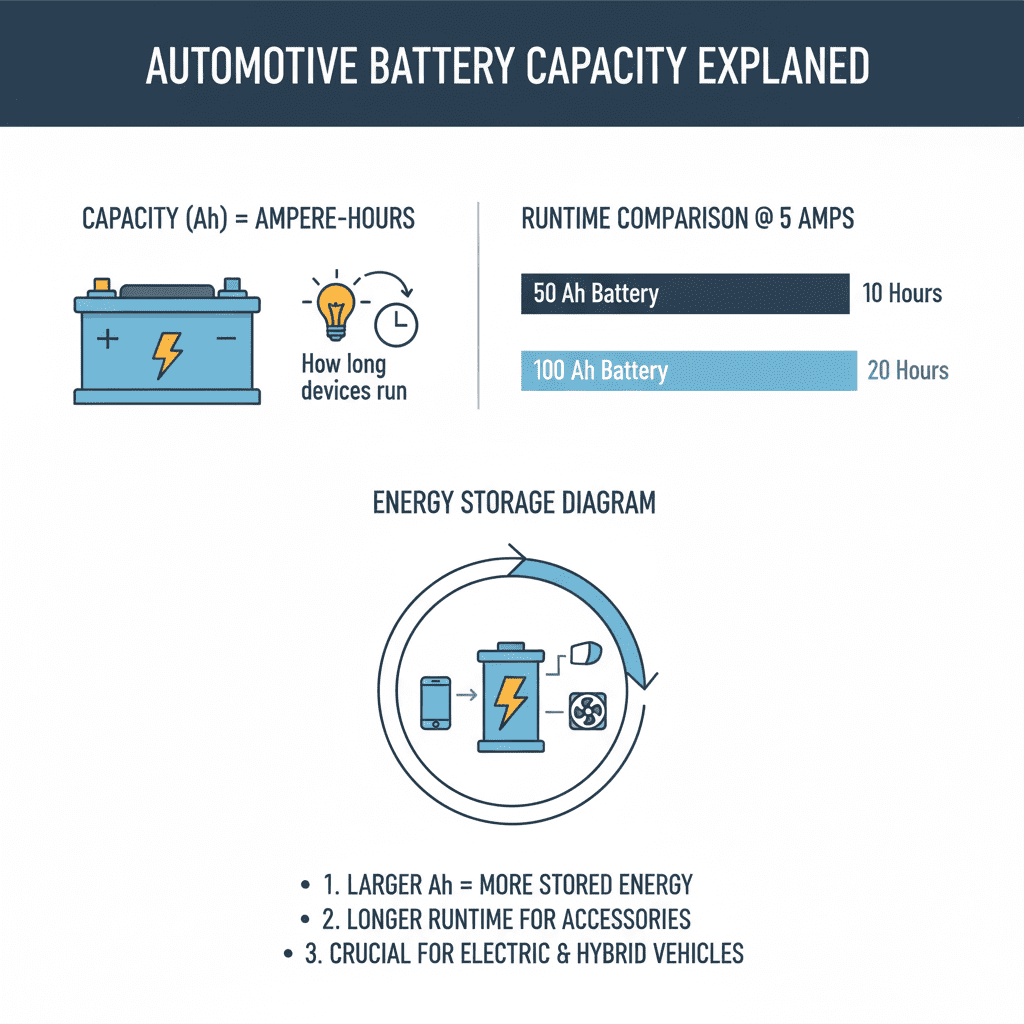
Battery capacity is measured in Ampere-hours (Ah).
It shows how long the battery can supply power before becoming empty.
Example:
A 70Ah battery provides 70 amps for 1 hour, or 7 amps for 10 hours, etc.
Capacity determines:
- Backup duration
- Resistance to discharge
- Stability under accessories load
- Time a vehicle can run electronics with engine off
- Reserve energy support for sensors & ECUs
Semantic variations included: amp-hour rating, energy storage, reserve capability, discharge endurance, deep-cycle strength, electrical stamina, runtime capacity.
How Voltage and Capacity Work Together
Voltage shows how much power the battery can push;
Capacity shows how long it can provide that power.
A high-voltage battery with a low capacity starts the engine fast but drains quickly.
A high-capacity battery with low voltage may struggle to start the engine.
Ideal performance requires both parameters to be balanced, especially in hot climates like Dubai.
Types of Voltage Drops and What They Mean
1. Cranking Voltage Drop
If voltage drops below 9.6V during engine start, the battery is weak.
2. Resting Voltage Drop
If voltage falls overnight more than 0.2V, the battery may have:
- internal sulfation
- plate corrosion
- parasitic drain
3. Load Voltage Drop
When AC, headlights, and infotainment are turned on, a strong battery maintains stable voltage.
Why Dubai Drivers Must Understand Voltage & Capacity
Extreme heat accelerates:
- electrolyte evaporation
- plate corrosion
- internal resistance increase
- faster voltage collapse
- capacity loss
This is why brands designed for heat—like Amaron, Bosch, and Tuflong—are preferred.
👉 For long-lasting heat-proof batteries, check:
Amaron Battery Replacement
Bosch Battery Replacement
Tuflong Battery Replacement
How Capacity Decreases Over Time
A battery loses about 18–25% capacity per year in UAE due to:
- excessive heat
- long idling
- frequent short trips
- alternator undercharging
- deep discharge cycles
Low capacity leads to:
- weak cranking
- voltage fluctuations
- sudden battery failure
Battery Voltage and Capacity Comparison Table
| Feature | Battery Voltage | Battery Capacity |
|---|---|---|
| Measures | Electrical pressure | Stored energy |
| Unit | Volts (V) | Ampere-hours (Ah) |
| Key Role | Starting power | Backup duration |
| Affects | Cranking ability | Runtime under load |
| Critical for | Engine ignition | Accessories & electronics |
| Impact of Heat | High voltage instability | Faster capacity drop |
Vehicle Voltage Requirements
| Vehicle Type | Ideal Voltage Behavior |
|---|---|
| Sedans | 12.4–12.8V resting |
| SUVs | 12.6–12.9V resting |
| Luxury Cars | Strong alternator with stable 14–14.4V charging |
| Hybrid Cars | Slightly lower engine-start voltage load |
Case Study: Voltage & Capacity Failure in a 2020 Nissan Altima (Dubai)
Scenario
Owner reported slow cranking and AC dip during startup.
Test Results
| Parameter | Reading | Expected |
|---|---|---|
| Resting Voltage | 12.1V | 12.6V |
| Capacity Test | 42Ah | 70Ah |
| Crank Voltage | 9.1V | ≥9.6V |
| Charging Output | 13.7V | 14.0V–14.4V |
Actual Cause
Battery suffered capacity degradation + low voltage stability due to heat.
Outcome
Battery replaced with a high-capacity, heat-resistant model. Engine cranking restored to normal.
Choosing the Right Voltage & Capacity for Dubai
A good rule:
| Vehicle Type | Recommended Capacity |
|---|---|
| Small Cars | 50Ah–60Ah |
| Sedans | 60Ah–70Ah |
| SUVs | 70Ah–90Ah |
| Luxury Cars | 90Ah–110Ah |
| Off-Road Vehicles | 80Ah–120Ah |
For updated average prices, check:
👉 Car Battery Price Guide Dubai 2025
Testing Voltage and Capacity — Professional Method

A technician performs:
- Open-circuit voltage measurement
- Load test for capacity
- Conductance test
- Alternator charging output
- Crank test under ignition load
This gives the true health score of the battery.
For expert testing:
👉 Car Battery Specialists in Dubai
What is the ideal voltage for a healthy car battery?
A healthy 12V car battery typically shows 12.6V to 12.8V at rest. Anything below 12.4V indicates partial discharge, while readings under 12.0V show the battery is weak and may fail soon. Regularly checking voltage helps prevent sudden breakdowns, especially in Dubai’s extreme heat.
What does battery capacity (Ah) mean?
Battery capacity, measured in Ampere-Hours (Ah), indicates how long a battery can deliver power. Higher Ah means longer running time for headlights, AC blowers, infotainment systems, and start-stop features. Choosing the right Ah rating improves performance and prevents battery drain.
Does higher battery voltage improve performance?
Not necessarily. Car electrical systems are designed for fixed voltage levels. What matters more is battery health, charging consistency, and capacity (Ah). Stable voltage ensures smoother engine cranking, optimal ECU performance, and reliable power delivery to all electronic components.
Conclusion
Battery voltage and capacity are the foundations of vehicle electrical performance. Healthy voltage ensures stable engine starting, ignition strength, and electronics reliability, while strong capacity delivers long-lasting backup power, better heat resistance, and dependable daily performance.
If your battery is showing slow starts, weak voltage, or reduced capacity, EuroSwift Auto Services provides professional on-site testing and replacement anywhere in Dubai.
For urgent help, call +971501508507.
Leave a Reply