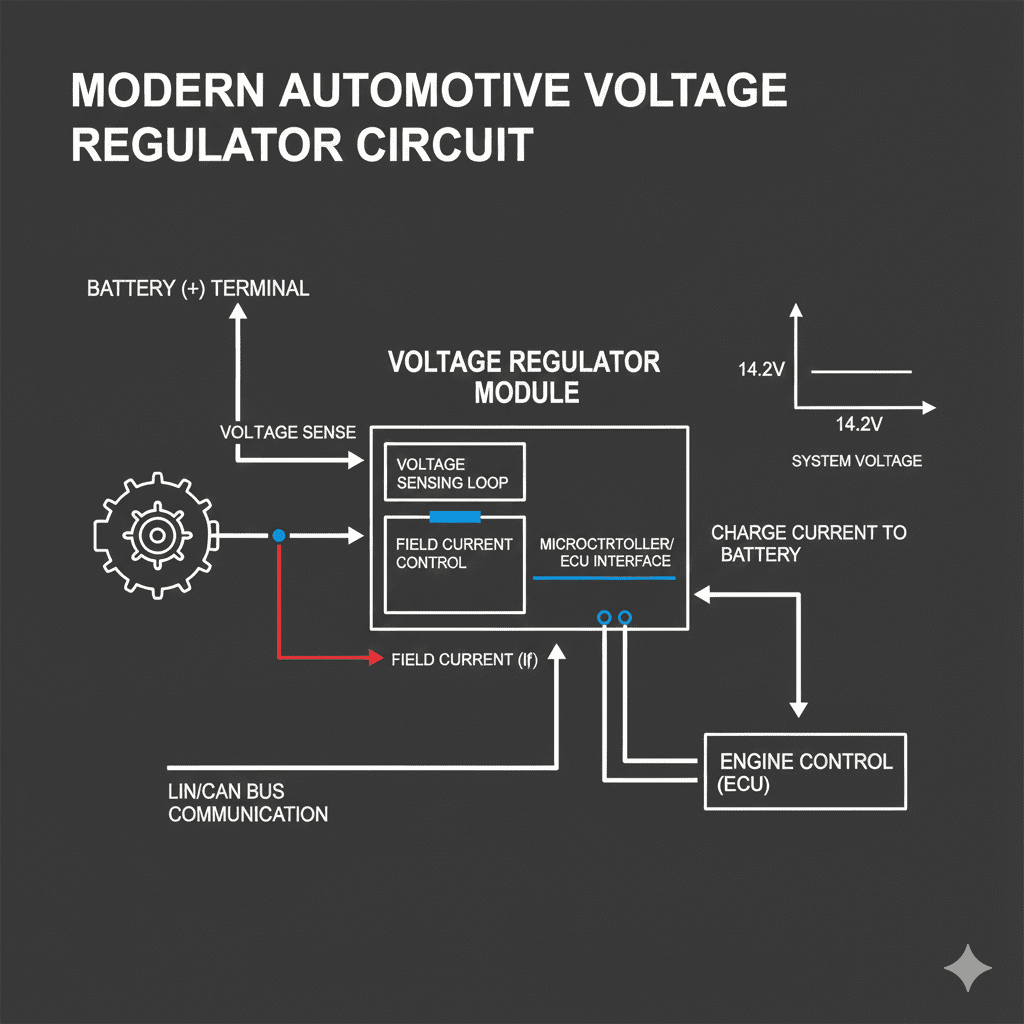
A car battery regulator—commonly called a voltage regulator—controls the electrical output of the alternator and ensures the battery receives a stable, safe, and precise charging voltage. Without a regulator, the alternator can overcharge, undercharge, or spike voltage, damaging the battery and electrical components.
This article explains only the keyword: how car battery regulators work — their electrical principles, control circuits, voltage stabilization behavior, and scientific functioning.
1. What Is a Car Battery Regulator? (Scientific Definition)
A car battery regulator is an electronic control device that:
- monitors alternator output
- senses battery voltage
- adjusts field current
- maintains charging voltage at 13.8–14.6 volts
Semantic Keywords Used:
voltage control module, regulator circuitry, field current regulation, stable charging voltage, electromagnetic control, electrical stabilization, alternator output management.
2. The Core Science Behind Voltage Regulation
A battery regulator works on three scientific principles:
1. Voltage Sensing
It constantly reads battery voltage through feedback loops.
2. Field Control
It adjusts the rotor’s magnetic field strength by regulating field current.
Higher field current → stronger magnetic field → higher alternator output
Lower field current → weaker field → reduced output
3. Output Stabilization
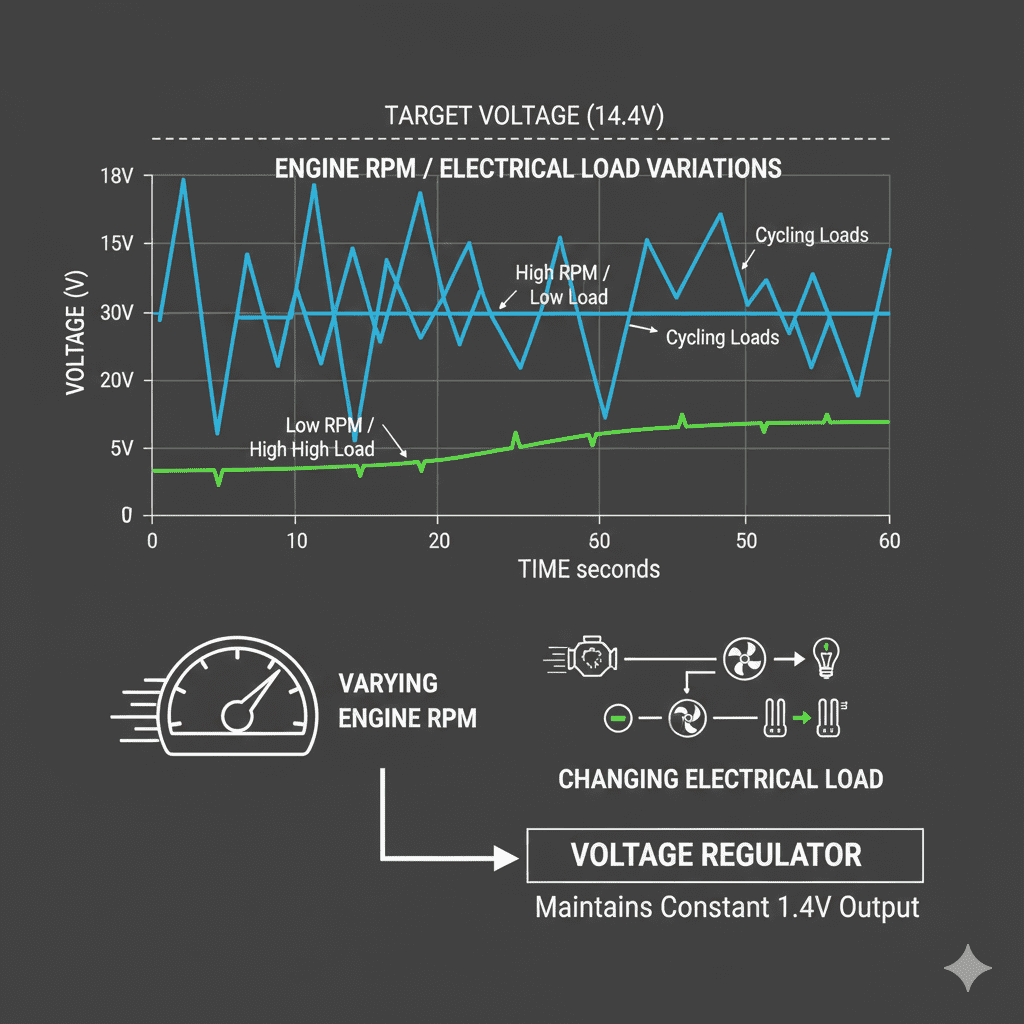
The regulator maintains stable charging voltage despite:
- engine speed changes
- electrical load variations
- temperature fluctuations
Semantic Keywords:
electromagnetic induction, rotor field strength, feedback sensing, voltage feedback loop, DC output regulation, load compensation.
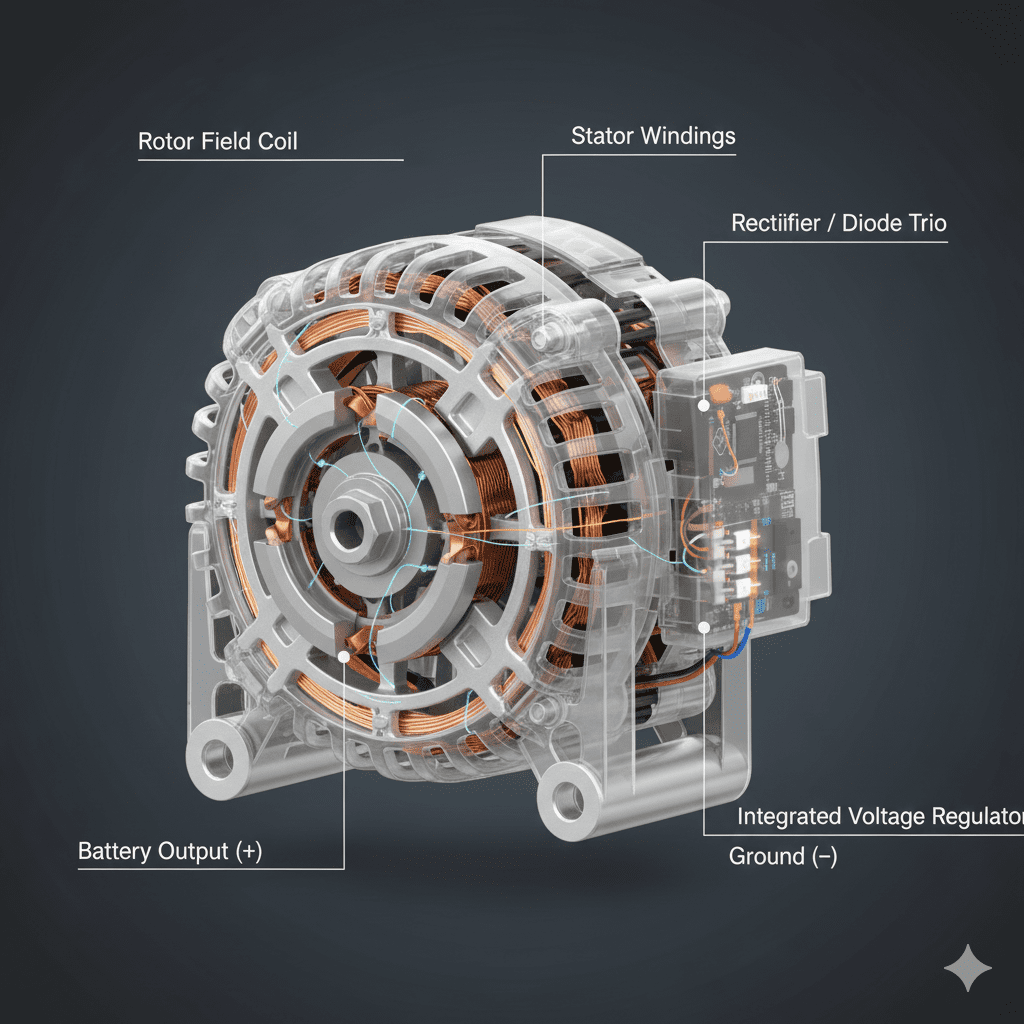
3. Step-by-Step: How a Battery Regulator Works
- Battery voltage drops below 12.6V → regulator boosts alternator field current
- Alternator increases electrical output
- Battery voltage reaches 14.4V → regulator decreases field current
- Charging stabilizes
- Regulator repeats micro-adjustments 1000+ times per second
This creates a closed-loop voltage control system.
4. Internal Components of a Battery Regulator
| Component | Function |
|---|---|
| Voltage sensing circuit | Monitors real-time battery voltage |
| Control transistor (MOSFET/IGBT) | Raises or lowers field current |
| Diode trio | Supports DC feedback |
| Temperature sensor | Adjusts voltage based on heat |
| Microcontroller (modern regulators) | Performs rapid regulation decisions |
Semantic Keywords:
pulse-width modulation, regulator transistor, thermal compensation, electronic control unit, alternator field driver.
5. Types of Battery Regulators (Working Science Only)
a. Internal Voltage Regulators
Mounted inside the alternator, they directly regulate the rotor field current.
b. External Voltage Regulators
Installed outside the alternator; used in trucks and older vehicles.
c. Smart/ECU-Controlled Regulators
Modern vehicles use ECU to dynamically adjust:
- charging maps
- field activation cycles
- energy efficiency
6. How Regulators Protect the Battery (Scientific Role)
- prevent overcharging
- avoid thermal runaway
- stop voltage spikes
- protect electronic modules
- maintain battery chemistry balance
Without regulators, alternators could reach 17–18V, destroying a battery within minutes.
7. Case Study: Regulator Working in Real-World Conditions
Case:
Hyundai Elantra 2024 – Low Voltage Issue
| Condition | Alternator Output | Regulator Action | Result |
|---|---|---|---|
| Lights ON + AC FULL | 12.9V | Increases field current | Output rises to 14.2V |
| Engine Rev @ 3000 RPM | 15.6V | Cuts field current | Output drops to 14.4V |
| Battery Cold Weather | Voltage drops rapidly | Compensates with higher charge voltage | Stable charging curve |
Observation:
The regulator continuously corrected voltage within milliseconds to protect the battery.
8. Signs a Regulator Is Not Working (Science Only)
- unstable voltage
- sudden overvoltage
- dimming and brightening lights
- battery overheating
- rapid sulfation
These are voltage behavior symptoms, not maintenance tips.
9. Why Battery Regulators Are Critical for Lead-Acid Chemistry
The regulator controls charging voltage to match the battery’s electrochemical absorption rate.
If voltage is too high:
→ water electrolysis
→ gas formation
→ plate corrosion
If voltage is too low:
→ incomplete charge
→ sulfate build-up
→ low CCA output
Regulators maintain the ideal voltage curve for battery health.
Natural Anchor-Text Links for EuroSwift Auto Services
✔ Learn how professional battery replacement services in Dubai ensure regulated charging:
https://euroswiftautoservices.ae/car-battery-replacement-near-me-dubai/
✔ Explore the high-efficiency charging compatibility of Amaron batteries:
https://euroswiftautoservices.ae/%F0%9F%94%8B-amaron-car-battery-replacement-dubai/
✔ Understand how Bosch battery stability improves regulator performance:
https://euroswiftautoservices.ae/bosch-car-battery-replacement-dubai/
✔ Study the charging behavior of Tuflong batteries under regulated voltage:
https://euroswiftautoservices.ae/%f0%9f%94%8b-trusted-tuflong-car-battery-replacement-dubai/
✔ Deep dive into battery pricing vs regulator compatibility:
https://euroswiftautoservices.ae/complete-guide-to-car-battery-prices-in-dubai-2025-updated-list/
What does a car battery regulator actually do?
A car battery regulator controls the alternator’s output voltage so the battery receives a stable 13.8–14.6V, preventing overcharging or undercharging.
How does a battery regulator sense voltage?
It uses a voltage feedback circuit that constantly measures battery voltage and adjusts alternator field current accordingly.
Why do alternators overcharge when regulators fail?
Because uncontrolled magnetic field strength forces the alternator to push excess voltage, often above 17V.
Leave a Reply