
Introduction
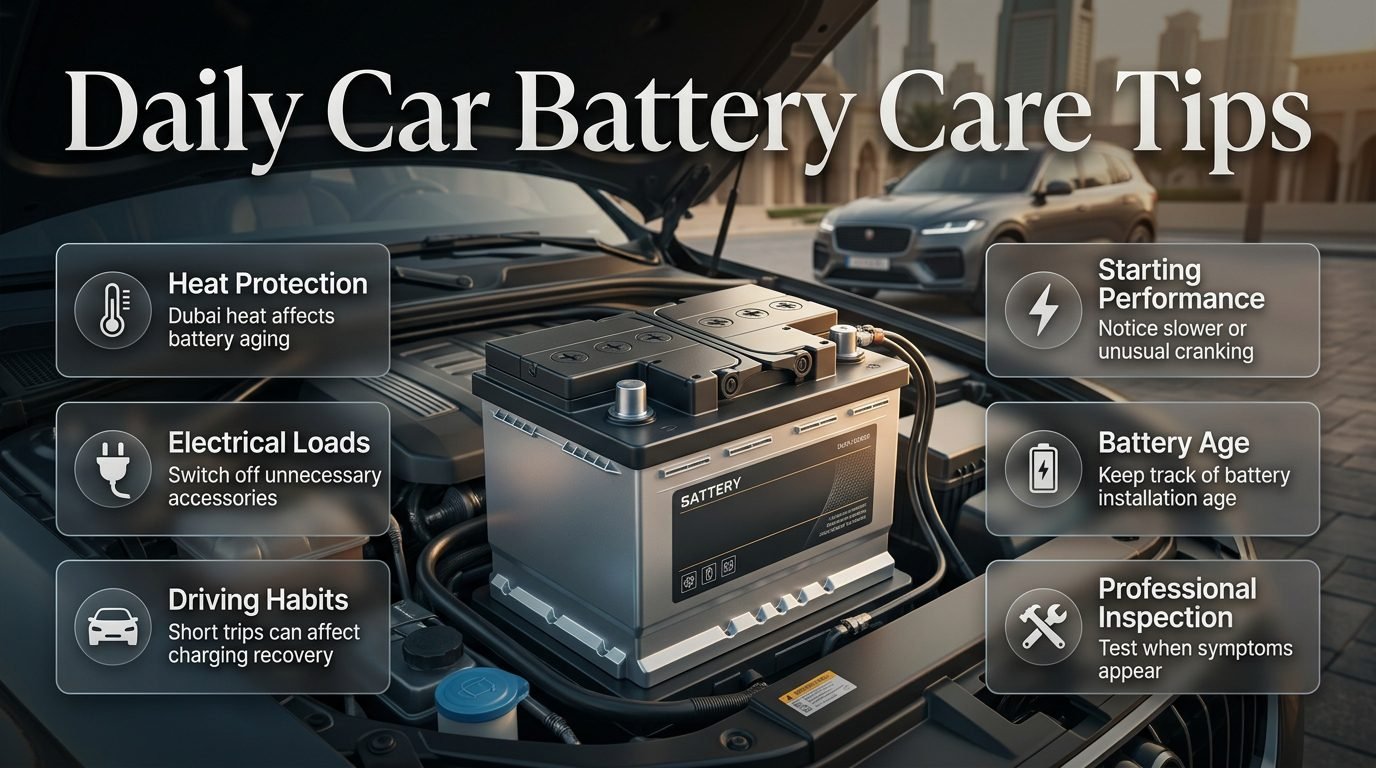
Daily Car Battery Care Tips | A car battery is one of the most important components in a vehicle, yet it is often ignored until the engine refuses to start. In reality, battery reliability depends on several factors, including temperature, driving habits, electrical demand, charging-system performance, battery age, connections, and the condition of the vehicle itself.
Following practical daily car battery care tips can help drivers notice developing problems earlier and reduce avoidable battery discharge. Daily care does not mean performing technical electrical tests every morning. It means understanding normal vehicle behavior, switching off unnecessary electrical loads, paying attention to warning signs, and arranging professional inspection when something changes.
This is particularly relevant in Dubai. High temperatures, prolonged parking outdoors, heavy air-conditioning use, traffic congestion, frequent short journeys, and periods of vehicle inactivity can all influence battery performance. Modern vehicles also use more electronic systems than older cars, making a reliable battery and charging system increasingly important.
For drivers looking for broader automotive maintenance and repair support, EuroSwift Auto Services provides a useful starting point for vehicle maintenance, diagnostics, battery services, and other automotive requirements in Dubai.
The purpose of this guide is to explain what drivers can realistically do every day, what should be checked periodically, which symptoms deserve professional attention, and when battery replacement may be more appropriate than continued maintenance.
1. Why Daily Car Battery Care Matters
A battery does more than provide the initial power required to start an engine. It forms part of the vehicle’s electrical system and works together with the alternator and other charging components to maintain electrical operation.
When a battery begins losing performance, the problem may develop gradually. The engine might crank slightly more slowly, starting may become inconsistent, or the battery may discharge more easily after the vehicle has been parked.
These early changes are valuable because they give the driver an opportunity to investigate the issue before complete failure occurs.
Good battery care therefore has three main purposes:
- Identify developing problems early.
- Reduce unnecessary electrical discharge.
- Maintain dependable starting performance.
It is important to remember that battery symptoms do not always mean the battery itself is defective. A charging-system fault, poor connection, starter problem, or parasitic electrical drain can produce similar symptoms.
That is why good maintenance combines observation with proper diagnosis.
2. What Should You Check Every Day?
Daily battery care should be simple. Most drivers do not need to open the bonnet every morning or perform electrical measurements before every journey.
Instead, pay attention to the way the vehicle behaves during normal use.
Observe the Starting Process
When starting the vehicle, notice whether the engine cranks at its normal speed.
A healthy starting system should behave consistently. If the engine suddenly sounds slower than usual, takes longer to crank, or requires repeated attempts, the change should be noted.
Pay particular attention to:
- Slower engine cranking
- Repeated starting attempts
- Clicking sounds
- Unusual starting hesitation
- Dashboard behavior during startup
- Electrical accessories behaving differently
One unusual start does not automatically prove battery failure. However, repeated changes are more significant.
Check Warning Lights
Modern vehicles provide useful information through the instrument cluster. A battery or charging-system warning should not be ignored.
Such a warning may indicate a problem with the alternator, charging circuit, wiring, belt system, or another electrical component rather than simply indicating a weak battery.
Notice Electrical Changes
Drivers should also notice unusual behavior from:
- Headlights
- Interior lighting
- Dashboard electronics
- Infotainment systems
- Power accessories
- Other electrical equipment
The driver’s role is not to diagnose these problems. The goal is to identify changes and report them accurately during a professional inspection.
3. Protect Your Car Battery From Dubai Heat
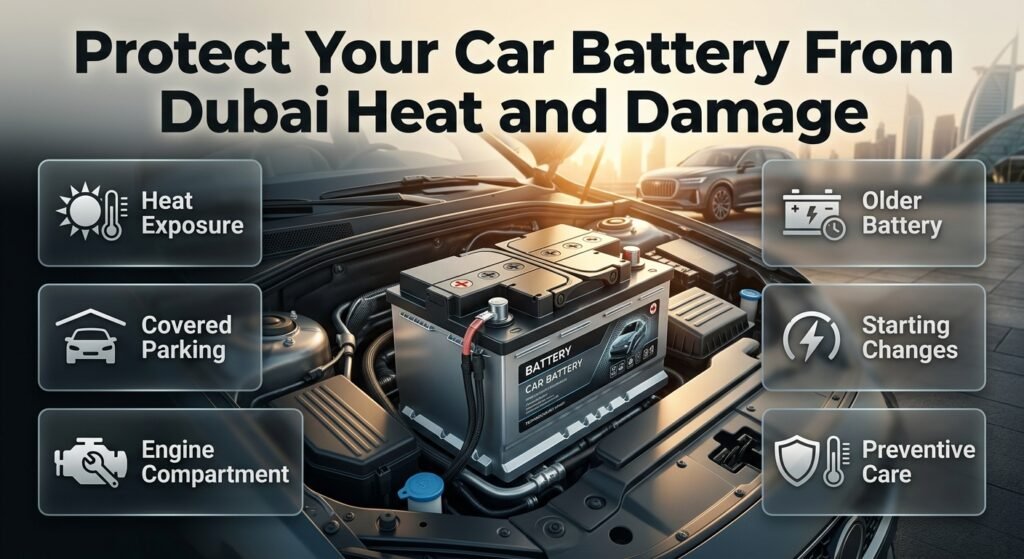
Temperature is one of the most important environmental considerations for automotive batteries.
Dubai’s climate makes heat management especially relevant. A battery operates inside a hot engine compartment, and repeated exposure to high temperatures can accelerate aging and deterioration.
This does not mean that every battery exposed to Dubai’s climate will fail prematurely. Battery design, age, vehicle usage, charging performance, parking conditions, and electrical demand all influence service life.
However, reducing unnecessary heat exposure is still a sensible preventive measure.
Practical Heat-Management Habits
Where possible:
- Use covered parking.
- Park in shaded areas when available.
- Avoid unnecessary prolonged exposure to direct sunlight.
- Keep the engine compartment properly maintained.
- Pay additional attention to older batteries during extreme heat.
- Investigate changes in starting performance instead of waiting for complete failure.
Covered parking cannot stop natural battery aging, but it can reduce unnecessary exposure to extreme conditions.
Why Heat Becomes More Important as a Battery Ages
A newer battery may continue performing normally under demanding conditions, while an older battery with reduced capacity may become less tolerant of heat and repeated electrical demands.
This is why battery age should be considered together with symptoms rather than treated as a completely separate issue.
4. Avoid Leaving Electrical Accessories On
One of the easiest ways to protect a battery is to avoid unnecessary electrical consumption when the engine is switched off.
When the engine is running, the charging system supplies electrical power. When the engine is off, accessories may draw energy from the battery.
Leaving lights, entertainment equipment, charging devices, or other electrical accessories active for an extended period can reduce the available energy needed for the next engine start.
Common Causes of Unnecessary Battery Drain
| Situation | Possible effect |
|---|---|
| Headlights left on | Significant battery discharge |
| Interior light left on | Gradual discharge |
| Entertainment system running while parked | Additional electrical consumption |
| Device charging for long periods | Continuous battery demand |
| Accessories left connected | Additional electrical load |
| Multiple systems operating together | Greater overall discharge |
Modern vehicles may have automatic shut-off features, but drivers should still develop the habit of checking the vehicle before walking away.
A few seconds of checking can prevent an unnecessary starting problem later.
5. Understand the Effect of Short Trips
Driving pattern has a direct relationship with battery management.
Every engine start consumes electrical energy. Once the engine is running, the alternator provides electrical power and helps replenish the energy used during starting.
If a vehicle repeatedly makes very short journeys, the charging system may have limited time to restore the energy consumed during multiple starts.
This does not mean short journeys automatically damage a battery. It means that repeated short-distance driving should be considered when a vehicle experiences unexplained battery discharge.
Different Driving Patterns
| Driving pattern | Battery consideration |
|---|---|
| Very short repeated journeys | Limited charging recovery time |
| Heavy stop-and-go traffic | More demanding operating environment |
| Moderate regular journeys | More opportunity for charging |
| Long periods of inactivity | Potential gradual discharge |
| Multiple starts throughout the day | Increased starting demand |
Drivers should not make unnecessary long journeys simply to “charge the battery.”
If a vehicle is primarily used for short trips and begins developing starting problems, professional battery and charging-system testing can help determine the actual cause.
6. Keep Battery Terminals and Connections Clean
Battery performance depends not only on the battery’s internal condition but also on the quality of its external connections.
Terminals and cables should be secure and free from excessive corrosion or contamination. Poor connections can increase resistance and interfere with the current required during starting.
What to Look For
During a basic visual inspection, look for:
- Excessive corrosion
- Loose-looking terminals
- Damaged cables
- Unusual deposits
- Physical battery damage
- Poor mounting
Not every visible deposit means the battery needs replacing. Some connection problems can be corrected without replacing the battery.
However, if corrosion repeatedly returns or electrical symptoms continue after cleaning, professional diagnosis may be appropriate.
A technician can determine whether the problem is limited to a connection or whether the battery, cables, charging system, or another component requires attention.
7. Make Sure the Battery Is Securely Mounted
Battery mounting is an easy part of maintenance to overlook.
The battery should be correctly positioned and secured using the vehicle’s intended mounting system. Excessive movement can expose the battery, terminals, and cables to unnecessary vibration.
Battery Mounting Check
A properly installed battery should:
- Sit correctly in its designated position.
- Be held securely by the mounting mechanism.
- Avoid excessive movement.
- Have properly positioned cables.
- Have secure terminals.
- Show no obvious physical damage.
If a battery appears loose, it should be professionally inspected rather than held in place using an improvised solution.
Correct installation contributes to electrical reliability and protects the battery from unnecessary mechanical stress.
8. Learn the Difference Between a Weak Battery and a Charging Problem
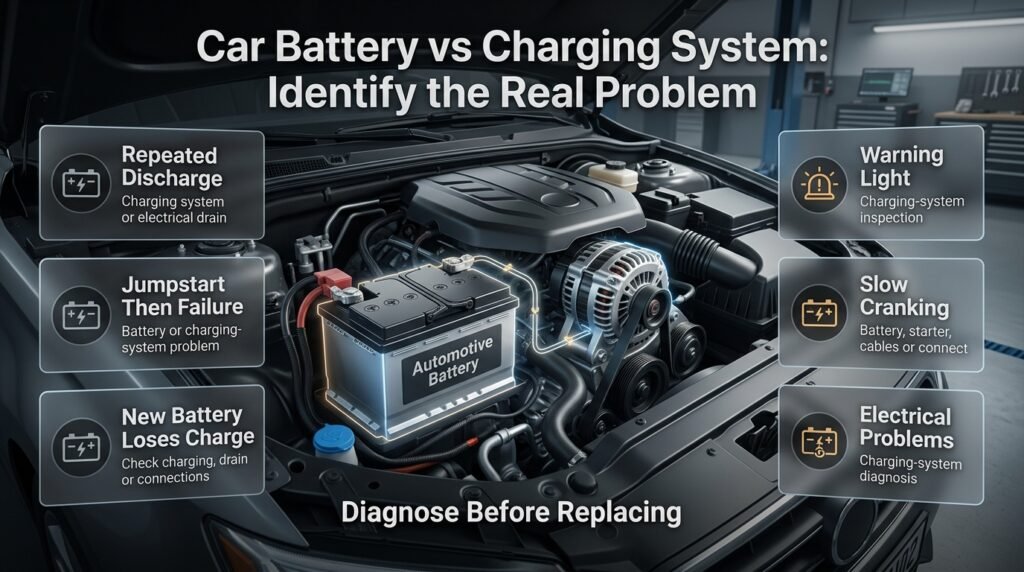
One of the biggest mistakes drivers make is assuming that every starting problem means the battery needs replacement.
The battery stores electrical energy. The alternator generates electrical power while the engine is running and helps replenish the battery.
Because these components work together, a fault in either system can create similar symptoms.
Battery or Charging System?
| Symptom | Possible area to investigate |
|---|---|
| Battery repeatedly becomes discharged | Battery, charging system, or electrical drain |
| Vehicle starts after a jumpstart but later fails | Battery or charging-system problem |
| New battery repeatedly loses charge | Charging system, electrical drain, or connections |
| Battery/charging warning appears | Charging-system inspection |
| Slow cranking | Battery, starter, cables, or connections |
| Electrical problems while driving | Charging or electrical-system diagnosis |
This is why repeatedly replacing batteries without identifying the cause can become expensive and ineffective.
If the battery continues to discharge, professional electrical testing and Engine Diagnostics may be necessary.
9. Keep Track of Your Battery’s Age
Knowing when the battery was installed is useful information.
Battery lifespan varies depending on battery technology, climate, driving pattern, vehicle design, charging performance, electrical demand, and maintenance.
There is therefore no universal rule that every battery must be replaced at exactly the same age.
Instead, battery age should be considered alongside its condition.
A Practical Battery-Age Strategy
- Record the installation date.
- Keep information about the battery specification.
- Monitor starting behavior.
- Pay attention to repeated discharge.
- Test the battery when symptoms develop.
- Replace it when testing indicates that reliable service can no longer be expected.
This approach is better than replacing a battery solely because it has reached a particular age.
10. Choose the Correct Battery Specification
Battery selection is more complicated than simply finding one that physically fits the vehicle.
A replacement battery should match the vehicle’s requirements for capacity, dimensions, terminal arrangement, starting capability, technology, and electrical system.
Depending on the vehicle, the correct battery may be conventional lead-acid, maintenance-free, EFB, AGM, or another specified technology.
Important Factors
Before replacement, consider:
- Physical dimensions
- Battery capacity
- Starting performance
- Terminal layout
- Battery technology
- Vehicle electrical requirements
- Start-stop system compatibility
- Manufacturer requirements
A battery that fits physically is not necessarily the correct battery electrically.
Battery Resources for Different Applications
Drivers researching battery options can review the dedicated Amaron Battery replacement resource when considering Amaron products for compatible vehicles.
Another option to research is Bosch Battery replacement, particularly when Bosch is being considered for a vehicle requiring a suitable Bosch specification.
For drivers researching Tuflong products, the Tuflong Battery replacement page provides another relevant battery resource.
For vehicles designed for higher electrical demands or specific start-stop applications, AGM Battery replacement may be a relevant category to investigate.
Other battery options can be explored through the Exide Battery replacement, Panasonic Battery replacement, FIAMM Battery replacement and AC Delco Battery replacement resources.
The important point is that brand should not be selected before confirming compatibility.
11. Why Battery Technology Matters in Modern Cars
Modern vehicles have significantly more electrical equipment than many older vehicles.
Start-stop systems, advanced infotainment, driver-assistance features, electronic control modules and other technologies can increase the importance of battery performance.
This is one reason why replacing a modern vehicle’s battery should be approached according to manufacturer specifications.
Common Battery Technologies
| Battery type | General consideration |
|---|---|
| Conventional lead-acid | Common in many traditional vehicle applications |
| Maintenance-free | Designed to reduce routine maintenance requirements |
| EFB | Used in certain vehicles with increased cycling requirements |
| AGM | Used in specific applications with higher electrical and cycling demands |
AGM is not automatically the correct choice for every vehicle. The appropriate battery depends on the vehicle’s original specification and electrical architecture.
A technically suitable battery is more important than choosing a product simply because its technology sounds more advanced.
12. Be Careful When Your Car Is Parked for Long Periods
A vehicle does not completely stop consuming electrical energy when the engine is switched off.
Modern electronic modules may continue operating at low levels while the vehicle is parked. Over an extended period, this can gradually reduce battery charge.
This is particularly relevant for vehicles that are:
- Used occasionally
- Parked for several weeks
- Stored during holidays
- Left at an airport
- Driven only once or twice a month
Before Extended Parking
Consider:
- Battery age
- Existing battery condition
- Vehicle manufacturer’s storage instructions
- Electrical accessories
- Door and luggage-compartment closure
- Previous discharge problems
Do not assume that briefly starting the vehicle and letting it idle is always the correct storage method. The appropriate approach depends on the vehicle, battery and duration of storage.
13. Do Not Depend on Repeated Jumpstarts
A jumpstart is useful when a vehicle lacks enough available starting power.
However, it is not a permanent battery-care strategy.
If the vehicle needs repeated jumpstarts, the underlying cause should be investigated.
Possible Causes
- Battery deterioration
- Charging-system fault
- Electrical drain
- Poor connections
- Excessive electrical use
- Long periods of inactivity
- Starter-system problems
A professional Car Jumpstart can restore mobility when a vehicle is stranded, but repeated jumpstarts should lead to diagnosis rather than becoming part of the driver’s normal routine.
If the battery repeatedly becomes discharged after a jumpstart, the vehicle should be assessed.
14. How Traffic Conditions Can Affect Battery Performance
Dubai’s roads can involve long periods of traffic congestion and stop-and-go driving.
Urban driving often combines frequent starting, extended idling, air-conditioning use, electrical accessories and relatively short journeys.
A healthy vehicle is designed to handle normal traffic conditions. Traffic itself does not automatically damage the battery.
The concern arises when the vehicle already has a weak battery, poor charging performance, electrical drain, or another underlying fault.
Warning Signs During Urban Driving
Pay attention to:
- Slower starting after repeated trips
- Battery or charging warnings
- Unusual electrical behavior
- Repeated discharge
- Problems appearing after heavy traffic use
If symptoms consistently appear under these conditions, professional inspection can determine whether the battery or another electrical component is responsible.
15. Does Air Conditioning Affect Battery Health?
Air conditioning is essential for comfortable driving in Dubai, particularly during summer.
A properly functioning vehicle’s electrical and charging systems are designed to support normal AC operation while the engine is running.
Therefore, drivers should not assume that the AC itself is the reason for battery failure.
However, if a vehicle already has a weak battery or charging-system problem, demanding operating conditions may make the weakness more noticeable.
The Correct Approach
If electrical symptoms occur when using:
- AC
- Headlights
- Infotainment
- Charging devices
- Other electrical accessories
the correct response is to inspect the vehicle’s electrical system rather than simply avoiding AC use.
If the problem is actually related to the climate-control system, separate AC Repair may be required. Battery and AC concerns should be diagnosed independently.
16. Warning Signs That Deserve Attention
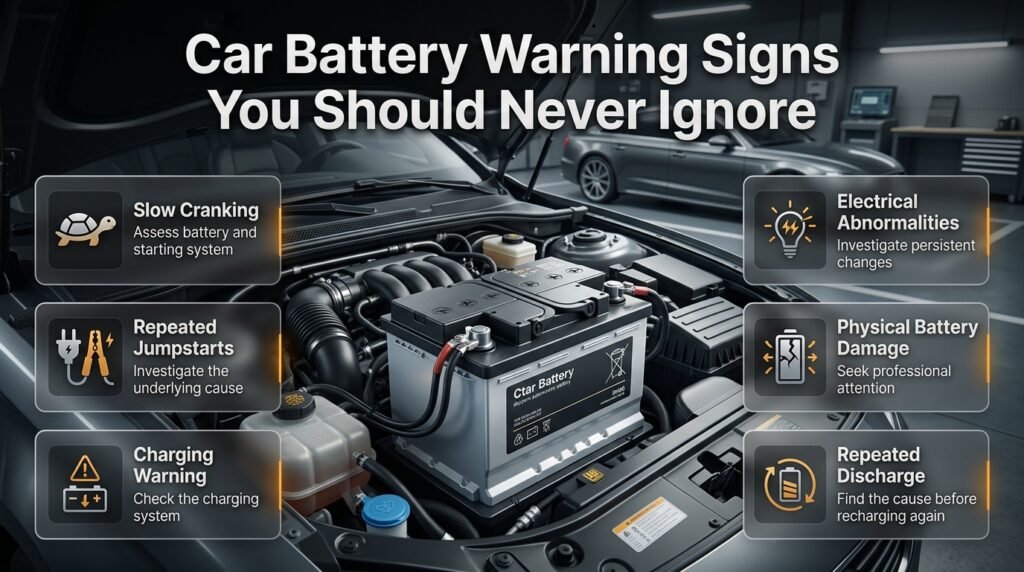
Some battery-related symptoms should not be ignored.
Slow Engine Cranking
If the engine consistently takes longer to crank, battery condition and the starting system should be assessed.
Repeated Jumpstarts
Repeated jumpstarting is a strong reason to investigate the underlying cause.
Charging Warning
A battery or charging warning can indicate an alternator or charging-system problem.
Electrical Abnormalities
Unexpected changes in lighting, dashboard operation or accessories should be investigated when persistent.
Physical Battery Damage
Visible cracks, swelling, leakage or other unusual physical conditions require professional attention.
Repeated Battery Discharge
A battery that repeatedly goes flat should not simply be recharged over and over without determining why.
17. Daily, Weekly and Professional Battery Maintenance
A useful maintenance routine separates driver observations from professional work.
| Frequency | Recommended action |
|---|---|
| Every drive | Observe starting behavior |
| Every drive | Notice warning lights |
| After parking | Switch off unnecessary electrical loads |
| Weekly | Pay attention to changes in electrical operation |
| Periodically | Perform a basic visual inspection |
| Scheduled service | Consider battery and charging-system assessment |
| Before long journeys | Address existing battery symptoms |
| After repeated discharge | Arrange professional diagnosis |
| Before extended storage | Follow suitable storage procedures |
This makes battery care practical instead of turning it into an unnecessarily complicated routine.
18. Common Car Battery Maintenance Mistakes
Mistake 1: Waiting for Complete Failure
Many drivers wait until the vehicle will not start before taking action. Early symptoms can provide valuable warning.
Mistake 2: Replacing the Battery Without Diagnosis
A new battery cannot correct an alternator fault, parasitic drain, starter problem, or damaged connection.
Mistake 3: Assuming a New Battery Cannot Have Problems
A new battery may still be affected by incorrect specification, charging problems, installation issues, or an underlying vehicle fault.
Mistake 4: Choosing Only by Price
Battery price should be considered alongside specification, technology, warranty, compatibility and service quality.
Mistake 5: Ignoring Connections
Loose or corroded terminals can create starting and charging problems.
Mistake 6: Ignoring Vehicle Storage
Long periods without driving can gradually reduce battery charge.
Mistake 7: Blaming the Battery for Every Electrical Problem
Modern vehicles have multiple electrical and electronic systems. Diagnosis is necessary before deciding what needs replacement.
19. When Should You Arrange a Professional Battery Inspection?
A professional battery inspection is particularly useful when symptoms become repeated or predictable.
Consider arranging an inspection if:
- The engine consistently cranks slowly.
- Starting performance has changed.
- The vehicle repeatedly requires jumpstarts.
- The battery repeatedly loses charge.
- A charging warning appears.
- Electrical behavior becomes unusual.
- The battery has visible physical damage.
- You are concerned about battery reliability before a long journey.
A professional inspection can include visual examination, battery testing, charging-system assessment, terminal inspection and starting-system evaluation.
The result may be that no replacement is necessary. In other cases, testing may show that the battery has deteriorated enough to justify replacement.
20. What Happens During a Professional Battery Inspection?
A professional assessment should follow a logical process.
Step 1: Visual Inspection
The technician checks the battery casing, terminals, cables, mounting and surrounding area.
Step 2: Battery Identification
Battery type, specification, age and installation details are considered.
Step 3: Electrical Testing
Appropriate equipment is used to assess battery condition and starting capability.
Step 4: Charging-System Assessment
Where required, alternator and charging performance are evaluated.
Step 5: Starting-System Assessment
If slow cranking is reported, the starter, cables and related connections may also be investigated.
Step 6: Recommendation
The technician determines whether the vehicle needs:
- Continued monitoring
- Connection correction
- Battery charging
- Electrical diagnosis
- Charging-system repair
- Battery replacement
- Further vehicle inspection
This structured approach is more reliable than assuming the battery is responsible based on one symptom.
21. When Is Battery Replacement Better Than Continued Maintenance?
Battery care can help extend reliable operation, but it cannot restore a battery that has reached the end of its usable condition.
Replacement becomes appropriate when testing indicates that the battery can no longer reliably meet the vehicle’s requirements.
The decision should consider:
- Battery health
- Battery age
- Starting performance
- Vehicle specification
- Battery technology
- Climate
- Driving pattern
- Charging-system condition
Before installing a replacement, the technician should confirm that the battery is compatible with the vehicle.
Replacement Checklist
- Correct physical dimensions
- Correct terminal arrangement
- Correct capacity
- Correct starting specification
- Correct technology
- Correct vehicle compatibility
- Charging system checked where necessary
A replacement battery should solve the actual problem rather than simply provide a temporary improvement.
22. Understanding Car Battery Prices in Dubai
Battery replacement cost varies considerably.
There is no single price that applies to every vehicle because battery specifications and service requirements differ.
Factors that can influence the total cost include:
- Battery brand
- Battery technology
- Capacity
- Starting specification
- Vehicle make and model
- Availability
- Installation requirements
- Diagnostic requirements
- Mobile service
- Warranty
Why Comparing Prices Alone Can Be Misleading
Suppose two batteries have different capacities or technologies. Their prices cannot be meaningfully compared simply because both are advertised for cars.
The more useful comparison is between batteries that meet the same vehicle requirements.
For drivers researching pricing, the complete car battery prices in Dubai guide can help explain the factors that influence replacement costs.
The objective should be appropriate specification and reliable service rather than selecting the lowest advertised figure.
23. Battery Care Should Be Part of Overall Vehicle Maintenance
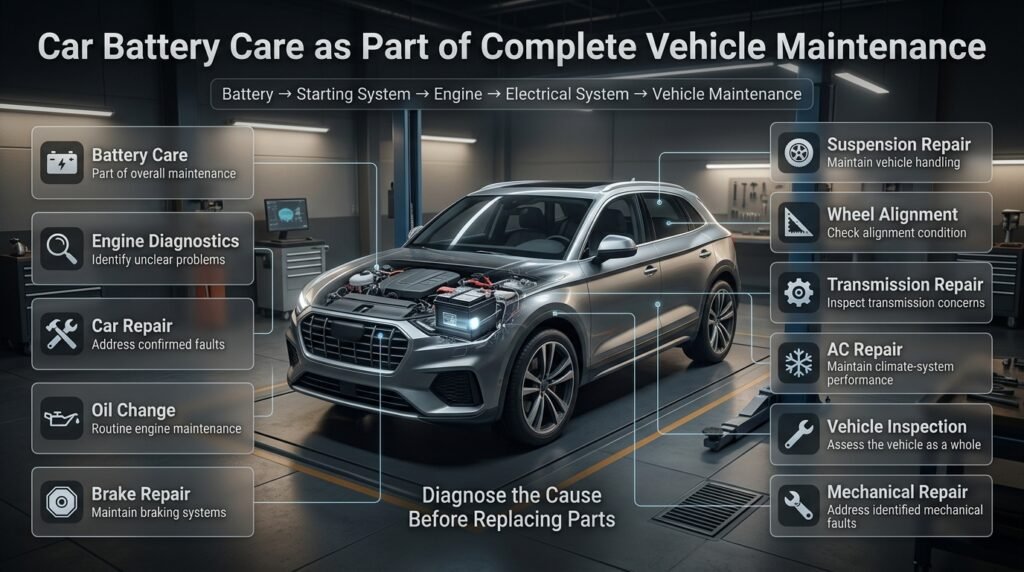
Battery maintenance should not be treated as an isolated task.
A vehicle is a connected system. A starting problem may involve the battery, starter, charging system, engine, fuel system, wiring or another component.
Likewise, electrical problems can sometimes be symptoms of a wider vehicle issue.
This is why routine Car Service should consider the vehicle as a whole when symptoms are unclear.
Depending on the vehicle’s condition, other maintenance needs can include:
- Car Repair
- Engine Diagnostics
- Brake Repair
- Oil Change
- Suspension Repair
- Wheel Alignment
- Transmission Repair
- Engine Repair
- AC Repair
- Vehicle Inspection
- Mechanical Repair
The purpose of broader inspection is not to replace unrelated parts. It is to determine what is actually causing the problem.
24. Preparing Your Battery Before a Long Journey
A battery problem is particularly inconvenient when it occurs immediately before a long trip.
Drivers do not necessarily need to replace an older battery simply because they are planning a journey.
However, if there have already been symptoms, it is sensible to investigate them before leaving.
Before a Long Trip, Consider:
- Recent starting behavior
- Battery age
- Previous jumpstarts
- Repeated discharge
- Warning lights
- Battery condition
- Charging-system performance
If the battery is functioning normally and has no concerning symptoms, routine maintenance may be enough.
If there is uncertainty, testing provides a much better basis for deciding whether the battery is ready for continued service.
25. What to Do After a Battery Jumpstart
After receiving a jumpstart, the driver should consider why the vehicle needed one.
If a light was accidentally left on, the incident may have been isolated.
If the battery repeatedly becomes discharged without an obvious explanation, further diagnosis is necessary.
After a Jumpstart
- Monitor starting performance.
- Check for warning lights.
- Avoid unnecessary electrical loads.
- Consider battery testing if the problem returns.
- Investigate the charging system if appropriate.
- Look for patterns of repeated discharge.
A jumpstart restores immediate starting ability. It does not automatically repair the underlying issue.
26. Battery Maintenance for Modern and Luxury Vehicles
Luxury and modern vehicles can have sophisticated electrical architectures.
Advanced infotainment systems, electronic comfort features, driver-assistance systems, sensors, control modules and other technologies can increase the importance of correct battery specification.
For these vehicles, selecting a replacement based only on physical fit is particularly risky.
The manufacturer’s battery requirements should be followed, and certain vehicles may require additional electronic procedures after battery replacement.
For owners who require broader Luxury Car Service, the battery should be considered as part of the vehicle’s overall electrical and electronic system.
Modern battery replacement can therefore involve more than removing an old battery and fitting a new one.
27. Latest Developments in Automotive Battery Maintenance
Battery maintenance is becoming increasingly technology-driven.
Modern vehicles can use battery monitoring systems, intelligent charging strategies and electronic energy-management systems.
This has changed the way technicians approach battery diagnosis.
Instead of relying solely on age or a driver’s assumption, professional assessment can increasingly combine:
- Battery health testing
- Electrical measurements
- Diagnostic scan information
- Charging-system assessment
- Vehicle energy-management data
- Starting-system analysis
Condition-Based Maintenance
One important industry direction is condition-based maintenance.
Rather than replacing a component simply because it has reached a certain age, technicians increasingly use actual condition and vehicle data to determine whether intervention is necessary.
This can reduce unnecessary replacement while improving preventive planning.
As vehicles become more electronically sophisticated, understanding battery condition will become an increasingly important part of professional vehicle maintenance.
28. Expert Recommendations for Dubai Drivers
1. Learn Your Vehicle’s Normal Starting Sound
Drivers often notice gradual changes before any diagnostic equipment is used.
2. Keep a Record of Battery Installation
Knowing the battery’s age makes later decisions easier.
3. Consider Dubai’s Climate
High temperatures make battery condition worth monitoring, particularly as the battery gets older.
4. Do Not Treat Jumpstarting as a Repair
A jumpstart solves an immediate starting problem but does not identify its cause.
5. Test Before Replacing
Battery testing can distinguish battery deterioration from other electrical problems.
6. Choose the Correct Specification
Battery technology and capacity must match the vehicle.
7. Investigate Repeated Discharge
A battery that repeatedly goes flat requires diagnosis.
8. Consider the Charging System
The alternator and battery work together, so both should be considered when discharge continues.
29. Complete Daily Car Battery Care Checklist
Every Drive
- Notice whether the engine starts normally.
- Pay attention to slower-than-usual cranking.
- Listen for unusual clicking.
- Observe dashboard warning lights.
- Notice unusual electrical behavior.
After Parking
- Turn off headlights.
- Switch off unnecessary interior lighting.
- Turn off unnecessary entertainment systems.
- Disconnect unnecessary accessories.
- Make sure doors and compartments are closed.
Regular Visual Inspection
- Battery casing appears intact.
- Battery is securely mounted.
- Terminals appear secure.
- Excessive corrosion is not visible.
- Cables appear undamaged.
During Scheduled Service
- Battery age reviewed.
- Battery condition considered.
- Charging system checked where appropriate.
- Starting symptoms reported.
- Repeated discharge investigated.
- Electrical connections inspected where necessary.
Before Long Journeys
- Consider battery age.
- Review recent starting performance.
- Investigate previous jumpstarts.
- Address warning lights.
- Test the battery if its condition is uncertain.
30. Battery Symptoms and the Right Response
| Symptom | What not to assume | Sensible next step |
|---|---|---|
| Slow cranking | Battery definitely needs replacement | Test battery and starting system |
| One-time discharge | Battery has failed permanently | Identify the reason for discharge |
| Repeated discharge | Battery alone is responsible | Check battery, charging system and electrical drain |
| Charging warning | Battery is necessarily weak | Inspect charging system |
| Visible corrosion | Battery must be replaced | Inspect terminals and battery condition |
| New battery loses charge | Battery is automatically defective | Investigate vehicle electrical system |
| Repeated jumpstarts | Jumpstarting is sufficient | Diagnose underlying cause |
| Electrical changes | Battery is definitely responsible | Perform appropriate electrical inspection |
The distinction between symptoms and diagnosis is important. Good automotive maintenance should be based on evidence rather than assumptions.
How Can I Take Care of My Car Battery Every Day?
Daily battery care is mostly about good driving and parking habits, not complicated maintenance. You do not need to test battery voltage every morning. Instead, pay attention to how the vehicle starts, switch off unnecessary electrical equipment before leaving the car, and notice any change in normal electrical performance.
A healthy battery should provide consistent starting performance. If the engine suddenly cranks more slowly, the vehicle requires repeated jump-starts, or electrical components begin behaving differently, those changes deserve attention. A battery can also deteriorate gradually, so waiting until the vehicle completely fails is not the best maintenance strategy.
Useful daily habits:
Check that lights and interior lamps are switched off after parking.
Avoid leaving electrical accessories operating unnecessarily when the engine is off.
Pay attention to slow or unusual engine cranking.
Do not ignore battery or charging warning lights.
Notice repeated starting difficulties instead of treating them as isolated incidents.
Keep track of when the current battery was installed.
Arrange professional testing when symptoms begin appearing repeatedly.
For Dubai drivers, heat deserves additional attention because high under-hood temperatures can accelerate battery deterioration. Parking in a shaded or covered location when practical can reduce unnecessary heat exposure, although it cannot stop normal battery aging.
The most effective approach is simple: observe your car every day, but inspect and test the battery professionally when something changes. That combination is much more useful than trying to perform technical battery maintenance every day.
Does Hot Weather in Dubai Affect Car Battery Life?
Yes, extreme heat is an important factor in battery aging, and it deserves particular attention in Dubai. High temperatures can accelerate internal battery deterioration, contribute to corrosion and affect the battery’s ability to maintain reliable performance over time. Heat and vibration are both recognized factors that can shorten battery life.
The important point is that heat does not necessarily mean a battery will suddenly fail. Instead, repeated exposure to high temperatures can gradually reduce its ability to perform reliably. An older battery that already has reduced capacity may be more vulnerable than a newer, healthy battery.
Practical ways to reduce unnecessary heat exposure include:
Use covered parking whenever available.
Choose shaded parking when practical.
Make sure the battery’s original heat shield or protective arrangement has not been removed.
Pay closer attention to an older battery during very hot periods.
Have the battery tested if starting performance changes.
Do not wait for complete failure if the battery has already shown warning signs.
Dubai’s climate also makes battery age and condition particularly important considerations. There is no single replacement age that applies perfectly to every vehicle, because driving pattern, battery type, charging performance, electrical demand and climate all influence service life.
A professional battery test is therefore more useful than simply saying, “The battery is old, so replace it.” If testing shows that the battery remains healthy, replacement may not yet be necessary. If its condition has deteriorated significantly, replacing it before a breakdown can be the more sensible decision.
Can Short Trips and Frequent Driving Drain a Car Battery?
Short trips can contribute to battery problems because starting the engine uses electrical energy, while very short journeys may provide limited time for the charging system to restore that energy. This becomes more relevant when a vehicle is repeatedly started, driven for only a short distance and then parked again.
This does not mean every short journey is harmful or that you should deliberately take long drives just to charge the battery. The real issue is the overall driving pattern.
For example, a vehicle used several times a day for short journeys may experience a very different battery workload from one used for longer regular journeys. Traffic congestion, extended idling and multiple electrical systems operating at the same time can add to the overall demand.
If your vehicle is mainly used for short journeys:
Monitor starting performance carefully.
Do not ignore repeated battery discharge.
Avoid leaving accessories operating unnecessarily when parked.
Include battery condition in routine servicing.
Investigate repeated discharge rather than simply charging the battery repeatedly.
Check the charging system if the battery continues losing charge.
There is another side to the issue: long periods of inactivity can also cause problems. Modern vehicles continue to use a small amount of electrical power while parked, and an unused vehicle can gradually lose battery charge.
So the goal is not simply “drive more.” The goal is to understand your vehicle’s usage pattern and investigate the battery if its performance becomes unreliable.
How Do I Know If My Car Battery Is Getting Weak?
A weakening battery often provides warning signs before complete failure, although some batteries can fail with limited warning. The most useful signs include slow engine cranking, repeated jump-starts, dim or unusual lighting, electrical problems, warning lights and recurring discharge.
One of the easiest symptoms for a driver to recognize is a change in the way the engine starts. If the engine normally cranks quickly but begins sounding slower or taking longer to start, that change is worth investigating.
However, a professional should not automatically conclude that the battery is defective from that symptom alone. A weak starter, poor battery connection or charging-system problem can create similar starting behavior.
Important warning signs include:
Engine cranks slower than normal.
Vehicle repeatedly needs a jump-start.
Battery or charging warning light appears.
Headlights or other electrical equipment behave unusually.
Battery repeatedly becomes discharged.
Corrosion is visible around the terminals.
Battery casing appears swollen, cracked or otherwise damaged.
The vehicle struggles to start consistently.
A particularly important distinction is between a discharged battery and a failing battery. A battery can become discharged because a light was left on, the vehicle sat unused, or another electrical issue drained it. That does not automatically mean the battery itself has failed.
On the other hand, if the battery repeatedly loses charge after being recharged, it deserves proper testing.
This is why professional inspection can include the battery, charging system, starting system and electrical connections rather than focusing on the battery alone.
How Often Should I Have My Car Battery Checked or Tested?
There is no universal testing schedule that is perfect for every vehicle, but regular inspection becomes increasingly valuable as a battery gets older or when the vehicle operates under demanding conditions. Current automotive guidance commonly recommends paying closer attention after the battery has been in service for several years, while hot climates can justify more proactive monitoring.
For many drivers, the easiest approach is to have the battery considered during routine vehicle servicing rather than treating battery testing as a completely separate task.
A professional assessment can look at:
Battery condition
Battery age
Terminal and cable condition
Battery mounting
Starting performance
Charging-system operation
Signs of electrical drain
Whether the battery specification remains appropriate
A battery check becomes especially important when:
The vehicle starts more slowly than usual.
The battery has needed repeated jump-starts.
The vehicle has been sitting unused for an extended period.
The battery repeatedly loses charge.
A battery or charging warning appears.
The battery is several years old.
You are preparing for a long journey and have already noticed starting problems.
The key point is that testing should support a maintenance decision, not automatically lead to replacement. A battery that tests healthy can continue in service, while one showing significant deterioration may be better replaced before it leaves you with an unexpected starting problem.
For Dubai vehicles, this proactive approach is particularly sensible because high temperatures can accelerate battery aging. Regular inspection, correct battery selection and attention to early warning signs can make battery maintenance much more predictable than waiting for complete failure
Conclusion
Good battery maintenance is not about waiting until the car refuses to start. It is about recognizing small changes early and taking sensible preventive steps before a minor battery concern becomes an unexpected breakdown. Simple habits such as switching off unnecessary electrical accessories, monitoring starting performance, checking visible battery and terminal condition, and keeping track of battery age can make everyday vehicle ownership more predictable.
For Dubai drivers, battery care deserves particular attention because high temperatures, frequent short journeys, traffic conditions, heavy electrical use and extended periods of parking can place additional demands on the vehicle’s electrical system. However, not every starting or electrical problem means the battery needs replacement. A weak alternator, poor connection, starter issue or electrical drain can produce similar symptoms, which is why accurate diagnosis matters.
A professional battery inspection can determine whether the vehicle needs continued monitoring, charging, electrical repair or Battery Replacement. Choosing the correct battery specification is equally important, particularly for modern vehicles equipped with start-stop systems and advanced electrical technology.
Ultimately, Daily Car Battery Care Tips are most effective when they become part of a wider Vehicle Maintenance routine. Regular Car Service, Vehicle Inspection, Engine Diagnostics, and timely Car Repair can help identify problems before they become inconvenient roadside failures. A proactive approach protects reliability, improves confidence behind the wheel and helps keep your vehicle ready for everyday driving across Dubai.

Leave a Reply