

Introduction
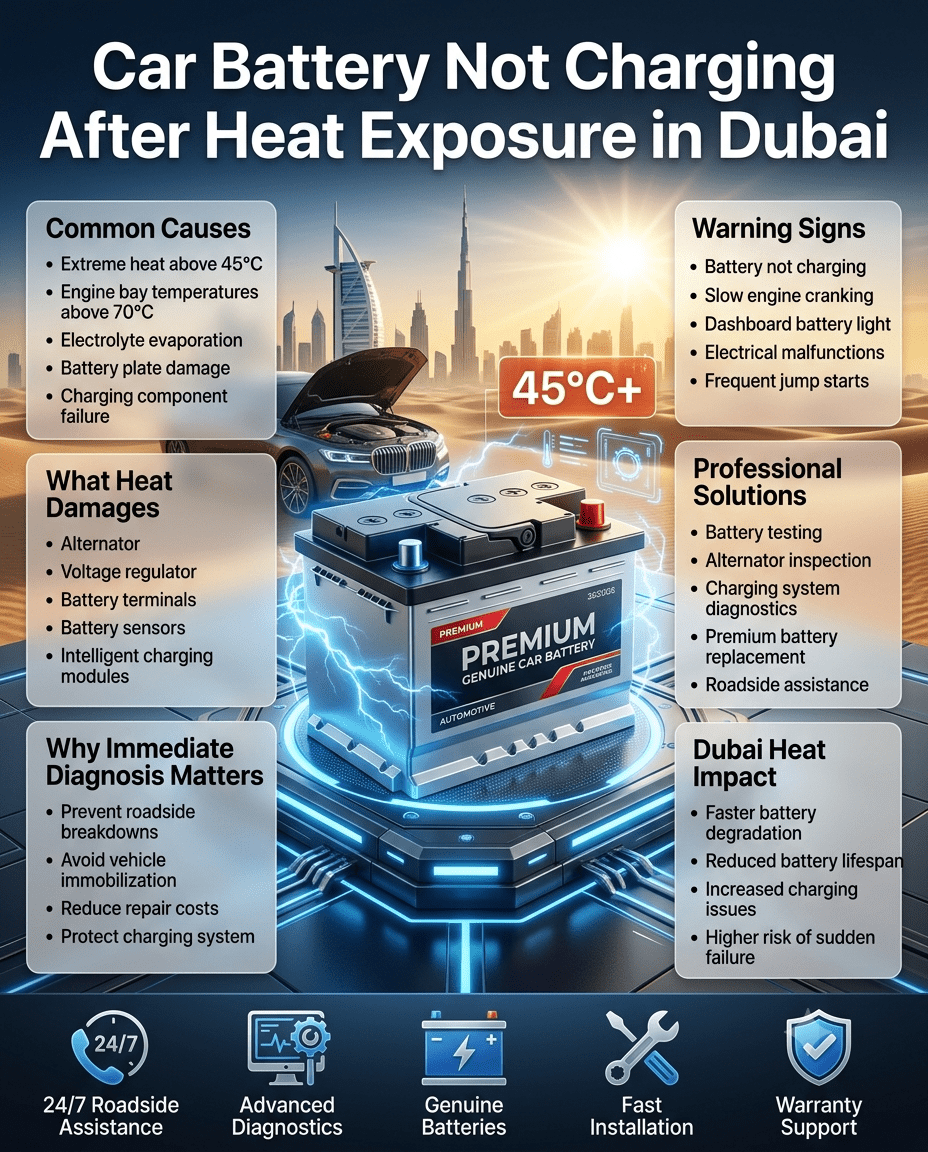
A car battery not charging after heat exposure in Dubai is one of the most common automotive emergencies faced by residents, tourists, fleet operators, and luxury vehicle owners. Dubai’s extreme summer temperatures frequently exceed 45°C, while engine bay temperatures can surpass 70°C during traffic congestion. These harsh conditions accelerate battery degradation, damage charging components, and reduce overall electrical system performance.
When a car battery is not charging after heat exposure, the issue often extends beyond the battery itself. Alternators, voltage regulators, battery terminals, sensors, intelligent charging modules, and vehicle energy management systems may also be affected. Immediate diagnosis is essential to prevent roadside breakdowns, vehicle immobilization, and expensive electrical repairs.
For drivers seeking rapid assistance, professional services such as EuroSwift Auto Services provide emergency diagnostics, premium battery replacement, charging system inspection, and roadside support throughout Dubai through their battery replacement service page:
https://euroswiftautoservices.ae/car-battery-replacement-near-me-dubai
Dubai Market Context
Dubai presents unique challenges for vehicle batteries compared to many other global cities.
Environmental Factors
| Factor | Impact on Battery Charging |
|---|---|
| Extreme heat | Accelerates internal battery deterioration |
| Long idling periods | Reduces charging efficiency |
| Heavy traffic congestion | Increases electrical load |
| Desert driving | Raises engine compartment temperatures |
| Humidity near coastal areas | Promotes terminal corrosion |
| Short city trips | Prevents complete charging cycles |
Vehicles Most Commonly Affected
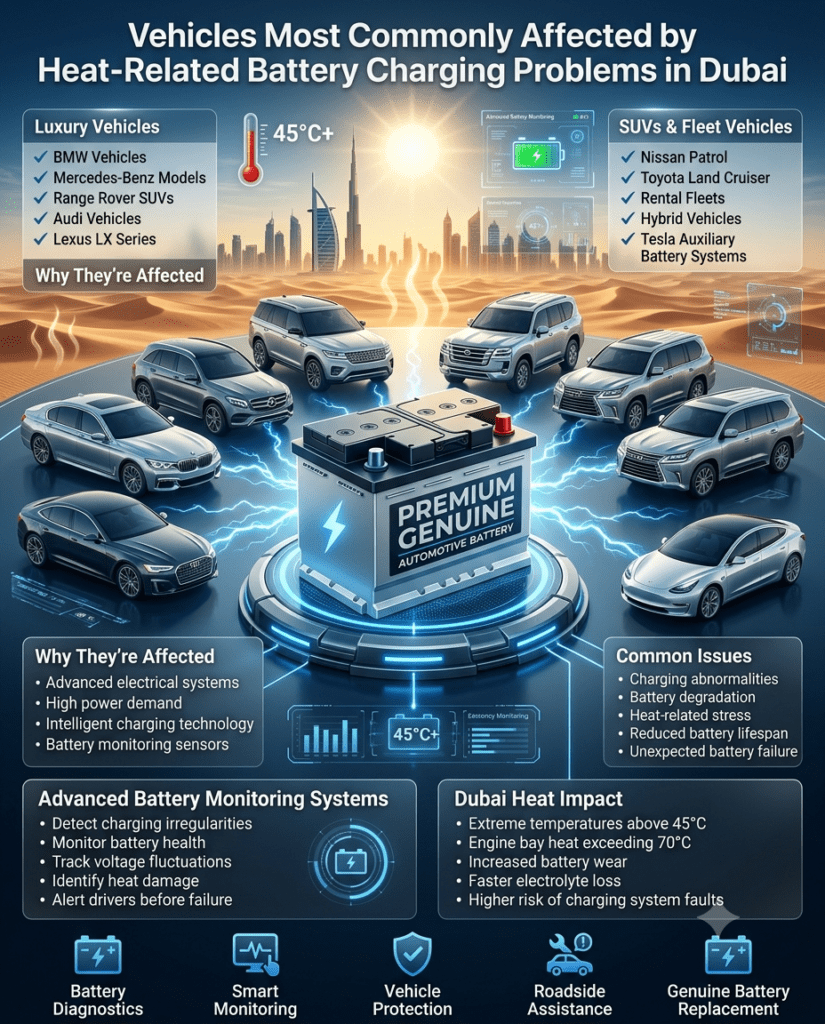
- BMW vehicles
- Mercedes-Benz models
- Range Rover SUVs
- Nissan Patrol
- Toyota Land Cruiser
- Lexus LX Series
- Audi vehicles
- Tesla auxiliary battery systems
- Hybrid vehicles
- Rental fleets
Luxury vehicles often feature advanced battery monitoring systems that quickly detect charging abnormalities after prolonged heat exposure.
Understanding Why a Car Battery Stops Charging After Heat Exposure
Heat damages multiple battery components simultaneously.
Internal Battery Damage
High temperatures can cause:
- Electrolyte evaporation
- Plate warping
- Internal short circuits
- Reduced reserve capacity
- Sulfation acceleration
- Increased self-discharge
Charging System Stress
Heat exposure may also affect:
- Alternator windings
- Voltage regulator modules
- Battery sensors
- Smart charging controllers
- Wiring insulation
- Ground connections
Common Symptoms
Drivers frequently report:
- Dashboard battery warning light
- Slow engine cranking
- Repeated jump-start requirements
- Flickering headlights
- Electrical malfunctions
- Battery voltage dropping rapidly
- Vehicle entering limp mode
- Start-stop system failure
Service Ecosystem for Heat-Damaged Battery Charging Problems
Dubai’s automotive industry offers several levels of support.
Roadside Emergency Services
Typical services include:
- Mobile diagnostics
- Battery voltage testing
- Alternator inspection
- Jump-start assistance
- On-site battery replacement
- Charging system analysis
Workshop-Based Services
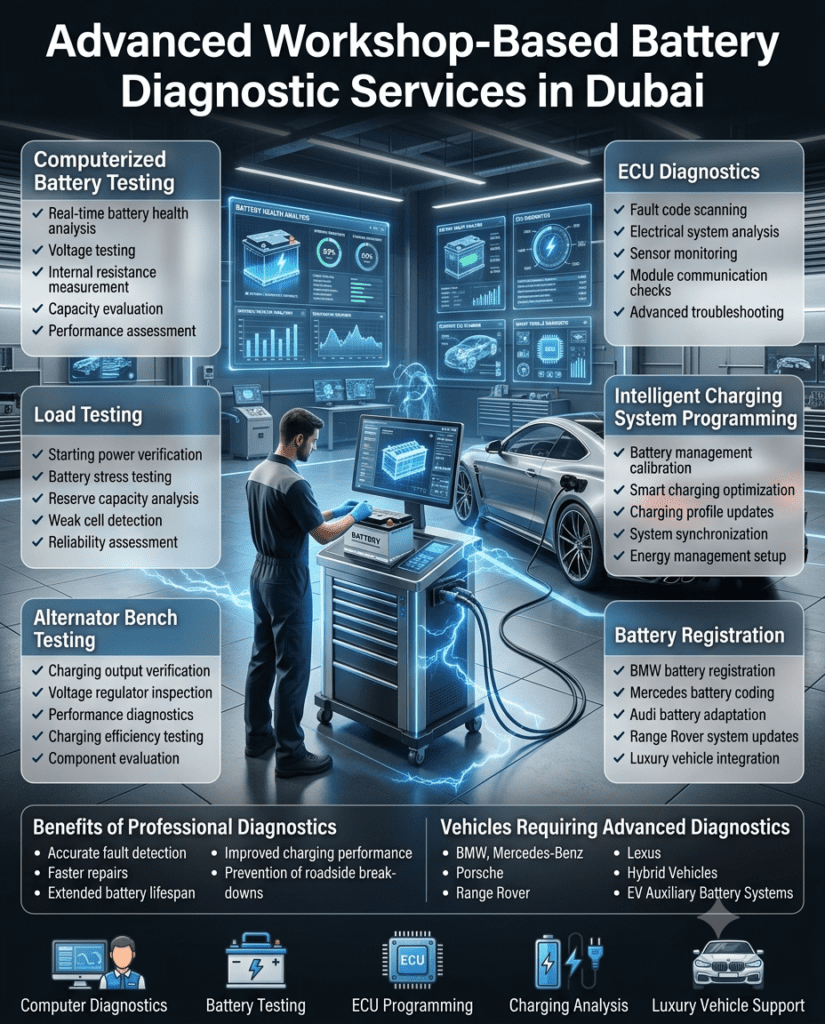
Advanced facilities generally provide:
- Computerized battery testing
- Load testing
- Alternator bench testing
- ECU diagnostics
- Intelligent charging system programming
- Battery registration for luxury vehicles
Fleet Support Services
Fleet operators often require:
- Scheduled battery inspections
- Predictive diagnostics
- Mobile replacement units
- Charging system audits
- Fleet battery management
Types of Battery Charging Failures After Heat Exposure
Battery Sulfation Failure
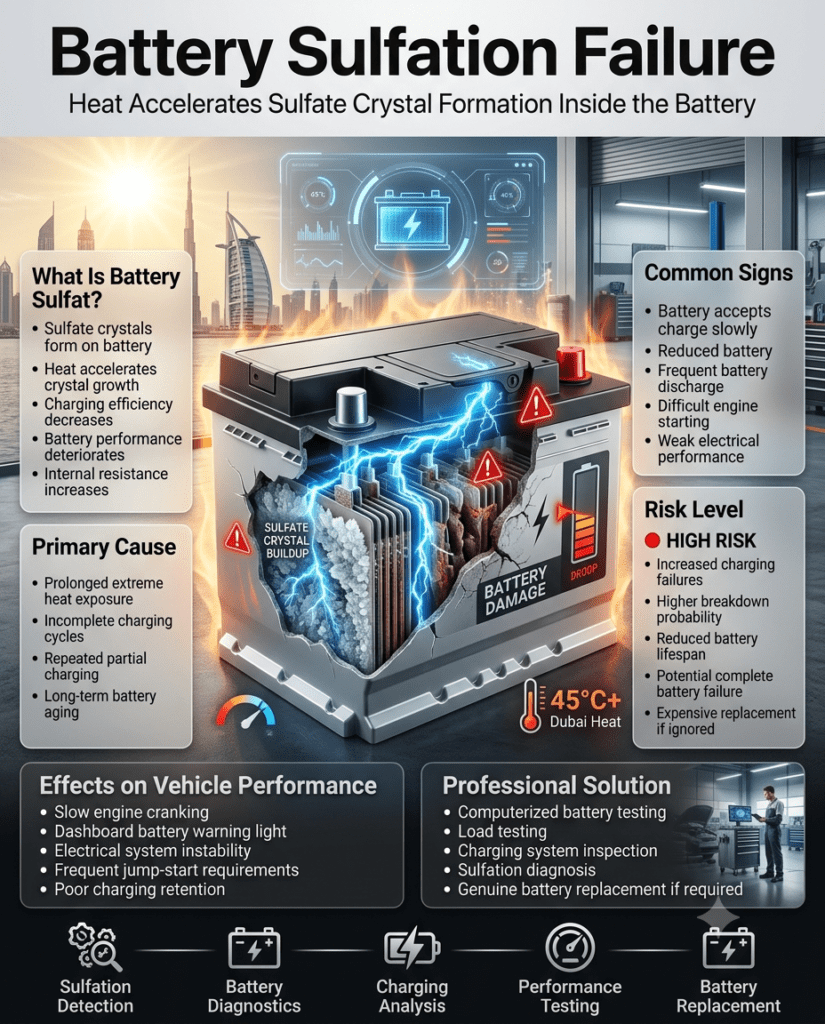
Heat accelerates sulfate crystal formation.
Signs
- Battery accepts charge slowly
- Reduced capacity
- Frequent discharge
- Difficult engine starting
Risk Level
High
Electrolyte Loss
Excessive heat causes electrolyte evaporation.
Signs
- Swollen battery casing
- Overheating
- Low voltage readings
- Charging inefficiency
Risk Level
Critical
Internal Plate Damage
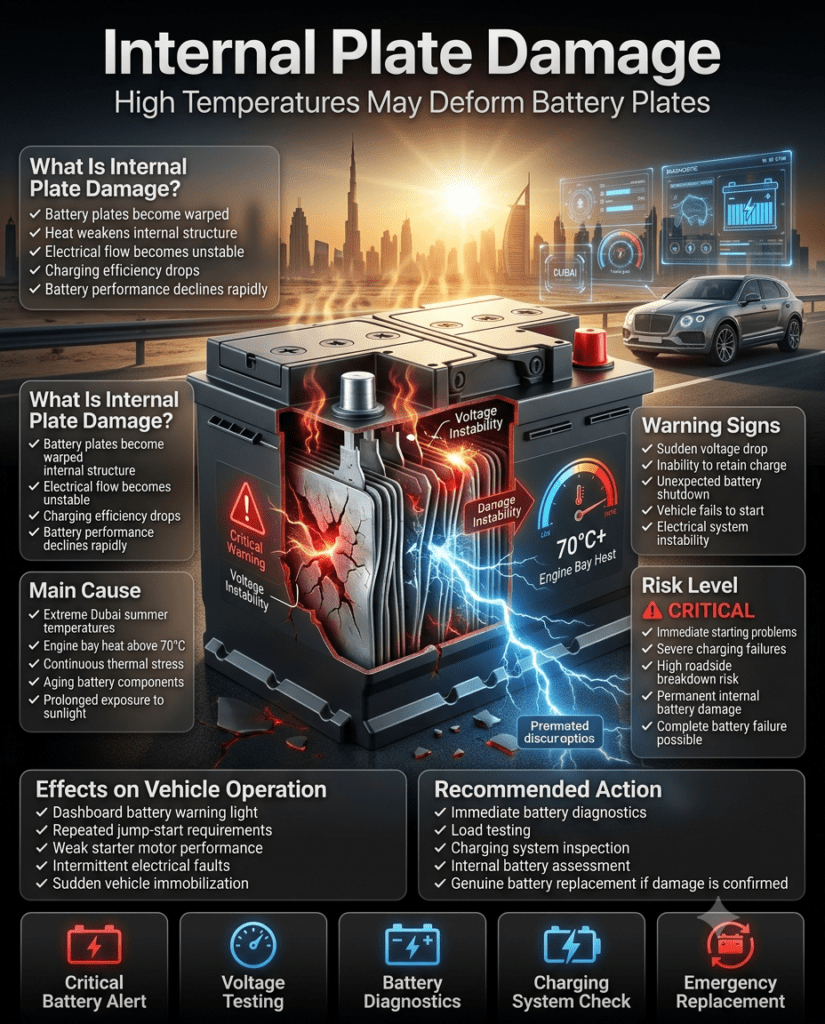
High temperatures may deform battery plates.
Signs
- Sudden voltage drop
- Inability to retain charge
- Complete battery failure
Risk Level
Critical
Alternator Heat Damage
The battery may be healthy while the charging system fails.
Signs
- Battery warning light
- Repeated dead battery
- Voltage below charging specifications
Risk Level
Critical
Smart Charging Module Failure
Common in modern luxury vehicles.
Signs
- Charging errors
- Sensor faults
- Battery management alerts
Risk Level
High
Types of Batteries Commonly Used in Dubai
| Battery Type | Heat Resistance | Charging Stability | Typical Vehicles |
|---|---|---|---|
| Flooded Lead Acid | Moderate | Moderate | Economy cars |
| EFB Battery | Good | Good | Start-stop vehicles |
| AGM Battery | Excellent | Excellent | Luxury vehicles |
| Gel Battery | Good | Good | Specialized applications |
| Lithium Auxiliary Battery | Very Good | Excellent | EV and hybrid systems |
Drivers of BMW, Mercedes-Benz, Audi, Porsche, and Range Rover vehicles frequently benefit from premium AGM technology.
Professional AGM battery solutions are available through:
Diagnostic Process for a Car Battery Not Charging After Heat Exposure
Step 1: Battery Voltage Testing
Technicians evaluate:
| Voltage Reading | Condition |
|---|---|
| 12.6V+ | Fully charged |
| 12.4V | Healthy |
| 12.2V | Weak |
| 12.0V | Discharged |
| Below 11.9V | Critical |
Step 2: Charging System Testing
Checks include:
- Alternator output
- Regulator performance
- Charging current
- Ground integrity
Step 3: Load Testing
Load testing determines:
- Actual battery capacity
- Starting performance
- Internal resistance
Step 4: Thermal Inspection
Inspection targets:
- Swelling
- Heat deformation
- Cable damage
- Terminal corrosion
Step 5: Computer Diagnostics
Modern vehicles require scanning of:
- Battery management systems
- Intelligent charging modules
- Power distribution systems
- Energy management controllers
UAE Legal Requirements
Vehicle owners must maintain roadworthy electrical systems.
Relevant Requirements
Drivers are expected to ensure:
- Safe vehicle operation
- Functional lighting systems
- Reliable starting systems
- Proper electrical performance
A failed charging system can indirectly affect compliance if lighting, signaling, or safety systems stop functioning.
Violations Associated With Ignoring Charging Problems
Ignoring a battery charging fault may result in:
| Issue | Potential Consequence |
|---|---|
| Vehicle breakdown | Traffic obstruction |
| Failed lighting | Safety violation |
| Emergency lane stoppage | Fines and towing |
| Accident due to electrical failure | Liability concerns |
| Fleet downtime | Commercial losses |
Premium Battery Replacement Packages
Economy Package
Includes:
- Battery testing
- Installation
- Terminal cleaning
Suitable for:
- Toyota
- Nissan
- Hyundai
- Kia
Premium Package
Includes:
- Advanced diagnostics
- Genuine battery
- Charging system inspection
- Warranty coverage
Suitable for:
- BMW
- Mercedes-Benz
- Audi
- Lexus
Luxury Vehicle Package
Includes:
- Battery registration
- ECU programming
- Intelligent charging calibration
- OEM specifications
Suitable for:
- Range Rover
- Porsche
- Bentley
- Maserati
Fleet Package
Includes:
- Multi-vehicle support
- Preventive diagnostics
- Priority roadside assistance
- Fleet reporting
Genuine Battery Options Available in Dubai
Amaron Battery
Popular for:
- Heat resistance
- Long service life
- Fleet reliability
https://euroswiftautoservices.ae/%F0%9F%94%8B-amaron-car-battery-replacement-dubai
Bosch Battery
Preferred for:
- European vehicles
- Advanced charging compatibility
- High cranking power
https://euroswiftautoservices.ae/bosch-car-battery-replacement-dubai
Tuflong Battery
Known for:
- Durability
- Stable charging performance
- Daily commuter vehicles
https://euroswiftautoservices.ae/%f0%9f%94%8b-trusted-tuflong-car-battery-replacement-dubai
Exide Battery
Suitable for:
- High-temperature operation
- Passenger vehicles
- Commercial fleets
Panasonic Battery
Ideal for:
- Hybrid systems
- Premium vehicles
- Smart charging platforms
FIAMM Battery
Used in:
- European vehicles
- Start-stop systems
- Luxury automotive applications
AC Delco Battery
Recommended for:
- American vehicles
- SUVs
- Commercial vehicles
Pricing Guide
| Service | Average Dubai Price (AED) |
|---|---|
| Battery diagnostic | 50–150 |
| Mobile battery testing | 100–250 |
| Economy battery replacement | 250–500 |
| Premium battery replacement | 500–1,200 |
| AGM battery replacement | 800–2,000 |
| Luxury battery registration | 150–600 |
| Alternator inspection | 100–400 |
| Complete charging system diagnostic | 250–800 |
Updated battery pricing references can be reviewed here:
https://euroswiftautoservices.ae/complete-guide-to-car-battery-prices-in-dubai-2026-updated-list
Comparison Table: Heat-Damaged Battery vs Charging System Failure
| Factor | Heat-Damaged Battery | Charging System Failure |
|---|---|---|
| Battery warning light | Sometimes | Usually |
| Accepts charge | Poorly | Normally |
| Holds charge | No | Yes |
| Alternator output | Normal | Abnormal |
| Voltage stability | Poor | Poor |
| Replacement needed | Usually | Not always |
| Repair complexity | Moderate | High |
Expert Tips
- Test battery voltage before replacing components.
- Inspect terminals after every summer season.
- Replace batteries older than two years if exposed to extreme heat.
- Avoid repeated jump-starts without diagnosis.
- Use OEM-approved battery specifications.
- Perform charging system inspections annually.
- Park in shaded locations whenever possible.
- Schedule preventive testing before long road trips.
- Check alternator output after battery replacement.
- Register new batteries in luxury vehicles.
Maintenance
Monthly Checks
- Battery voltage inspection
- Terminal cleaning
- Corrosion assessment
Quarterly Checks
- Load testing
- Charging system evaluation
- Ground connection inspection
Summer Maintenance
- Heat damage inspection
- Battery health analysis
- Cooling system review
Annual Maintenance
- Comprehensive electrical diagnostics
- Alternator performance testing
- Battery replacement planning
UAE Case Study 1
BMW X5 – Dubai Marina
A BMW X5 owner experienced repeated battery warning messages during August. Initial assumptions pointed to battery failure. Diagnostic testing revealed excessive heat had damaged the intelligent battery sensor, causing inaccurate charging commands.
The sensor was replaced, battery registration completed, and charging performance restored without requiring a new battery.
UAE Case Study 2
Range Rover Vogue – Downtown Dubai
A Range Rover owner reported a battery that would not charge after prolonged outdoor parking during a heat wave.
Testing identified electrolyte loss and internal plate deformation caused by extreme temperatures. The vehicle received a genuine AGM replacement battery and charging system calibration.
Normal operation returned immediately.
UAE Case Study 3
Nissan Patrol Fleet Vehicle – Al Quoz
A logistics company experienced multiple charging complaints across its fleet.
Fleet diagnostics revealed alternator overheating due to continuous operation in high-temperature environments. Alternator replacements combined with preventive battery maintenance reduced breakdown incidents significantly.
EV and AI Trends
AI-Based Battery Monitoring
Modern vehicles increasingly utilize:
- Predictive charging algorithms
- Battery health forecasting
- Intelligent power management
- Real-time diagnostics
EV Auxiliary Battery Systems
Electric vehicles continue to rely on low-voltage batteries for:
- Control modules
- Safety systems
- Vehicle startup functions
- Communication networks
Heat exposure remains a critical concern even for advanced EV platforms.
Connected Vehicle Diagnostics
Advanced systems now provide:
- Remote battery monitoring
- Predictive maintenance alerts
- Fleet battery analytics
- Real-time charging system reporting
These technologies are becoming increasingly important as Dubai expands smart mobility initiatives and electric vehicle adoption across residential, commercial, tourism, and fleet transportation sectors.
Does Extreme Heat Cause Battery Failure?
Yes. Extreme heat is one of the leading causes of car battery failure, especially in hot climates like Dubai.
High temperatures can:
Evaporate battery electrolyte fluid
Accelerate internal chemical reactions
Damage battery plates
Cause battery swelling
Increase self-discharge rates
Reduce battery lifespan significantly
Common Signs of Heat-Damaged Batteries
Slow engine cranking
Battery warning light
Frequent jump starts
Dim headlights
Electrical system malfunctions
Swollen battery casing
Battery not holding a charge
In Dubai, batteries often last 2–3 years compared to 4–5 years in cooler climates due to constant heat exposure.
What to Do When a Car Battery Is Not Charging?
If your car battery is not charging, follow these steps:
1. Check Battery Terminals
Inspect for:
Corrosion
Loose connections
Damaged cables
Clean terminals if corrosion is present.
2. Test Battery Voltage
Voltage
Condition
12.6V+
Fully Charged
12.4V
Healthy
12.2V
Weak
12.0V
Discharged
Below 11.9V
Critical
3. Check Alternator Output
A healthy charging system typically produces:
13.8V–14.7V while engine is running
Lower readings may indicate alternator failure.
4. Inspect Drive Belt
A worn or slipping belt can prevent proper alternator operation.
5. Perform Professional Diagnostics
Modern vehicles such as:
BMW X5
Mercedes-Benz GLE
Range Rover Vogue
often require computer diagnostics to identify charging system faults.
How Do I Charge the Battery on My Summer Car?
Vehicles stored during summer or used occasionally require proper charging procedures.
Step 1: Let the Battery Cool
If the battery has been exposed to extreme heat:
Park in shade
Allow cooling for 30–60 minutes
Never charge an extremely hot battery immediately.
Step 2: Use a Smart Charger
A smart charger automatically controls:
Charging voltage
Charging current
Overcharge protection
Step 3: Charge Slowly
Recommended charging rate:
Approximately 10% of battery amp-hour capacity
Example:
60Ah battery → 6A charger
Step 4: Monitor Voltage
Charging should stop once the battery reaches:
Around 12.6V–12.8V at rest
Step 5: Test Before Driving
Verify:
Stable voltage
Strong starting performance
Proper alternator charging
How to Fix an Overheated Battery?
The solution depends on the level of damage.
If the Battery Is Simply Hot
Turn off the engine.
Open the hood safely.
Allow natural cooling.
Inspect for leaks or swelling.
Test voltage after cooling.
If the Battery Is Swollen
Do not:
Charge it
Jump-start it repeatedly
Continue driving long distances
A swollen battery usually requires replacement.
If Electrolyte Has Evaporated
Common symptoms include:
Weak charging
Low capacity
Repeated discharge
Professional inspection is recommended because internal damage may already exist.
If Charging Components Are Damaged
Technicians may need to repair or replace:
Alternator
Voltage regulator
Battery sensor
Wiring connections
Battery management system
When Replacement Is Necessary
Replace the battery if you observe:
Bulging casing
Cracked housing
Internal short circuits
Repeated charging failure
Age above 2–3 years in extreme heat conditions
For Dubai drivers, preventive battery testing before summer travel can help avoid roadside breakdowns and unexpected charging failures caused by extreme temperatures.
Conclusion
A car battery not charging after heat exposure is a common problem in Dubai’s extreme climate, where prolonged high temperatures can damage battery cells, evaporate electrolyte fluid, and place additional stress on the charging system. While some charging issues may be caused by loose connections or alternator faults, severe heat exposure often accelerates battery wear and shortens its service life.
Early warning signs such as slow engine cranking, dim lights, dashboard battery warnings, and repeated jump starts should never be ignored. Prompt diagnostics can identify whether the problem lies with the battery, alternator, voltage regulator, or vehicle energy management system before a complete breakdown occurs.
Regular battery inspections, voltage testing, and preventive maintenance are especially important for vehicles operating in Dubai’s demanding conditions. Whether you drive a daily commuter, luxury SUV, rental vehicle, or modern EV, maintaining a healthy charging system helps ensure reliable starting performance, improved electrical efficiency, and reduced risk of roadside emergencies throughout the year.
Leave a Reply