
What Does “Safely Handling a Car Battery” Mean?
How to safely handle a car battery means following proper safety steps when touching, lifting, disconnecting, inspecting, or replacing the battery. Because a car battery contains acid, electric charge, and heavy components, safe handling prevents shocks, leakage, short-circuits, burns, and accidental damage.
This guide explains every safety rule, correct handling method, risk-prevention strategy, and professional-level precautions you must follow.
1. Why Safe Handling of a Car Battery Is Important
Safe battery handling matters because:
- Car batteries store high current, which may cause sparks.
- Electrolyte spills can damage skin, paint, and engine parts.
- Incorrect lifting or tilting can cause acid leakage.
- Mishandling can permanently damage terminals or internal plates.
- Safety steps prolong battery life and reduce replacement cost.
To avoid such risks, follow the safety actions explained below.
2. Essential Safety Precautions Before Touching a Car Battery
These precautions ensure complete safety before any physical interaction.
Checklist of Safety Measures
| Safety Step | Why It Matters |
|---|---|
| Wear insulated gloves | Prevents accidental shock or acid contact |
| Use safety goggles | Protects eyes from possible splashes |
| Turn off engine | Eliminates voltage surge risks |
| Remove jewelry/watch | Prevents accidental terminal bridging |
| Ensure proper ventilation | Avoids buildup of hydrogen gas |
| Keep flames away | Prevents explosion risks |
3. How to Safely Disconnect a Car Battery
Rule: Always remove the Negative (-) terminal first.
Safe Disconnection Steps
- Turn off ignition completely.
- Open the hood and locate the battery securely.
- Identify negative (black) terminal.
- Use an insulated wrench to loosen the negative clamp.
- Move cable away from the terminal.
- Repeat for positive (red) terminal.
This prevents spark formation and electrical shorting.
If you prefer expert help, you can book a professional visit through
➡️ Car Battery Replacement Near Me in Dubai.

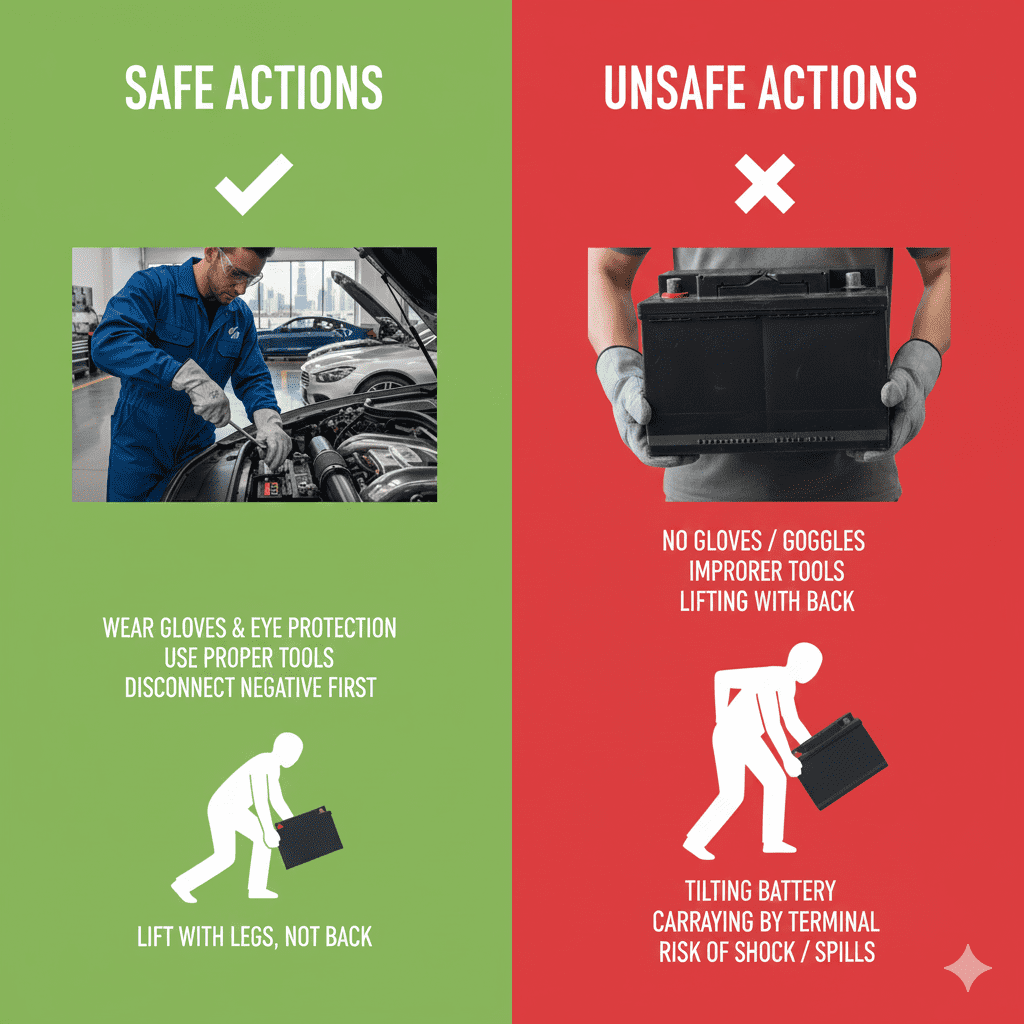
4. How to Safely Lift and Carry a Car Battery
Car batteries can weigh 15–25 kg, so improper lifting can cause injury or acid tilt.
Safe Lifting Rules
- Always use both hands.
- Keep the battery upright; never tilt or flip.
- Carry the battery close to your body.
- Hold from the sides, not the terminals.
- If the battery has a handle, use it.
Incorrect lifting may damage internal plates and reduce battery health.
5. How to Safely Inspect a Car Battery
Inspection must be done without touching exposed acid or metal with bare hands.
Safe Inspection Areas
- Terminals: Check for corrosion (white/green salt).
- Case: Look for swelling, cracks, leakage.
- Top Surface: Ensure it’s dry and clean.
- Vent Caps: Never open them on sealed MF batteries.
- Voltage Test: Only with insulated tools.
If your battery needs replacement, you can explore branded battery options:
6. Proper Handling During Car Battery Installation
Safe Steps
- Place the battery in the tray firmly.
- Secure it with the hold-down clamp.
- Connect positive terminal first, negative last.
- Tighten clamps moderately (not over-tightened).
- Ensure no metal object touches both terminals.
7. What You Should Never Do While Handling a Car Battery
❌ Never smoke near a battery
❌ Never touch terminals with metal tools
❌ Never attempt to open a sealed battery
❌ Never tilt the battery unnecessarily
❌ Never connect positive and negative cables wrongly
❌ Never dispose of batteries in regular trash
8. Real Case Study: Unsafe Battery Handling Accident in Dubai
Case Summary
In 2024, a customer in Al Quoz, Dubai tried replacing his car battery at home. He removed the positive terminal first, causing a spark.
Result
- Spark melted part of terminal clamp.
- ECU fuse blew due to voltage fluctuation.
- Extra repair cost: AED 580.
Safety Lesson
Always remove negative first → spark risk becomes zero.
How EuroSwift Auto Services Resolved It
The technicians:
- Replaced damaged terminal
- Installed a new battery safely
- Conducted ECU reset
- Provided safety guide
For such professional support, trust EuroSwift Auto Services anytime.
9. Table: Safe Handling vs Unsafe Handling Comparison
| Safe Handling Action | Unsafe Handling Action | Risk Level |
|---|---|---|
| Removing negative first | Removing positive first | High shock/spark risk |
| Wearing gloves | Barehand touching | Medium burn risk |
| Keeping battery upright | Tilting during lifting | High leak risk |
| Disconnecting with insulated tool | Using metal spanner directly | High short-circuit risk |
| Cleaning terminals with brush | Hitting terminals | Damage risk |
10. When to Call a Professional Instead of Handling Yourself
You should avoid touching the battery yourself when:
- Battery is leaking acid
- Battery is swollen
- Terminals are heavily corroded
- Car shuts off repeatedly after start
- You see sparks while touching the terminals
- You smell rotten-egg odor (sulfur smell)
In such cases, instantly contact EuroSwift Auto Services at +971501508507 for a safe, immediate battery check.
11. Helpful Resource for Price Safety Awareness
Battery safety also includes knowing correct market pricing to avoid low-quality or fake batteries.
➡️ Dubai Car Battery Price Guide (2025 Updated)
What safety precautions should I take before touching a car battery?
Turn off the engine, wear gloves and goggles, remove jewelry, ensure ventilation, and keep all flames or metal objects away from the battery.
Can touching a car battery shock you?
A car battery can cause shock or burns if you touch both terminals with a conductive tool or wet hands. Always use insulated gloves for safety.
What should I avoid when handling a car battery?
Avoid smoking, using open flames, touching terminals with metal tools, over-tightening clamps, or tilting the battery unnecessarily.
Leave a Reply