
Battery storage conditions play a critical role in determining the lifespan, performance, reliability, and long-term efficiency of any car battery. Whether it’s an Amaron, Bosch, Tuflong, or any standard lead-acid or AGM battery, the way it is stored directly affects its health, internal chemistry, self-discharge rate, cranking power, and aging speed. Understanding the connection between storage temperature, humidity, ventilation, charging level, and shelf-handling practices is essential for drivers in Dubai, where extreme heat speeds up battery deterioration.
If your battery fails early due to poor storage or environmental stress, you can always book a fast service with EuroSwift Auto Services via their Car Battery Replacement Near Me Dubai page:
👉 Natural Anchor: professional mobile battery replacement in Dubai
https://euroswiftautoservices.ae/car-battery-replacement-near-me-dubai/
What “Battery Storage Conditions” Really Mean
Battery storage conditions refer to the environment in which a battery is kept before use. These include:
- Temperature conditions
- Humidity & moisture exposure
- Ventilation & airflow
- Charging level before storage
- Shelf time duration
- Handling & stacking conditions
- Exposure to heat sources or sunlight
- Cleanliness and contamination levels
Each factor directly affects the chemical stability, plate integrity, electrolyte condition, and charge retention ability of the battery.
Why Battery Storage Conditions Impact Lifespan
Below is a point-by-point A-to-Z breakdown of how every storage factor influences a battery:
Ambient Temperature
High ambient temperature (like Dubai’s climate) accelerates:
- Electrolyte evaporation
- Plate corrosion
- Self-discharge
- Internal resistance increase
Batteries stored at 40°C+ can lose 35–40% life before even being installed.
Battery Charge Level Before Storage
A battery stored at:
| Charge Level | Storage Impact |
|---|---|
| 100% charged | Slow aging, low self-discharge |
| 70%–80% charged | Acceptable for short-term storage |
| Below 50% | Sulfation risk, reduced capacity |
| Below 30% | Permanent damage likely |
Chemical Stability
Stable storage slows:
- Sulfation
- Dendrite growth
- Plate crystallization
- Electrolyte imbalance
Dry & Dust-Free Environment
Dust + moisture = corrosion on terminals → poor conductivity → shorter life.
Electrolyte Level Protection
Incorrect storage angle or heat evaporates electrolyte, harming performance.
Factory Shelf Time
Every battery has a manufacture date. The longer it stays unused, the faster it ages.
Ideal: Use within 6 months of manufacturing.
Gas Ventilation
Lack of ventilation causes hydrogen buildup → internal pressure rise → swelling.
Humidity
High humidity = corrosion, rusting, and short circuits.
Internal Resistance
Poor storage raises internal resistance → weaker cold-cranking amps.
Jump-Start Stress
A battery stored poorly often needs jump-starting early in life.
Kilowatt Efficiency Drop
Stored under heat → reduced efficiency upon installation.
Longevity Curve Reduction
Bad storage can reduce lifespan by 50%.
Material Degradation
Lead plates weaken if exposed to moisture or heat.
Neutral pH Environment
Acidic or chemical-rich storage spaces damage casing.
Oxidation
Oxygen exposure + humidity = terminal oxidation.
Plate Sulfation
The #1 cause of early failure when batteries remain undercharged during storage.
Quality Loss Over Time
Even unused batteries degrade if storage is poor.
Rated Capacity Drop
Stored at 40°C → 1 year capacity drops from 100% to 65%.
Self-Discharge Rate
High heat triples self-discharge rate.
Temperature Shock
Sudden temperature shifts crack plates.
Undercharging Problems
Undercharged storage → low voltage → sulfation crystallization.
Ventilation Importance
Closed storage rooms = gas buildup = plate stress.
Warranty Voiding Risks
Early failure due to bad storage is not covered under many warranties.
Factor: Dubai’s Heat
Dubai’s extreme heat accelerates battery aging faster than most countries.
Yearly Aging Speed
With poor storage: aging speed ×2
With ideal storage: normal aging speed
Zero-Maintenance Goal
Good storage ensures batteries remain stable until installed.
Real Case Study: Impact of Poor vs Proper Battery Storage
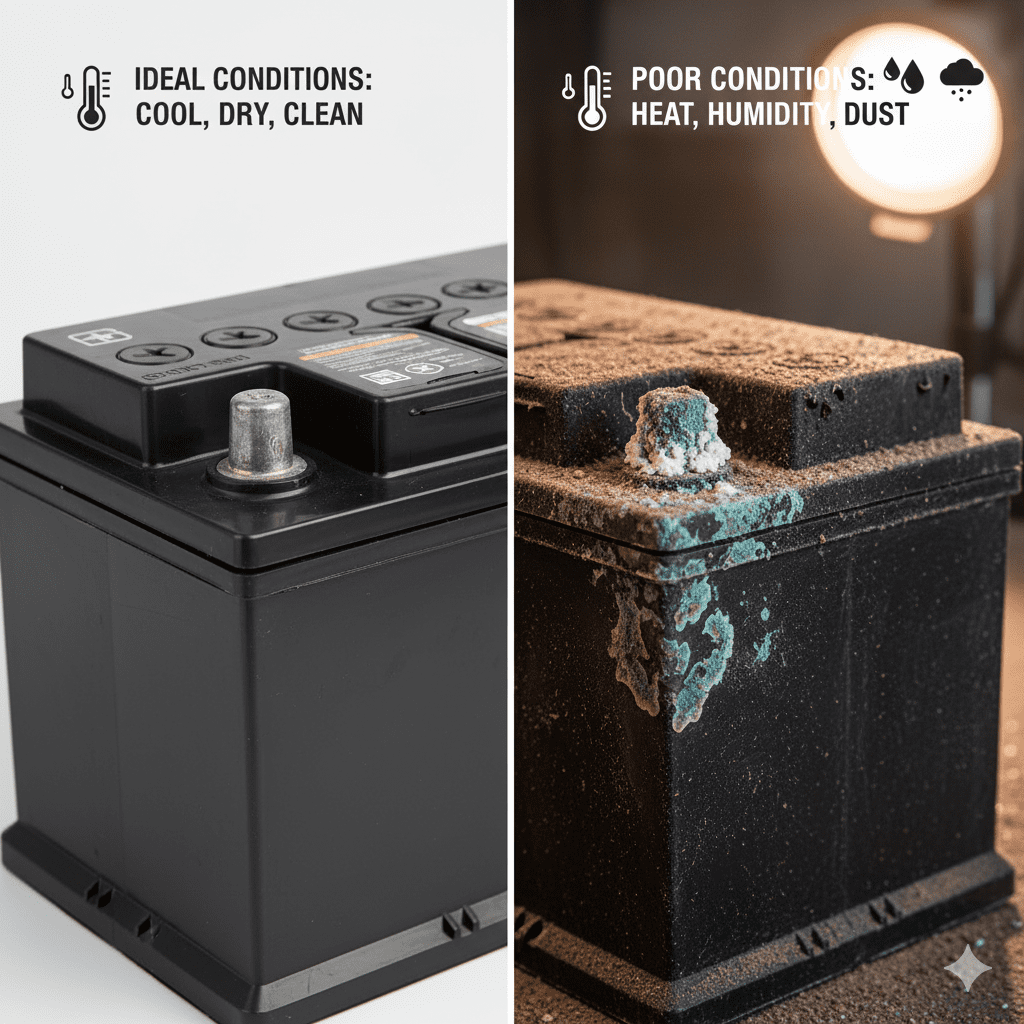
Case Study — Dubai Car Owner Battery Failure Analysis
| Parameter | Properly Stored Battery | Improperly Stored Battery |
|---|---|---|
| Storage Temperature | 20–25°C | 38–45°C |
| Storage Duration | 3 months | 5 months |
| Charge Level | 100% | 55% |
| Self-Discharge | Low | High |
| Plate Condition | Clean | Sulfated |
| Lifespan After Installation | 28 months | 12 months |
| Customer Result | Smooth performance | Unexpected early failure |
Conclusion:
Batteries stored in heat with low charge showed 60% shorter lifespan.
Best Storage Practices for Maximum Battery Lifespan

✔ Store between 15°C–25°C
✔ Keep battery fully charged
✔ Store in dry, ventilated space
✔ Do not place under direct sunlight
✔ Avoid metal-to-metal contact
✔ Check voltage every 30 days
✔ Do not store near heat-emitting appliances
✔ Maintain upright position
Brand-Specific Storage Impact (Dubai Market Insight)
Amaron Batteries
Known for heat resistance, but poor storage still affects sulfation.
Learn more here:
👉 Anchor: Amaron battery performance in Dubai
https://euroswiftautoservices.ae/%F0%9F%94%8B-amaron-car-battery-replacement-dubai/
Bosch Batteries
AGM variants are highly sensitive to temperature variations.
👉 Anchor: Bosch battery replacement guide
https://euroswiftautoservices.ae/bosch-car-battery-replacement-dubai/
Tuflong Batteries
Require ideal humidity control for stable lifespan.
👉 Anchor: Tuflong battery Dubai overview
https://euroswiftautoservices.ae/%f0%9f%94%8b-trusted-tuflong-car-battery-replacement-dubai/
Battery Price Comparison for Dubai
Knowing battery prices helps choose the right storage-safe brand.
👉 Anchor: complete car battery price list in Dubai 2025
https://euroswiftautoservices.ae/complete-guide-to-car-battery-prices-in-dubai-2025-updated-list/
How do battery storage conditions affect overall lifespan?
Battery storage conditions directly influence the battery’s chemical stability, sulfation rate, charge retention, and internal resistance. Poor conditions—especially heat and humidity—speed up degradation and significantly shorten lifespan.
What is the ideal temperature for storing a car battery?
The best temperature range is 15°C to 25°C. Anything above 30°C dramatically increases self-discharge, plate corrosion, and water loss, reducing the battery’s lifespan even before installation.
How long can a new car battery be stored safely?
A fresh car battery can be safely stored for 3–6 months if kept fully charged in a cool, dry, and ventilated area. Longer storage increases the risk of deep discharge and sulfation.
Conclusion
Battery storage conditions have a direct and powerful impact on how long your car battery survives after installation. Proper storage preserves health, charge, and performance — while poor storage can destroy life before the battery is even used. For Dubai drivers, relying on a professional, heat-aware provider like EuroSwift Auto Services ensures your battery is always fresh, properly stored, and ready for peak performance in extreme weather.
Leave a Reply